







Austria’s 130 km Koralmbahn railway formally opened for traffic on December 12, marking a major milestone in the country’s efforts to forge a direct rail link between Wien and the southwest of the country. Toma Bačić reports from the celebrations.
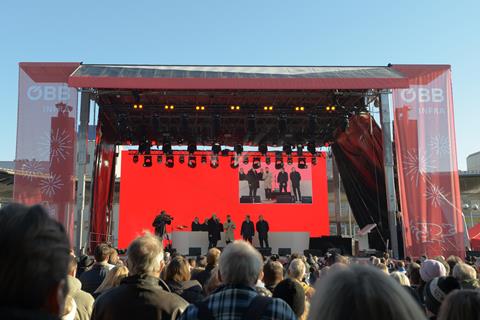
AUSTRIA: At the heart of the Koralmbahn scheme is a 130 km section of new railway across southern Austria, which was ceremonially inaugurated on December 12, although revenue-earning freight trains had been using the route since November 3.
The project scope covered construction of a 250 km/h high speed line featuring a 33 km base tunnel to link Klagenfurt with Graz, plus upgrading of part of the existing network. After 27 years of construction, the celebrations marked a major milestone in a much wider programme of works covering the modernisation of the Südbahn route between Wien, Graz, Klagenfurt, Villach and the Italian and Slovenian borders. A 53 km western section of the Koralmbahn between Klagenfurt and St Paul im Lavanttal had opened for service in December 2023.
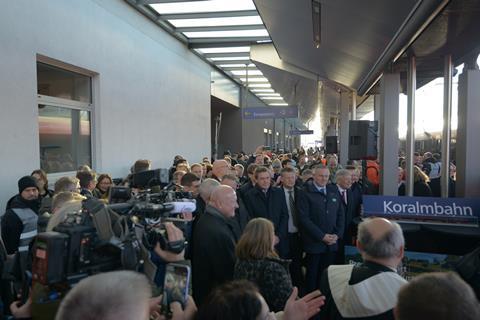
A nominal first train left Graz to Klagenfurt at 11:00 on December 12 in very mixed weather conditions. The celebratory events in Graz and Klagenfurt and the inauguration ride were attended by dignitaries including Federal President Alexander Van der Bellen, Federal Chancellor Christian Stocker, representatives from the European Commission and the various cities and Länder served by the railway, and by Austrian Federal Railways CEO Andreas Matthä.
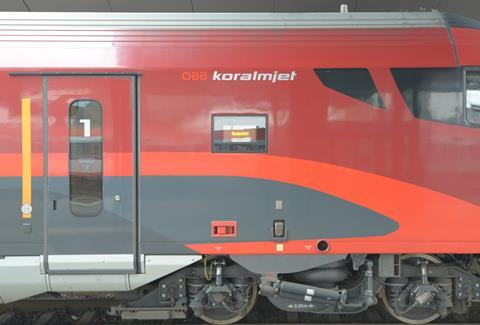
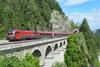
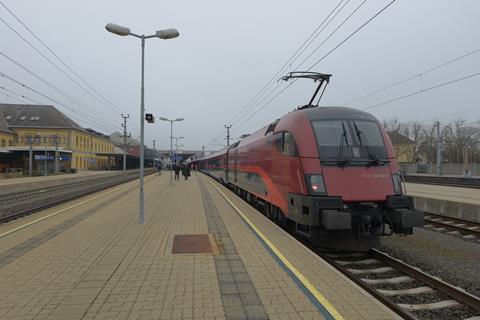
The inaugural train was formed of a newly refurbished Railjet formation, specially branded as Koralmjet for the day. The first run over the new infrastructure was completed in 38 min, 3 min faster than the fastest advertised timings between the two cities. Each guest received a Koralmdudler, a version of the popular Austrian herbal soft drink, and a commemorative scarf.
However, on its return from Klagenfurt, the special train reportedly stirred up too much dust in the southern tube of the Koralm Tunnel, triggering the fire alarm. The first public train departing at 14.30 from Graz Hbf was delayed by almost 45 min as a result. No fewer than 5 500 free tickets were allocated in advance on a first-come, first-served basis, and were sold out within just a few hours; these covered the public trains between Graz and Klagenfurt on December 12-13.
The first scheduled passenger trains started to run along the Koralmbahn from December 13, and according to ÖBB, around 10 000 passengers booked the tickets for the first day of revenue operations. ÖBB Regional Manager Reinhard Wallner highlighted the high punctuality and very positive reactions from passengers on the first day.
Civil works
The Koralmbahn comprises 50 km of tunnels, over 100 bridges, and 23 stations and terminals. The line is part of the EU’s Baltic-Adriatic Corridor, and it is designated as a ‘high-performance railway’ designed for operation at up to 250 km/h. Detailed planning began in 1995, with initial construction works starting in 1999.
The total investment was reported to be €6∙1bn. The project was established under a 2004 financing agreement between the Austrian federal government, ÖBB and its subsidiary ÖBB-Infrastruktur, and the Länder of Steiermark and Kärnten. The two regional governments made fixed annual payments of €280m over the construction phase, while the rest of the investment was covered by ÖBB and the Austrian federal budget in accordance with the Federal Railway Act. The European Union has contributed €606m: €543m from Austria’s share of the Recovery & Resilience Facility, and an additional €63m from the Connecting Europe Facility.
The project is estimated to have generated added value in the economy already during construction, with its benefits now calculated to exceed its costs by a factor of 1∙44.
Timetable improvements
With rail connections between Graz and Klagenfurt having long been regarded as uncompetitive, ÖBB ran an express bus between the two hubs following completion of the A2 motorway. This had an advertised journey time of 2 h, compared to 2 h 53 min by rail with a change at Bruck an der Mur.
The best Wien – Klagenfurt timing was 3 h 55 min, Wien - Villach was 4 h 18 min. With the new timetable, the travel time from Graz to Klagenfurt with two intermediate stops (Weststeiermark and St. Paul in Lavanttal) is 54 min, while the best timing for Wien – Klagenfurt is 3 h 10 min; Wien – Villach falls to 3 h 34 min.
The corridor is now also handling international passenger trains, including night trains linking Wien and Roma, as well as Graz and Zürich. There is also a Wien – Lienz Railjet routed along the new line, as well a daily pair of DB Fernverkehr ICE services that link Frankfurt-am-Main with the Austrian capital via Villach and Graz.
Austria at number one
Welcoming the opening of the corridor, Federal Transport Minister Peter Hanke said the railway was ‘undoubtedly a landmark project. It ensures faster, more frequent, and better rail travel: Graz and Klagenfurt are linked in just 41 min. This increases the attractiveness of public transport and directly supports the mobility transition. A project with many superlatives that also stands out internationally: cost-stable, environmentally friendly, and technically state-of-the-art. Austria remains Europe’s number one rail country, with a comprehensive service and the highest quality.’

‘The Koralmbahn is a key component of the Trans-European Transport Network’, added Eric von Breska, a Director in the European Commission’s Directorate-General for Mobility and Transport. ‘As part of the Baltic-Adriatic Corridor, it connects ports in Poland with ports in Italy, Slovenia, and Croatia. The EU has co-financed this pioneering project, [which] makes a crucial contribution to improving economic and social cohesion within the European Union.’
‘With the launch of the Koralmbahn, we are not only opening a new route, but also writing a new chapter in the history of Austrian railways. Its 130 km connect not just places, but people, ideas, and markets’, said Matthä. ‘This once-in-a-century project transforms distances into opportunities — for people, the economy, and an entire region. Today marks the beginning of an era in which southern Austria is growing closer together than ever before.’