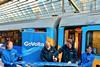



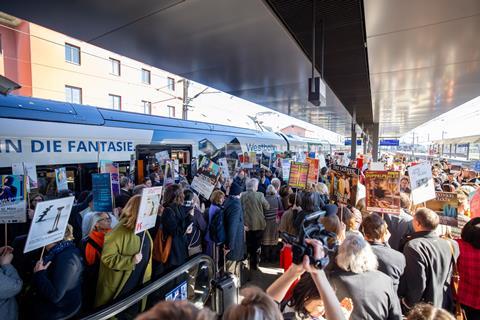
AUSTRIA: Open access passenger operator Westbahn expanded its network significantly on March 1 with the launch of services between Wien, Graz, Klagenfurt and Villach via the recently-opened Koralmbahn.
‘For passengers, this means a modern, reliable, and comfortable travel option on one of the country’s most important rail connections’, the company emphasised.
Westbahn is initially operating three trains per day in each direction, increasing to five from May 29.
The inaugural run featured an onboard cultural programme. ’We want to demonstrate that modern mobility can combine quality, comfort and substance’, said Westbahn Managing Director Thomas Posch. ’This inaugural journey perfectly embodies that: travelling faster while experiencing more.’
Westbahn and its fleet
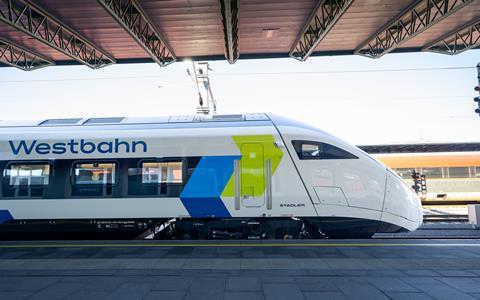
Westbahn is owned by Rail Holding AG, whose shareholders are Haselsteiner Familien-Privatstiftung (48·3%), Kolomani Holding (31·7%) and SNCF Voyages Développement (20%). It began operations in December 2011 on the Wien – Salzburg corridor, historically known as the Westbahn, and has since expanded to offer services to Innsbruck, Bregenz, Lindau, St Johann im Pongau, München and Stuttgart.
The operator currently has a fleet of 15 Stadler Kiss double-deck EMUs, three Stadler Smile trainsets and four Class 4100 double-deck EMUs built by CRRC Zhuzhou.
The 11-car Smile trainsets were ordered specifically for the Wien – Villach route in March 2025. The 250 km/h trains are technically identical to sets used by Swiss Federal Railways under the Giruno brand, but have some design refinements to suit Westbahn’s requirements.
Competition
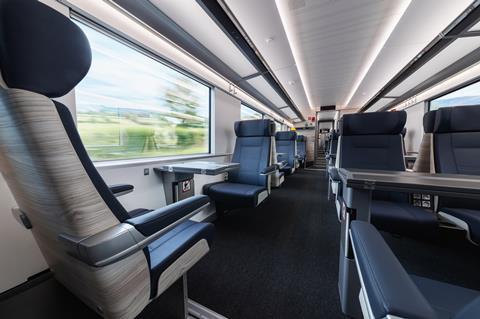
Westbahn offers a different stopping pattern to the Railjet and Railjet Xpress services provided by incumbent Austrian Federal Railways. The open access trains call at Pörtschach am Wörthersee and Kühnsdorf-Klopeiner See to serve leisure travellers.
Commenting on the launch, Nick Brooks, Secretary General of the AllRail association of new entrants to the passenger market, said the Koralmbahn which opened in December was ‘not only a major infrastructure project’; it was ’a real-world test whether PSO concession services costing the taxpayer are justified or not’.