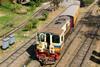








INDIA: The northeastern state of Mizoram has been connected to the national rail network, with the opening of a broad-gauge line. Aizawl becomes the fourth of the isolated region’s eight state capitals to be served by rail.
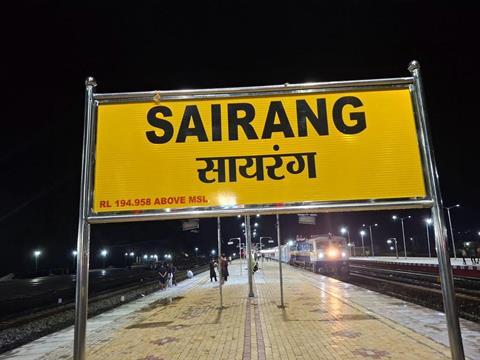
Built at a cost of Rs60bn, the 51·4 km line from Bairabi currently terminates at the satellite town of Sairang, around 20 km northwest of Aizwal.
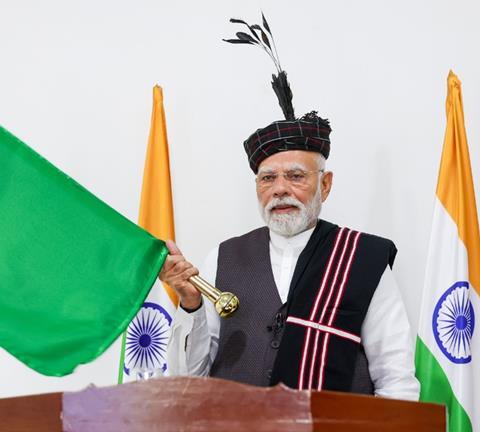
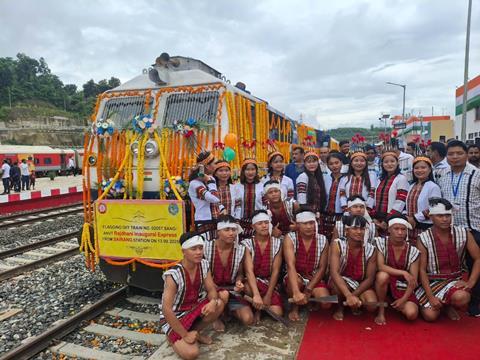
The railway was formally inaugurated on September 13 by Prime Minister Narendra Modi, dressed in a local tribal costume.
‘This is a historic day for the nation, and particularly for the people of Mizoram’, he said. ‘From today, Aizawl will be on India’s railway map. A few years ago, I had the opportunity of laying the foundation stone for this line, and today, we proudly dedicate it to the people of the nation. Overcoming many challenges, including difficult terrain, the Bairabi – Sairang line has become a reality.’
Previously, the IR network only extended 1·5 km into Mizoram, crossing the border from Assam to terminate at Bairabi in the Kolasib district. Studies for an extension to the state capital were launched in 1999, and Northeast Frontier Railway carried out initial reconnaissance to identify a preferred route in 2006. RITES completed a geotechnical survey two years later, after which the scheme was designated a National Project. The foundation stone was laid by Modi on November 29 2014.
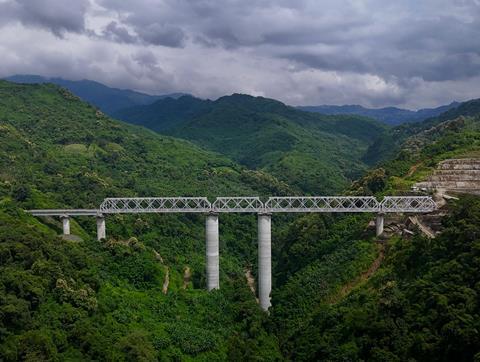
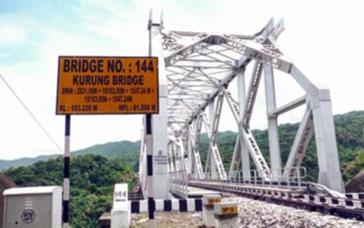
Passing through difficult mountainous terrain, it required 48 tunnels with a total length of 12·8 km as well as 55 major and 87 minor bridges. One notable structure is Bridge 144, which reaches a height of 104 m above the valley floor.
Improving connectivity
Recognising the need to improve connectivity to the northeastern states, the government has increased its budget for railway development in the region. The allocation for 2014-25 totalled Rs624·8bn, a five-fold increase on the amount provided in 2009-14. This year’s budget is Rs104·4bn, and IR reports that projects worth Rs770bn are underway.
The government has already confirmed its intention to extend the line to the Myanmar border at Hbichhuah, around 232 km beyond Aizawl. This is deemed vital for national security, not just improved regional connectivity. A Detailed Project Report is currently being compiled which should pave the way for the start of construction.
Construction challenges
Railway Minister Ashwini Vaishnaw described the line as ‘one of the most difficult projects in the region’, adding that it had required some innovative construction techniques. ‘Thousands of engineers, workers, and local communities came together to make this possible’, he said.
‘The northeastern Himalayas are young mountains, with large sections comprising soft soil and organic material’, he explained. ‘Constructing tunnels and building bridges in these conditions presented extraordinary challenges. Traditional methods fail because the loose soil cannot support the construction. To overcome this, our engineers have deployed the Himalayan Tunnelling Method, where the soil is first stabilised and then solidified to carry out tunnelling and construction.
‘Another major challenge was ensuring the stability of bridges at great heights in a region prone to seismic activity. Here too, special designs and advanced techniques were deployed to make the bridges resilient and secure. This home-grown innovation is a model for similar terrains worldwide.’
IR Chief Engineer, Vinod Kumar pointed out that construction could only progress for four or five months each year because of landslides, monsoons and heavy rain. ‘Because the roads were very narrow and steep, it was practically impossible to bring heavy machines and cranes. They came in pieces and were assembled on site. Workers were brought from other states, as local labour was in short supply. Sand and ballast had to be transported from Assam, West Bengal, and Meghalaya.’
Traffic potential
Following the inauguration of the line, Modi flagged off the first of three long-distance trains intended to serve the state capital. A weekly Rajdhani Express will connect Sairang with Delhi, while the Mizoram Express will link Sairang with Kolkata. The daily Aizawl Intercity service will run between Sairang and Guwahati in neighbouring Assam, departing from each city at 19.00 and arriving at 08.30 the following morning.
‘Our hearts have always been directly connected with each other’, he said. ‘Now, for the first time, Sairang in Mizoram will be connected directly with Delhi by the Rajdhani Express. This is not just a railway connection, but it is a lifeline of transformation.’
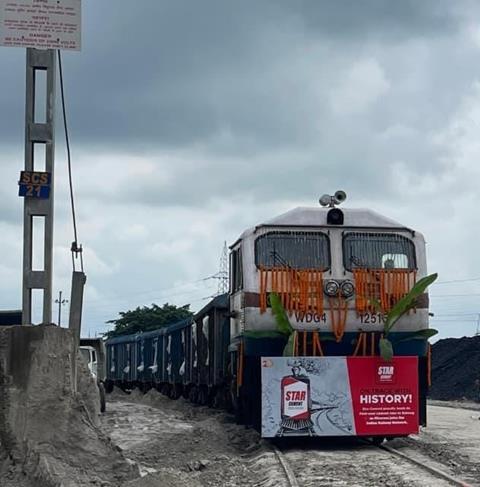
Mizoram is noted for its rich culture, a love of sport and its beautiful hills, but the state has suffered from its isolation and poor connectivity. Completion of the railway is expected to open up new markets, create trade opportunities and improve living conditions for local residents.
Freight traffic is expected to include the transport of essential commodities, such as foodgrains and fertilisers, as well as serving the horticulture sector and bamboo cultivation. On the passenger side, the railway will providing better access to education, health care and employment opportunities.
Tourism is also expected to receive a boost, with IR announcing its intention to operate ‘Vistadome’ trains on the route. These will give passengers a 360° view of prominent attractions such as the Reik Hills, Tamdil Lake, Vantawng Waterfall, Phawngpui National Park and the Dampa Tiger Reserve.