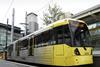






UK: Transport for Greater Manchester has launched the process of appointing the next operating and maintenance contractor for the Metrolink light rail network, after the Great Manchester Combined Authority’s Bee Network transport committee opted for a revised franchising model rather than taking operations in-house.
The UK’s largest light rail system totals 103 km with 99 stops, 147 trams and two depots, and carried 45·6 million passenger-journeys in 2024. It is currently operated and maintained by a joint venture of Keolis and Amey under a contract which expires in July 2027. This integrated contract replaced separate contracts with RATP Dev as operator and MPact-Thales as maintenance contractor.
The next contract is planned to run from July 25 2027 to July 24 2034, with options to extend to July 24 2038. The value is estimated at £1·6bn (excluding VAT) over the maximum 11 years.
TfGM is seeking a ‘step change’ in asset management to maximise life and service capacity. The contractor would also support the procurement and delivery of new stops, trams and control systems and the expansion of the network with new, extended or converted lines, including tram-train services.
‘With patronage at record levels and plans to add further capacity and expand the network, it’s an exciting time for Metrolink’, said TfGM’s Chief Network Officer Danny Vaughan on April 24. ‘In order to maintain this positive momentum, we’re hoping to enter into a new arrangement which better aligns Metrolink with our franchised buses and plans to integrate with local rail services, while also paving the way for even more integration and an improved customer experience.’
The deadline for requests to participate in the procurement is September 11 2025, and the contract is expected to be awarded in January 2027.
Franchising preferred

Before launching the procurement, TfGM worked with external specialists to review other potential models for the operation and maintenance of Metrolink.
The review shortlisted two options: a TfGM-owned arm’s length entity, similar to the West Midlands Metro and South Yorkshire Supertram models, or a franchise arrangement in line with TfGM’s bus contracting strategy, with the authority taking more control over customer experience, service delivery and asset management.
The review found that the current contracting model had been successful, with good performance in comparison with peer networks, and TfGM and the combined authority had a large degree of control and faced limited and well understood risks. Meanwhile, the network’s scale, balance of risks and contractual maturity makes it attractive to bidders, with all major operators interested in the contract.
As a result, the Bee Network Committee confirmed a new franchise as the preferred option. It is envisaged that this will allow it to focus on other strategic priorities including integrating rail services into the Bee Network and enhancing the bus network. The review found that introducing a new Metrolink model could dilute this focus, while an enhanced version of the current model would de-risk planned changes over the next seven to 10 years by enabling Metrolink to benefit from a global operator’s expertise.
The franchise is to be structured in a way that does not preclude further integration of light rail, bus and potentially rail operations into a single, unified operating structure in the 2030s, should the combined authority subsequently wish to pursue that option.