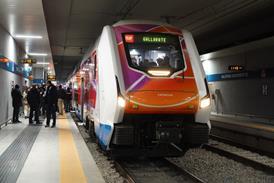




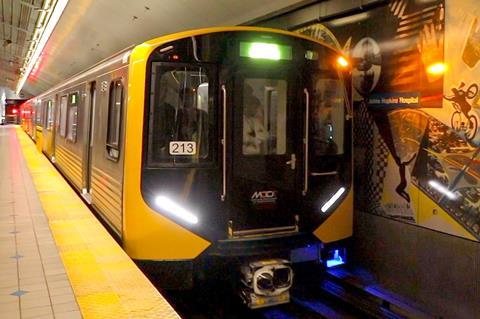
USA: The first of 78 metro cars being supplied by Hitachi Rail have entered service on the Baltimore Metro SubwayLink, along with a communications-based train control system.
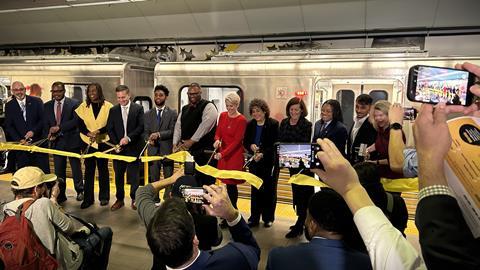
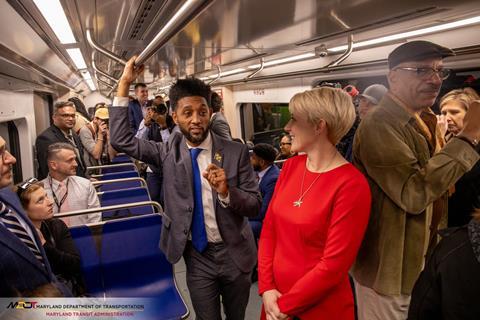
The cars were launched with a ceremony on January 7, and began carrying passengers on January 9.
‘These new railcars represent an important investment and commitment to our riders and our region’s economic vitality’, said Maryland Department of Transportation Acting Secretary Katie Thomson. ‘This is far more than a fleet replacement — it is a generational investment in creating a modern, reliable and safe transportation network that resident and employers can rely upon.’
Fleet and signalling renewal
In July 2017 Maryland Transit Administration awarded the Hitachi Ansaldo Baltimore Rail Partners joint venture a $400·5m contract to replace Budd-built vehicles and legacy control systems dating back to the opening of the 25 km metro line in November 1983. Hitachi was to the supply rolling stock, and Ansaldo STS’s US subsidiary the CBTC. Hitachi subsequently acquired Ansaldo STS.
Hitachi Rail said its SelTrac CBTC will provide higher system capacity and improved performance, with data analytics, lower lifecycle costs and flexible and scalable architecture.
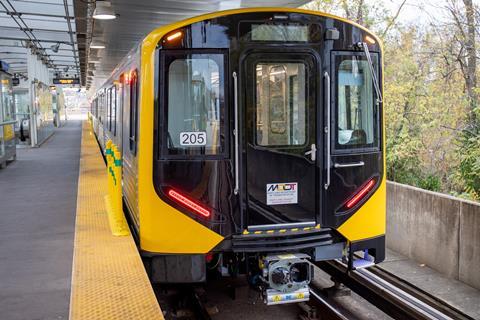
The vehicles are similar to cars that Hitachi Rail supplied to Miami in 2017-20, and are designed for a 30-year lifespan with average duty cycles of 129 000 km/year. The first of the cars for Baltimore were produced at Hitachi Rail’s facility in Miami, but a significant portion of the fleet is being produced at its $100m factory at Hagerstown in Maryland which was officially opened in September 2025 and is capable of building up to 20 vehicles per month. So far 12 cars have been delivered, and more will be phased in this year with all expected to be in service by 2027.
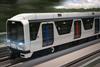
The 78 cars are formed into 45·8 m long bidirectional married pairs, with each stainless steel car being 3 111 mm wide and having 76 seats and a capacity of 196 passengers. Compared to the older stock they have larger windows, brighter and more energy efficient LED lighting, better bicycle space and improved digital signage with updated route information and an audio announcements. Wider doors and reconfigured interiors will allow for faster boarding to improve punctuality and comply with American with Disabilities Act accessibility requirements.
The car ends are made of glass fibre and along with shaped LED lights is designed by Hitachi to appear ‘modern and innovative’. The floor structure provides fire resistance for at least 30 min.
The trains use a 700 V DC third rail power supply and have a maximum speed of 75 km/h. Each car is fully motored, with an IGBT inverter per motor bogie. The updated cab includes an integrated diagnostic system.
The ‘modern and sustainable’ fleet ‘will meet passenger needs for decades to come’, said Joseph Pozza, President of Hitachi Rail in the USA.