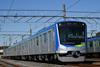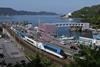
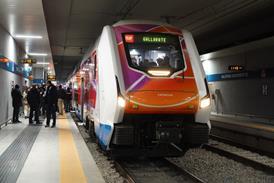

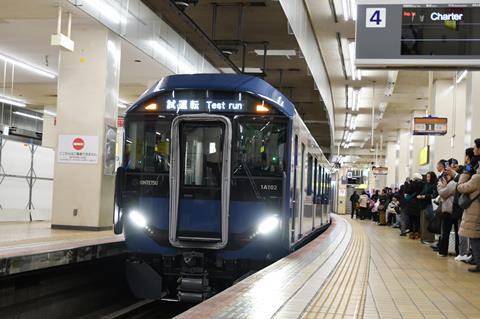
JAPAN: Kintetsu Railway has put into service the first of its Series 1A EMUs, which are being supplied by Kinki Sharyo to replace older trains that have been in traffic for up to 40 years.
Kintetsu operates the largest non-JR network in the country, totalling more than 501 route-km. The 1 435 mm gauge system serves the cities of Osaka, Kyoto and Nagoya, as well as more rural parts of Mie Prefecture. The first Series 1A unit entered service in Nagoya on January 16.
According to the railway, the new EMUs represent an investment of more than ¥13bn. The first three four-car units are being introduced on the Nagoya Line, and will be followed by two similar sets for the Osaka Line. Another nine cars are to be procured in fiscal year 2026 for use on the Nagoya Line; these will be formed as three-car sets designated Series 1B. Further units are expected to be introduced on the Yamada and Toba lines.
Aluminium-bodied
Unveiled with a demonstration run on January 8, the four-car Series 1A sets are formed of a driving trailer, intermediate motor car, trailer and driving motor car. The double skinned aluminium bodyshells have been assembled using a laser assisted MIG hybrid welding technique. Whereas the railway’s earlier EMUs had a maximum width of 2 744 mm, the Series 1A cars are 2 800 mm wide, following revisions to the loading gauge clearances. All cars are 20·7 m long and have a maximum height of 4 150 mm. Total weight of a four-car unit is 145·5 tonnes. Each four-car unit is designed to carry up to 500 passengers with a longitudinal seating configuration or 470 with a mix of transverse seating.
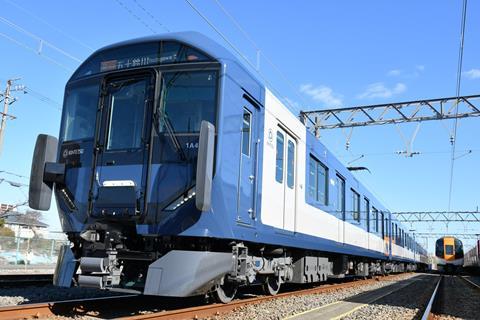
Taking power at 1·5 kV DC through a single-arm pantograph, the four-car Series 1A sets are designed to run at a maximum speed of 120 km/h. They have eight totally enclosed cage-type three-phase induction motors, each rated at 240 kW. There are two VVVF inverter control modules with hybrid SiC elements, each controlling four motors. Maximum acceleration is 0·83 m/s2, and maximum deceleration 1·1 m/s2.
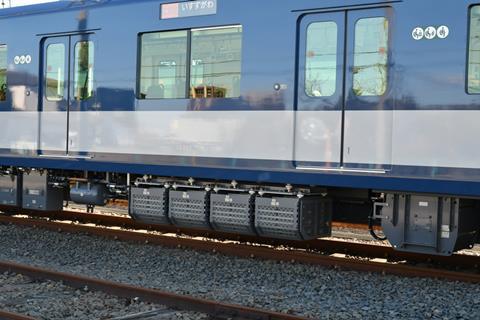
To cope with gradients of up to 3·3%, the EMUs are fitted with high-efficiency braking equipment. Regenerative braking will be used in normal service, backed up by high performance rheostatic brake resistors and conventional electro-pneumatic disc brakes. According to the operator, energy consumption will be reduced by as much as 45% compared with its older conventional EMUs.
Design enhancements
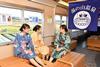
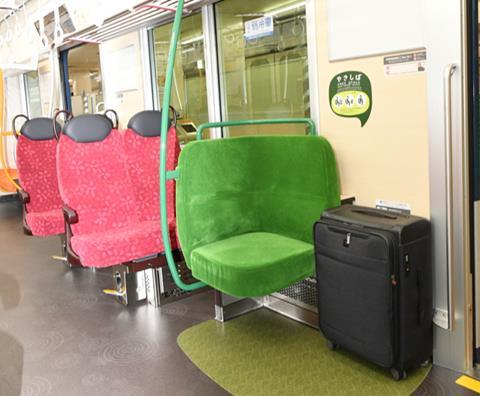
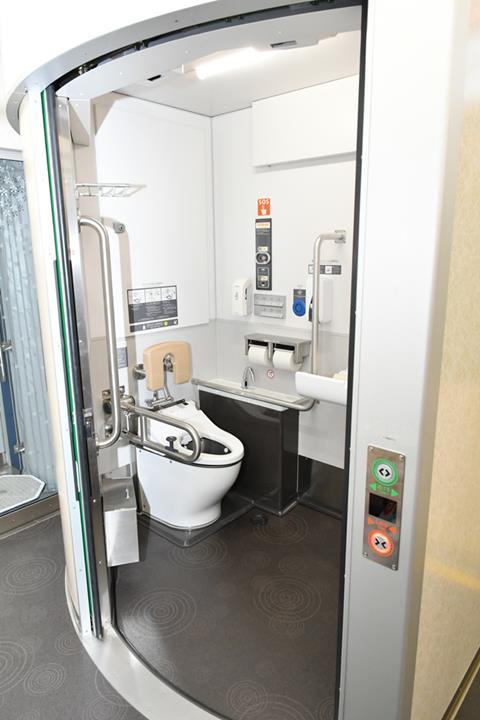
Kintetsu conducted surveys among its passengers to inform the design of the new trainsets, resulting a number of changes to the interior layout, including manual control of the inter-car doors. There is improved luggage storage, and special seats for passengers accompanying a child in a pram; these are branded Yasashiba from the terms for ‘affectionate lawn space’. There is also an accessible toilet compartment in one car, with a controlled-emission vacuum toilet.
The interior decor is based on Manyoh-shu, a collection of Haiku poems dating from up to 700 years ago. Meanwhile, the exterior profile has been designed to engender feelings of friendliness and safety. The octagonal front end is intended to reflect the region’s many historic buildings, while the blue livery depicts a coastal seaside feel.