









EUROPE: A joint working group is to be formed to bring together the British and Swiss governments and rail industry experts to examine how to overcome the commercial and technical barriers to launching a direct high speed train service between the countries.
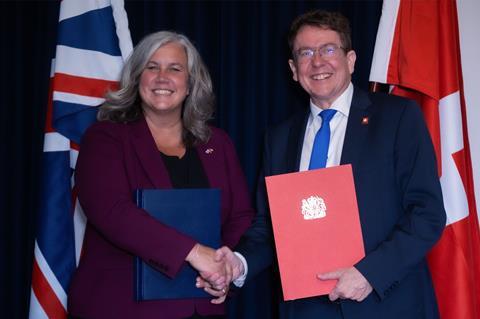
A memorandum of understanding was signed at London St Pancras station on May 8 when UK Transport Secretary Heidi Alexander met Swiss Federal Councillor and head of the the Federal Department of the Environment, Transport, Energy & Communications Albert Rösti who saw the facilities used by international rail passengers.
The MoU aims to formalise co-operation between the two governments to look at the operational, regulatory, policy and commercial requirements for launching a service, including Channel Tunnel safety requirements and security arrangements, and to facilitate conversations with operators. This will build on existing industry efforts to increase international services from London. The UK Department for Transport said the MoU would also support long-term ambitions for enhanced rail connectivity between the UK and central Europe.
‘This is an exciting and important milestone in our efforts to strengthen international rail connections and promote greener travel to Europe’, said Alexander. ‘A direct rail link between the UK and Switzerland has the potential to boost tourism, grow our economy and bring people closer together – all while offering a greener option for passengers.’

The Swiss department said the number of flights shows that there is high demand for travel between Switzerland and the UK, and the confederation believes that there is also potential for a direct rail connection if the journey time is right. It is envisaged that a direct rail connection from Genève with a journey time of 5 h compared to 7½ h with a change in Paris could be competitive. ‘I am convinced that its a good opportunity, and rail travel will be competitive to flights’, said Rösti. ‘If you can fill one train with 1 000 passengers, you can reduce the number of flights from Switzerland by five.’
He predicted launching the service would not be as fast as he would like, but it is ‘really likely’ that services could launch in five to 10 years.
This would require an agreement between Switzerland, the UK and France, and Rösti intends to submit a policy decision to the Federal Council during the coming year. ‘A direct rail connection between Switzerland and the United Kingdom is an ambitious goal’, he said. ‘With today’s memorandum of understanding, we are establishing the basis to jointly examine concrete next steps. Such a connection would send a strong signal for international public transport.’

Robert Sinclair, CEO of London St Pancras Highspeed, said the ‘exciting’ MoU builds on preliminary work that the Channel Tunnel to London high speed line infrastructure manager has undertaken to ensure track and station access for the expansion of international services. This includes plans to expand capacity at St Pancras station, and the launch of an International Growth Incentive Scheme. ‘We look forward to continuing our discussions with the Swiss national railway, SBB, to help realise this fantastic opportunity’, he said.
In March SBB said it was looking to expand its cross-border services, annoucing plans to order up to 40 high speed trainsets for use on international routes to Italy, France, and ’potentially for other destinations such as Barcelona and London’. Its studies had found that launching a direct service to London would be technically feasible but challenging. The need to provide security and border controls at all stations served is a major barrier to new services through the Channel Tunnel, but SBB believes this may be possible at Zürich HB, Basel SBB and Genève Cornavin.
Eurostar CEO Gwendoline Cazenave said ‘we welcome steps to strengthen sustainable travel between the UK and Switzerland. Eurostar customers can now book their entire journey between London and Genève, Zürich, Basel or Lausanne via Paris. This is a first step in a wider plan with our partners to grow connections in the greenest way.’