

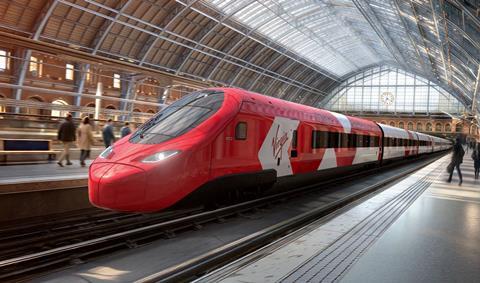
EUROPE: Virgin has set out details of its plans to launch high speed train services through the Channel Tunnel to compete against Eurostar, and says that it is ready to confirm an order for Alstom trainsets which would enable the start of services from London to Paris, Brussels and Amsterdam during 2030.
Virgin Group company VTE Holdings Ltd set out its plans for ‘Project Bullet’ in documents supplied to UK regulator the Office of Rail & Road as part of its application for rights to access the Temple Mills maintenance depot in London which is used by the incumbent operator.
Virgin said the capacity already identified as available at Temple Mills would be sufficient to support its plans, but it also believed that more capacity could be made available.
Financing model
According to the VTE submission, the project requires a total capital investment of around £700m. The planned operating company would be funded by Virgin Group (50%) and two unnamed investors.
This OpCo would lease trainsets from an AssetCo, to be 100% funded by one of the unnamed investors through a combination of equity and long-term senior debt. Apex Rail has been appointed as financial adviser for the AssetCo debt financing.
Virgin said the rolling stock and financing agreements would be ready for finalisation by October 31, when ORR is expected to make a decision on whether to grant access to the depot.
Rolling stock plans
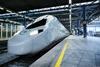
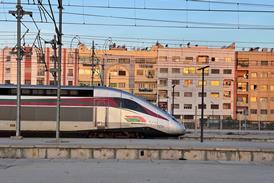
Virgin and Alstom have already agreed detailed heads of terms for the supply of 12 seven-car Avelia Stream trainsets able to run at a maximum speed of 300 km/h.
These 200 m long trainsets would be equipped to use 25 kV 50 Hz, 1·5 kV DC and 3 kV DC electrification, and would be fitted with ETCS Baseline 3 onboard equipment, supporting the TVM430, KVB and ATB national safety systems via Specific Transmission Modules.
Virgin said it was also ‘exploring‘ a four-voltage option that would add 15 kV 16·7 Hz networks for use in Germany and Switzerland, subject to ensuring that the delivery programme remained unchanged.
The promoter described Avelia Stream as a high-capacity and energy-efficient evolution of a proven platform, compliant with the Technical Specifications for Interoperability and offering cross-border interoperability.
It aided that Alstom’s track record in Channel Tunnel operations through the original Eurostar fleet and its past relationship with Virgin for the West Coast Main Line Pendolino trains in the UK rail market would make the supplier an ‘ideal partner’.
Alstom told Railway Gazette International it was ’thrilled to support Virgin’s submission to the Office of Rail & Road. We eagerly await the ORR decision and look forward to seeing Virgin bring joy to passengers through the Tunnel.’
Virgin plans to place the order in the fourth quarter of 2025, triggering a 4½-year schedule for manufacturing and delivery.
‘Substantially all’ maintenance would be carried out by Alstom at Temple Mills under a 30-year train service agreement. Seven trainsets would be stabled at Temple Mills each night, with three in Paris and one each in Brussels and Amsterdam.
Access and regulation
Virgin reported that it had engaged with ‘all relevant regulatory bodies’ and obtained confirmation that there were no material obstacles to securing the necessary licences, safety certificates, vehicle authorisations and border approvals for its proposed operation. Its infrastructure plan had been independently reviewed by LEK Consulting.
The group said it was ’engaging’ with London St Pancras Highspeed, Eurotunnel, SNCF Réseau, Infrabel and ProRail to negotiate track access; it was also negotiating station access rights at London St Pancras International, Paris Nord, Brussels Midi and Amsterdam Centraal; and seeking depot access at London Temple Mills, Paris Le Landy, Brussels Vorst and Amsterdam Watergraafsmeer.
Virgin is collaborating with French open-access start-up Le Train, which has experience of that country’s regulatory environment. After placing the train order Virgin would engage Le Train to support its application for track access in France, and to support discussions about operating licences and safety certification.
Planned services
Virgin plans to offer 20 trains a day from London: 13 to Paris, four to Brussels and three to Amsterdam. There would be a phased start-up in 2030, with the full timetable to be in place six months after the initial launch. The company is targeting both business and leisure travel, envisaging ‘high-frequency’ peak services and ‘convenient’ off-peak options.
Virgin said its customer proposition would be built around product and service quality, including a ‘modern, spacious and digitally-enabled’ onboard experience. It would ‘lean into its brand, design expertise and hospitality heritage to create a distinctive offer that resonates with passengers.‘
The group added that it had ‘ambitions to expand further across France, and into Germany and Switzerland’, and would ‘continue to explore ways to bring services back to Kent and to enhance onward connectivity to the wider UK rail network.’
Le Train said it saw opportunities to co-operate to offer a ‘compelling product’ on routes to southwest France.
Growing the market
Virgin emphasised that its aim was to grow the cross-Channel market by offering a better service, lower prices and increased visibility, expanding capacity, attracting new passengers and raising standards across the board. It would be ‘the operator this route needs, the competitor customers want and the catalyst for a new era of cross-Channel rail travel.’
Writing in the document setting out the group’s plans, Virgin founder Richard Branson commented that ‘just as Virgin has successfully challenged incumbents in air, cruise and of course rail, we’re ready to do it again. We will shake up the cross-Channel market with our signature approach, delivering a service that is innovative, bold and unmistakably Virgin.’
He added ‘now really is the time to give customers the service they deserve. It’s time to end a 30-year monopoly and it’s time to bring joy back to the journey from a brand with more than 20 years’ experience in the rail industry.’