










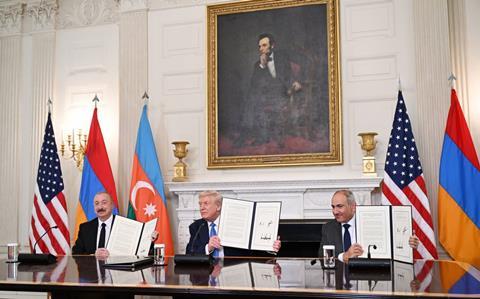
INTERNATIONAL: The opening up of all regional transport routes, including the long-mooted Zangezur Corridor – now renamed the Trump Route for International Peace & Prosperity – is included in a joint declaration agreeing to end more than 30 years of armed conflict which was signed by Armenia and Azerbaijan on August 8.
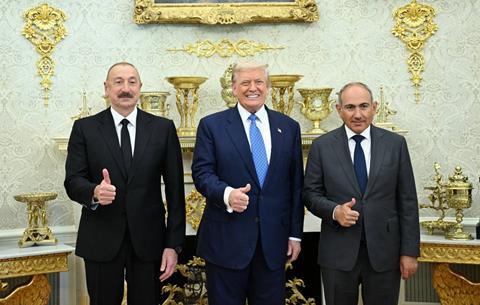
The seven article non-binding declaration was signed in Washington by Azerbaijan’s President Ilham Aliyev and Armenian Prime Minister Nikol Pashinyan, in the presence of US President Donald Trump.
Article three of the declaration recognises Azerbaijan’s right to ‘unimpeded connectivity’ from the main part of the country to its Naxçıvan exclave through southern Armenia, with ‘reciprocal benefits for international and intra-state connectivity’ for Armenia.
Article four allows for the creation of the TRIPP rail corridor linking Azerbaijan with Naxçıvan, with Armenia agreeing to co-operate with the USA and third parties to implement the transit route.
According to White House officials the TRIPP designation was proposed by Armenia and agreed by Azerbaijan.
Azerbaijan’s Aliyev said it would take only six months to a year to extend the country’s existing rail network to the Armenian border, with another 40 km of line needing to be constructed in Naxçıvan.
The TRIPP corridor in Armenia would use the route of the former Soviet-era rail alignment through the River Aras valley to the north of the border with Iran. This has been unused since the break-up of the Soviet Union.
Pashinyan said TRIPP would ‘promote infrastructure investment and regional connectivity’ and ‘unlock strategic economic opportunities that will create long-term benefits’, but did not comment on how long he expected work on Armenia’s section of the corridor to take or how it would be funded.
Armenian links
Neither Aliyev nor Pashinyan commented on the other part of the declaration, covering the reopening all transport routes into Armenia.
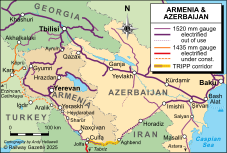
Armenia’s land borders with Iran and Georgia are open, with a functioning rail link to Georgia. It also has land borders with Azerbaijan and Turkey through which Soviet era rail links once operated.
If fully implemented the declaration could herald the reopening of the line between Kars in Turkey and the Armenian capital Yerevan, and also the reopening of the line between Ijevan in northeast Armenia and Ağstafa in northwest Azerbaijan.
It could also see the reopening of the line from Yeraskh in western Armenia to Heydarabad in Naxçıvan which would re-open the Soviet era rail link between Yerevan and Iran.
China to Europe
Aliyev said TRIPP would give Armenia the chance to become a transit country.
Turkey is developing a new alignment between its northeastern rail hub of Kars via İğdir and Aralık to its border with Naxçıvan, the only section of the proposed corridor that has never had a rail alignment. In July Turkey’s infrastructure manager TCDD secured US$2·8bn in external financing for the project, which is scheduled to take seven years to complete.
Once completed, this would offer a high-capacity rail link between Azerbaijan’s Caspian ports and the European rail network via Armenia and Turkey.
In combination with Kazakhstan’s rail network and the existing maritime links across the Caspian Sea, this would facilitate rail traffic between China and Europe.
TRIPP is expected to offer higher capacity and faster transit times that the existing Middle Corridor route which utilises the Baku – Tbilisi – Kars railway linking Azerbaijan and Turkey via Georgia.