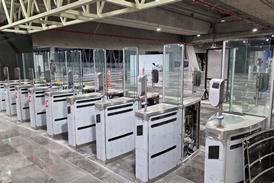











SPAIN: Masats has completed dynamic testing of a radar positioning system which enables the highly accurate stopping of trains without relying on CBTC. The company says this could be used on regional and non-automated metro lines where there is a desire to install platform screen doors or platform gap fillers, but the existing signalling system cannot provide the necessary data to enable this.
The RPS was originally developed by Auto Drive Solutions and has been adapted by Masats to suit railway needs.
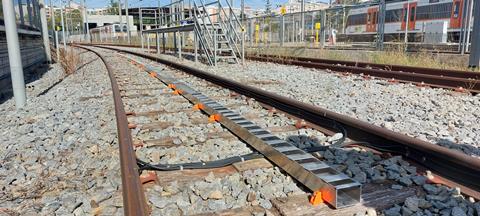
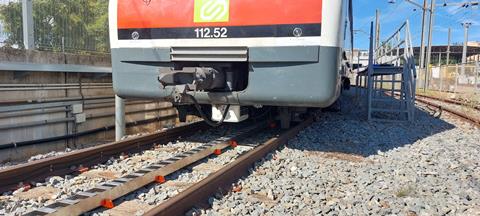
It comprises a radar sensor installed beneath the train and a passive continuous balise mounted on the track that encodes unique positional data. The system delivers real-time data on the train’s position (cm), speed (cm/sec), and acceleration (cm/sec²). The balise can be installed either in discrete or continuous segments along the station.
Once the train has come to a stop, the RPS verifies that the stopping point is within the specified limits. It can then enable the opening of the train doors, as well as the activation of other systems such as platform screen doors and gap fillers.
Catalunya operator FGC made track and trains available for the testing, which found that a precision stop requires a balise section of 16 m to be installed on the track at a station.
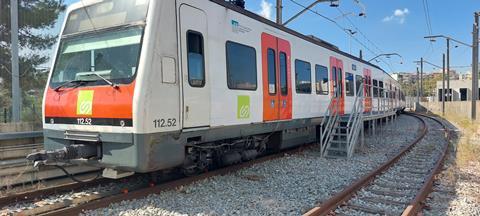
The RPS was tested as a standalone driver assistance device with a visual interface in the cab to indicate the required braking. The tests conducted at FGC used this setup, consistently achieving precise stops at the designated point with an accuracy better than 50 mm, compared to the normal stop accuracy using external visual references of ±2 m. The RPS could also be integrated into automated train operation systems, Masats says.
The system could also be used on tramways, where the passive beacon would be replaced with markings painted on the road to provide the coded information.