



NEW ZEALAND: Greater Wellington Regional Council has awarded Alstom a NZ$1·066bn contract to design, supply and maintain 18 battery-electric multiple-units for the Wairarapa and Manawatū lines. The order forms part of the Lower North Island Rail Integrated Mobility programme to improve passenger services.
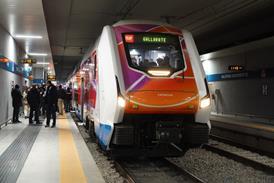
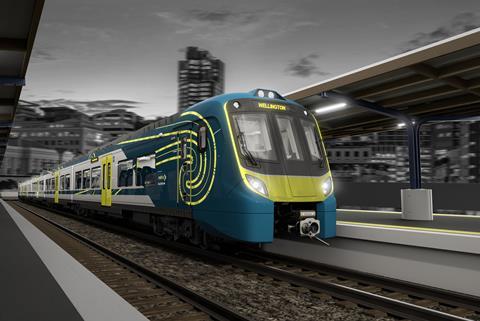
The new fleet ordered on September 8 will be branded Tūhono, meaning to connect or unite, representing how urban centres and regional communities will be better connected with the new fleet enabling through running beyond the electrified suburban network without requiring diesel traction.
Tūhono train design

GWRC had shortlisted Alstom, CAF and Stadler for the contract. WSP supported the procurement process, and law firms Ashurst and Bell Gully advised on the contract.
Alstom is to build the units at its Savli factory in India, based on its Adessia Stream B (previously X’Trapolis) commuter train platform with adaptations to meet Wellington’s operating environment.
The 120 km/h BEMUs will have roof-mounted Li-ion traction batteries charged from the 1·5 kV DC electrification where available. The use of tri-mode diesel-hybrid trains had been contemplated at an earlier stage of the current project.
The five-car 1 067 mm gauge sets will be semi-articulated with offset bogies, allowing for simplified architecture and the use of standard bogie types. A similar arrangement is being used for BEMUs Alstom is supplying to Ireland for services around Dublin.
Alstom said ‘a comfort-centric passenger experience will be at the heart of the new trains’, with capacity of 475 passengers, spaces for wheelchair users, bicycles, luggage and pushchairs, a toilet, vending machine and water dispenser facilities. A local requirement is the provision of train front emergency evacuation doors.
The livery developed by Māori-owned design agency Indigenous Design & Innovation will feature local cultural elements.
Maintenance and digital systems

Alstom will maintain the fleet for 35 years at a depot which is to be purpose-built by the Greater Wellington Regional Council in Masterton. Further stabling is to be provided in Wellington and Palmerston North.
The manufacturer will use its FlexCare Perform maintenance concept and HealthHub condition-based monitoring platform. A connected driver advisory system will help to enhance reliability and energy efficiency.
Ling Fang, President of Alstom’s Asia-Pacific region, said ‘the contract will see us bringing our zero-emissions rail technology to the Asia-Pacific region for the first time and I look forward to even greater expansion and partnership in the region, as we continue supporting our clients in building a cleaner, more sustainable future.’
Infrastructure modernisation

The train order forms part of the Lower North Island Rail Integrated Mobility programme to modernise lower North Island passenger services, along with infrastructure upgrades to be delivered by KiwiRail.
The national government is funding 90% of the cost of the programme, with the remainder funded by the Greater Wellington and Horizons regional councils.
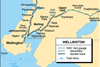
The route from Wellington to Masterton on the Wairarapa Line is electrified for the first 32 km as far as Upper Hutt, leaving the remaining 56 km through the 9 km Remutaka tunnel and onward to Masterton without overhead supply.
The line from Wellington to Palmerston North via the Kapiti Coast and Manawatū is 136 km, with only the first 48 km as far as Waikanae being electrified.
The government has confirmed NZ$802·9m of funding for upgrading the two lines.
This will include station enhancements at Solway, Woodside, Shannon, Ōtaki and potentially Levin. Passing loops will be added or extended, and comprehensive resignalling and level crossing modernisation works are scheduled for completion by early 2027.
KiwiRail is upgrading the Wellington electric network’s power system for the BEMUs, with work underway to provide five new substations and upgrade existing ones.
Substantial track works are also underway, including 9 km of track renewals within the Remutaka Tunnel.
Planned service improvements
Rollout of the BEMU fleet is planned from 2029, with full service from 2030.
‘These new trains will replace the ageing diesel locomotive-hauled fleet which dates back to the 1970s and has frustrated commuters for years’, said Transport Minister Chris Bishop. ’They will deliver faster, more frequent and more reliable services for passengers travelling between Wellington, the Wairarapa and the Manawatū.’
He said the new trains would ‘deliver real benefits for commuters, increase productivity, support economic growth, and allow Kiwis to get where they need to go quickly and safely’.
Plans include a doubling of peak services on both lines, additional off-peak services, time savings of up to 15 min between Wellington and Masterton, and increased speeds on the Wairarapa line.
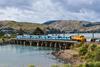
The solitary weekdays-only Capital Connection return service between Palmerston North and Wellington using ageing diesel-hauled rolling stock will be enhanced, with four weekday and two weekend return services, strengthening regional accessibility.
Horizons council Chair Rachel Keedwell said ‘to move from fighting for survival to establishing a future-fit passenger transport service for our region is both a relief and a triumph‘.
Keedwell said ‘like a living thread weaving our regions together, the Tūhono fleet will help the heartlands thrive. Through better access to work, education and recreation, Tūhono trains will increase provincial productivity, while reducing road congestion.’