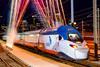
USA: National passenger operator Amtrak put the first of its long-awaited NextGen Acela trainsets into passenger service on the Northeast Corridor on August 28, after launch ceremonies the previous day.
‘Acela is synonymous with American high speed trains, and today marks a new era of next-generation service’, said Amtrak President Roger Harris. ‘The future of high speed rail starts now.’
US Transportation Secretary Sean P Duffy said ‘with these new Acela trainsets, Amtrak will provide more reliable service and lower prices for the American people – all while increasing the organisation’s profitability.’
An elevated experience for savvy travellers

A total of 28 of the Alstom trainsets are to enter service on the 735 km North East Corridor linking Washington, DC, New York and Boston in 2025-27, enabling Amtrak to offer more services and 27% more seats per train than the existing Acela trainsets which entered services from December 2000.
The trains are designed for operation at up to 300 km/h, but in the absence of suitable infrastructure they will operatte at up to 255 km/h, compared to 240 km/h for the older Acela trainsets.
Each set is formed of two short-wheelbase power cars and nine articulated trailers. They are equipped with Alstom’s Tiltronix active-tilt technology, which the manufacturer says will facilitate operation at 30% higher speeds through curves compared to conventional high speed trains without compromising safety or passenger comfort.
Amtrak said NextGen Acela offers ‘an elevated experience, with features and amenities that today’s savvy travellers expect‘, with wide speat with winged headrests, wi-fi, individual power outlets and reading lights. Food and drink is sold in Cafe Acela, with a trolley service in business class.
Amtrak board Chair Tony Coscia said ‘from the moment our guests step onboard, they’ll feel the difference of a NextGen Acela train thanks to a more modern, premium and elevated experience’.
Built in America

The trainsets from Alstom’s Avelia product line were ordered in August 2016, when entry into services has been planned from 2021.
Alstom CEO Henri Poupart-Lafarge said they ‘are the first high speed trains to be built in America’, and ‘the team at Alstom has brought nearly five decades of global experience in high speed rail to the United States to deliver the fastest and most technologically advanced trains in the nation.’
Known as Avelia Liberty by the manufacturer, production is being undertaken at Alstom’s Hornell site in New York state using 95% domestically sourced components from more than 180 suppliers across 29 US states. Alstom also noted that the design shared a ‘technology platform’ with the Avelia Horizon high speed trainsets now being delivered to French national operator SNCF, which brands them TGV M. The supplier added that its factories in France, Italy and India were involved in the design and manufacturing of the fleet, with the power cars being conceived at Belfort in Alsace, and the Savigliano plant in Italy being responsible for car bodyshell design, manufacturing and painting, and the tilting and bogie monitoring system.
‘Today marks a pivotal moment for American rail as we unveil the NextGen Acela, a testament to homegrown innovation and our commitment to revitalising US manufacturing’, said Michael Keroullé, President of Alstom Americas.
‘These trains, built by skilled American workers in Hornell, are not just about speed; they symbolise our dedication to bringing the world’s best rail technology to the United States and supporting economic growth across the nation. We are proud to contribute to the resurgence of American rail innovation, creating jobs and building a robust supply chain in the process.’
The Railway Supply Institute said the NextGen Acela supported 15 000 US jobs across the economy during varying stages of development. ‘The debut of the NextGen Acela fleet is a moment of immense pride for our industry’, said RSI President Jim Riley. ‘This project demonstrates the vital role of the railway supply industry in driving innovation and economic growth nationwide.’