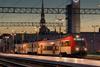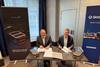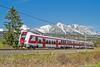







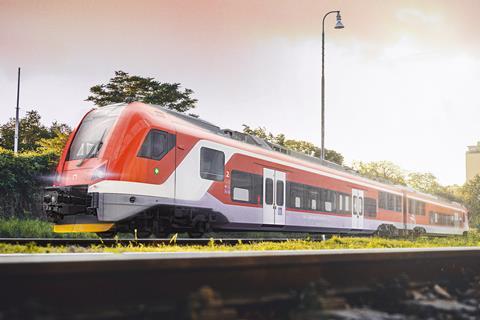
SLOVAKIA: National train operator ZSSK has awarded a consortium of Škoda Group and ŽOS Trnava a €332m framework contract for the supply of up to 36 two-car battery-electric multiple-units.
ZSSK plans to place a €144m firm order for the first 16 trains in 2026 once the funding is secured, with an option for 20 more. Škoda said this would be its first export order for battery trains, and some production work would be undertaken in Slovakia by ŽOS Trnava.
ZSSK plans to deploy the BEMUs on the Kúty – Skalica na Slovensku, Nové Zámky – Nitra, Nitra – Trnava – Bratislava and Myjava – Trenčín routes from 2028.
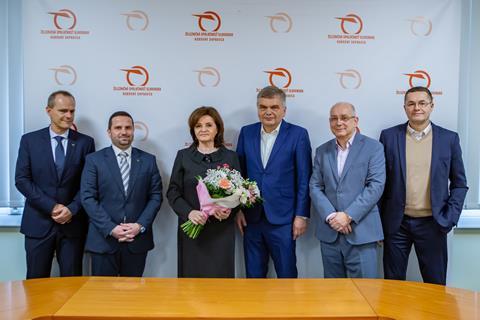
They will replace diesel trains on non-electrified regional lines and enable through running to and from electrified lines without requiring passengers to change trains. They will also reduce emissions. ‘This project fits in with the vision of a modern and sustainable railway that brings greater comfort to passengers and better technical and working conditions for our employees’, said ZSSK CEO Ivana Piňosová on December 3.
The order is being supported with EU funding. ‘Funding from EU funds for battery electric units is an important milestone on the road to modern and environmentally friendly rail transport in Slovakia. This is a project that combines innovative technologies with sustainable mobility while making effective use of European resources’, said Denisa Žiláková, State Secretary of the Ministry of Transport.
BEMU specifications
The two-car BEMUs based on Škoda’s Panter family of EMUs will have low-floor access, 157 seats, air-conditioning, wi-fi, 230 V and USB sockets, modern passenger information systems and ETCS.
They will have a maximum speed of 160 km/h using overhead power and 120 km/h in battery mode, with an off-wire range of at least 80 km which is sufficient for most regional services where ZSSK current uses diesel trains.
The batteries will be charged during operation from the overhead line and at charging points, with braking energy recovered on non-electrified lines.
‘Fast and realistic path to zero-emission’
ZSSK said Slovakia has 3 630 km of railway of which only 1 585 km is electrified. ‘We see battery trains as a fast and realistic path to zero-emission regional transport in Slovakia’, said Škoda Group Vice-Chairman Tomáš Ignačák. ‘They combine the advantages of classic electric units with operation on non-electrified lines, without the need for high investment in infrastructure.’
He said ‘our experience with battery trains shows that passengers appreciate their deployment, with passenger numbers on these lines increasing by up to tens of percent’.