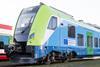







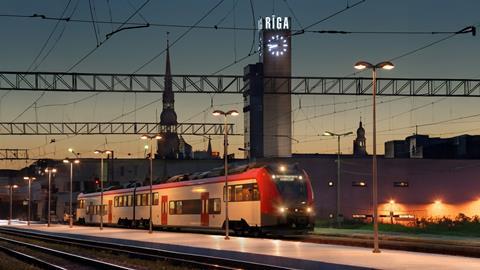
LATVIA: National transport authority Autotransporta Direkcija awarded Škoda Group a €89·4m contract on December 11 to supply nine 1 520 mm gauge two-car battery-electric multiple-units.
The deal comprises the provision of spare parts and staff training, and an option for seven more BEMUs, which would take the total value of the order to €160m.

The deal is being financed by the national government and the European Union’s cohesion funds. The other two bidders were CAF and Stadler Polska.
The vehicles are to be based on Škoda’s next generation regional train platform developed for the Baltic markets.
They are intended for regional services and will be capable of operating under both 3 kV DC and 25 kV 50 Hz power supplies. Their maximum speed is 160 km/h when using the overhead electric supply and 120 km/h in battery mode. The vehicles will feature 164 seats in second class with 3+2 seat configuration, and 24 in first class with a 2+2 arrangement.
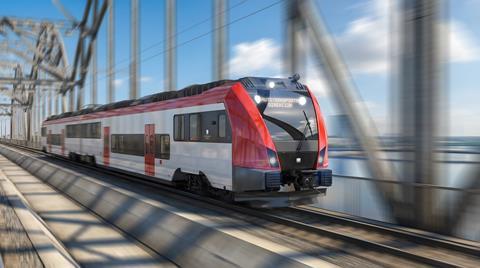
The BEMUs are expected to run primarily from Riga southeast to Daugavpils and northeast to Cēsis. The necessary charging infrastructure will also be built for the vehicles on these lines.
The BEMUs would reduce travel time by up to 15 to 25 min compared to the current diesel loco-hauled trains used on these routes. The seven additional BEMUs would allow the replacement of most of the 23 diesel trainsets now deployed on those lines, plus the extension of the Cēsis service to Valmiera, as well as serving additional destinations from Riga such as Rēzekne to the east.
The first of the battery trainsets are scheduled to enter service from the first half of 2029.
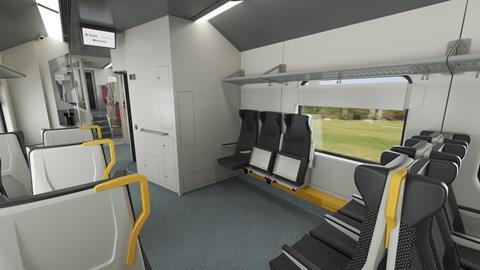
‘Battery-powered electric trains represent a significant investment for Latvia, aimed at strengthening the role of railways as the backbone of public transport and improving the quality and accessibility of passenger transport’, said Jānis Lapiņš, Chairman of the Board of ATD. ‘During the journey, passengers will be able to enjoy all the modern conveniences: air conditioning, reduced noise and vibration, modern equipment, electrical sockets, and USB-C charging points. The new trains will be adapted to all passenger groups and will meet the latest European accessibility requirements, equipped with a modern information system and spaces for passengers in wheelchairs.
’Conditions for passengers with bicycles will also be improved. While old diesel trains usually have a high floor and only three spaces for bicycles, the new battery trains will have space for eight bicycles in the low-floor section, four in a vertical position and four in a horizontal position’, he added.