





SOUTH AFRICA: Leasing company Traxtion has announced a R3·4bn programme of investment in locomotives and rolling stock to expand capacity as the South African rail freight sector is reformed.
The programme comprises R1·8bn for locomotives and R1·6bn for wagons.
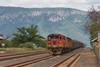
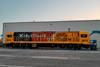
It includes the purchase of 42 partly-modernised GE Transportation U26C locomotives from KiwiRail in New Zealand, along with four fully-modernised C30-8MI locos. New Zealand and South Africa both use 1 067 mm gauge.
The secondhand locos will be delivered in four tranches between April 2026 and August 2027. Traxtion’s Rail Services Hub in Rosslyn will work with Wabtec, as successor to GE Transportation, to upgrade the U26C locos to the C30-MEI specification, with new fuel-efficient 7FDL-EFI engines and Brightstar control systems to improve tractive performance and reliability. It will also undertake a six-yearly major overhaul and full repaint.
The first upgraded locos are expected to roll out in Q3 2026, ‘marking the historic entry of Traxtion’s trains to South African main line operations’.
The wagons are to be manufactured domestically by Traxtion’s existing suppliers.
The programme has a minimum 60% local content target, and Traxtion expects to support at least 662 direct permanent jobs through manufacturing, assembly, commissioning and operation. Traxtion said the multi-year demand for components, maintenance and technical services would deepen South Africa’s rail services and manufacturing base. Training and certification of operating crews and technical teams would be supported by its government-accredited Rail Training Centre at Rosslyn.
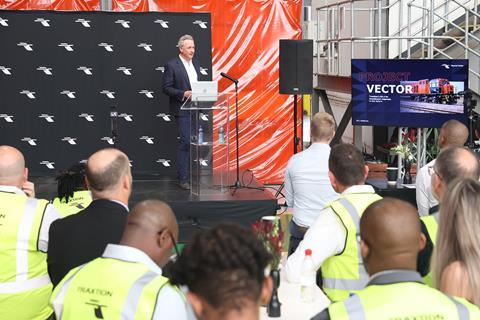
Traxtion CEO James Holley said ‘we have structured this programme to maximise South African industrial value-add, such as local assembly, supplier development and skills transfer, while getting modern locomotives and wagons into service as quickly as possible’.
Aligned with rail reform
Traxtion said its programme is the largest private investment in South African rail freight in terms of fleet size and value. It is expected to address about 5% of the national rail freight capacity shortfall, providing ‘high capacity and highly reliable’ locomotives and wagons for high-demand bulk and container flows ‘to move more freight by rail, reliably and at scale’.
Commenting on the government’s rail reform framework, which includes the vertical separation of infrastructure and operations, Holley said ’we welcome the progress to date and the leadership shown by the Department of Transport and the Interim Rail Economic Regulatory Capacity.
‘We are preparing to unlock significantly more in further investment. To unlock that, the next iteration of the Rail Access Agreement under the Network Statement must be fully bankable with service-level guarantees for awarded slots, balanced legal protections and clear recognition of lender rights.’
Holley said ‘private capital flows when government policies create confidence in the private sector to invest. This investment is our vote of confidence in South African rail and in the reform momentum we are seeing. Every additional locomotive we put to work lowers logistics costs, protects the road network, improves our environmental footprint, and most importantly, creates jobs in the upstream economy.’
Traxtion operates across 10 African countries and has an existing fleet of more than 50 locomotives on long-term contracts. Holley said allowing third party access has underpinned increases in freight volumes on the Tazara corridor and in DR Congo, and ‘South Africa can capture the same benefits, like more tonnage on rail, lower system costs and stronger industrial spillovers, if we keep momentum on reform’.
He said ‘rail is a network industry. When trains move efficiently, the whole economy moves. This programme is about getting South Africa’s freight system working for growth and proving that private-sector investment, aligned with reform, can deliver fast, measurable gains for the country and the region.’