

Completely zero-emission operation and the ability to benefit from electricity cost arbitrage are the among the reasons why Nexrail selected batteries rather than diesel to provide last-mile capabilities for a fleet of powerful locos it has ordered from Stadler, the leasing company’s CEO Luuk von Meijenfeldt tells Railway Gazette International.
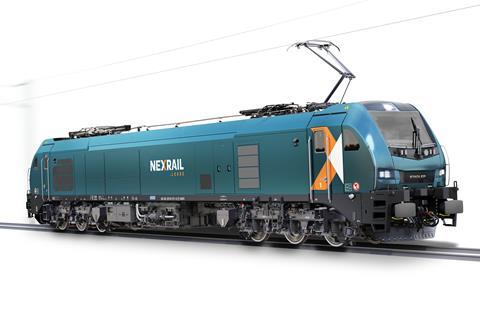
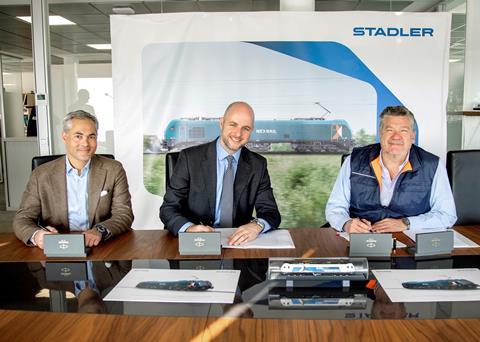
LUXEMBOURG: Leasing company Nexrail Lease has awarded Stadler a framework contract for the supply of up to 200 Euro9000 electric-battery freight locomotives, with the smart battery modules expected to provide benefits extending beyond fully zero-emission operation from terminal to terminal.
‘We decided on batteries instead of diesel, because diesel reduces reliability and requires more maintenance’, Nexrail CEO Luuk von Meijenfeldt told Railway Gazette International when the contract was announced on November 12.
As well as enabling off-wire last mile operations, the 636 kWh lithium-titanium-oxide battery module and smart management system will enable brake energy to be recovered and stored for reuse. This will then be used to provide a power boost to increase performance on DC networks, to smooth out peak power requirements, and to enable train operators to benefit from electricity cost arbitrage through the real-time optimisation of the timing of energy purchases.
Proven platform
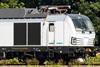
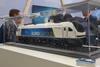
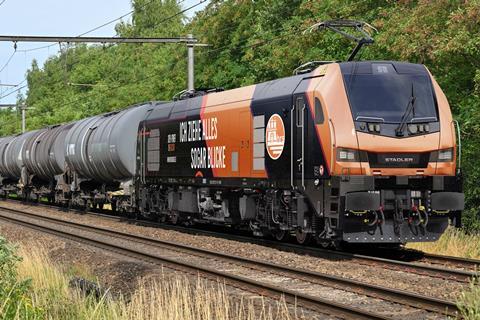
The locomotives ordered by Nexrail are based on Stadler Valencia’s six-axle Euro9000 design. European Loc Pool has previously ordered 40 electro-diesel locos from the same family, of which 25 have been delivered, and Alpha Trains has ordered 12.
Nexrail expects its electric-battery locos to be very attractive for use on long-distance European freight services, eliminating the need for diesel shunters and enabling single loco operation on the most challenging routes — such as the trans-Alpine corridors — without needing a banker.
‘Nexrail is excited to lead the European locomotive market toward a zero-emission future’, said von Meijenfeldt. The Euro9000 is ‘an important step forward in that transition because it eliminates the need for diesel traction and offers freight operators completely new benefits of having battery storage onboard.’
The locos will be able to use 25 kV 50 Hz, 15 kV 16·7 Hz, 3 kV DC and 1·5 kV DC overhead. They will be rated at up to 9 MW using overhead electrification and 1·2 MW on battery power, with starting tractive effort of 500 kN, continuous tractive effort of 430 kN and a maximum speed of 120 km/h.
CEO of Stadler Valencia Iñigo Parra said the order for battery-equipped locos ‘highlights our joint commitment to sustainable innovation in rail freight. By combining high-power electric performance with emission-free battery operation, the Euro9000 sets a new benchmark for flexible, green traction solutions across Europe.’
Launch customer
The first locos are scheduled to be delivered to launch customer Hamburger Rail Service in 2029.
The operator’s CEO Adem Güla said they would offer ‘a unique combination of flexible traction on-and-off the catenary, high tractive effort for our heavy loads and zero-emission operation for our rail construction logistics business’.
Cost benefits
Von Meijenfeldt said the Euro9000 locos had not been the cheapest on offer, but would be worth the cost.
‘I won’t talk about the price, but since we have ordered a huge number of locomotives, and operators will benefit greatly from battery power, it will save so much money that it will pay off in the end’, he said.
Electricity consumption is expected to be about 10% lower than conventional four-axle locomotives on the European market.
‘We are currently developing a system for monitoring the price of electricity in real time’, said von Meijenfeldt. ‘Also, the batteries will be able to be used under 3 kV DC, which can sometimes be problematic due to fluctuations.
‘With the battery it will also be possible to reduce peak consumption. In Germany, for example, the energy price for train operators is calculated according to peak consumption values.
‘Finally, as the locomotive converters consume energy when the locomotive is at rest or stationary, the batteries will be used for air-conditioning, and therefore the overall [power] consumption can be reduced.’
Further savings will come from standardisation. The locos will initially be approved for use in the Netherlands, Belgium, Germany, Switzerland, Austria and Italy. Nexrail expects to add eastern European countries as Stadler obtains the relevant certifications.
‘Our idea is to have one type of locomotive, with all the train protection and signalling systems’, said von Meijenfeldt. ‘State operators can easily organise a second locomotive, but smaller operators will greatly benefit from the Euro9000 locomotives, because there will be no need for a second locomotive or a banking locomotive.’
Stadler gains market share
Stadler Group’ Deputy CEO and Head of Marketing & Sales Ansgar Brockmeyer told Railway Gazette International that the locomotive market has needed more competition and Stadler has ‘developed a strong strategy in order to provide this’.
He said research by consultancy SCI Verkehr had found Stadler’s share of the European electric locomotive market ‘has grown from 6% to 14% within the last five years. At the same time, Alstom’s share dropped from 22% to 11%.’
This means Stadler is ‘already number two in terms of European market share, following Siemens Mobility with a 44% share’.
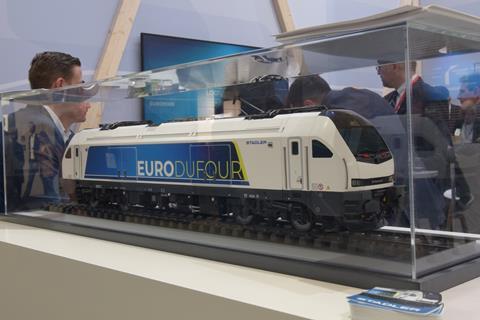
Stadler is pursuing the same strategy with locomotives as it does in other market sectors, with ‘strong standardised platforms to serve the majority of the market’, including the Euro DuFour for Swiss Federal Railways and Euro-C-cab centre-cab shunter. ‘And then we still have our tailor-made options, where we deliver custom-designed locos to customers that have special requirements.’