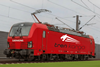








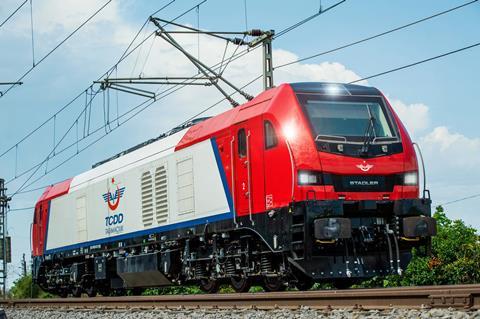
TURKEY: National train operator TCDD Taşımacılık has awarded Stadler a contract to supply 35 Euro4001 diesel-electric locomotives, along with spare parts, tools and test equipment and the provision of three years of maintenance and repair services.
The locos will be produced at Stadler’s Valencia site, and the manufacturer will work with local partners Aykal Group and Certifer Türkiye to get them ready for service.
The six-axle Euro4001 is designed for heavy freight services on non-electrified lines and steep gradients. Stadler said the Euro Stage V emission standard-compliant locos with CAT C175-16 engines would reduce particulate emissions by more than 90% and nitrogen oxides and hydrocarbons by more than 50% compared to the operator’s existing fleet, while meeting European TSI interoperability requirements and featuring both ETCS and the Turkish national ATS safety systems.
| Stadler Euro4001 diesel-electric locomotives for TCDD Taşımacılık | |
|---|---|
| Gauge mm | 1 435 |
| Axle arrangement | Co’Co’ |
| Transmission | AC/AC |
| Diesel engine | CAT C175-16 Stage V |
| Diesel engine power kW | 2 800 |
| Starting tractive effort kN | 500 |
| Continuous tractive effort kN | 430 |
| Maximum speed km/h | 120 |
‘The Euro4001 is the most advanced and powerful diesel-electric locomotive in Europe’, said Iñigo Parra, CEO of Stadler Valencia, on February 9. ‘We are delighted that it will enable us to make a significant contribution to Turkey’s goal of creating an efficient, interoperable freight transport network that is committed to reducing emissions.’
More than 400 locos from the Euro family have now been sold in 12 European countries, Uruguay and Turkey, where EuroDual electric diesels have been in use with open access freight operator Körfez Ulaştırma since 2022 and Arkas Rail took delivery of five in 2025.
The order comes as Turkey continues to develop is role as transit country for freight between Europe and Asia. Ongoing market liberalisation and government investment in expanding the rail network is intended to increase rail traffic from 29 000 containers moved in 2021 to around 400 000 containers/year by 2030.