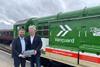
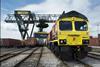
UK: Network Rail and industry partners held an event at Tuxford in Nottinghamshire on December 3 marking the first use of rail to transport hydrogen on the main line network. Nick Kingsley reports.

UK: Network Rail and industry partners held an event at Tuxford in Nottinghamshire on December 3 marking the first use of rail to transport hydrogen on the main line network.
Held at NR Test Tracks’ Tuxford research site, the event heralded ‘five firsts’ for the use of hydrogen and related sustainable technology in rail and energy applications, the organisers said. The five cited were:
- the UK’s first use of rail to move hydrogen as a commodity;
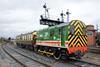
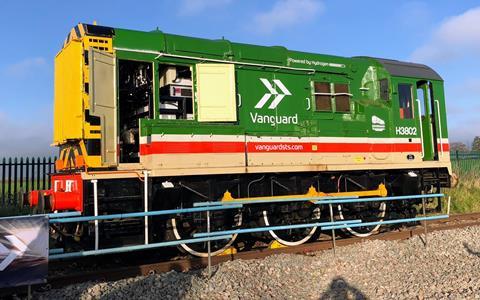
- the UK’s first hydrogen-powered shunting locomotive was on static display;
- the world’s first net-zero railway test track where hydrogen would play a significant role;
- the world’s first rail-connected green hydrogen production facility;
- the UK’s first joint railway-energy industry innovation zone where hydrogen would play a significant role.
Gareth Dennis, NR’s Strategy Lead for Test Tracks, said these ‘five firsts’ showed that the UK railway ‘was ready’ to play its part in supporting the emergence of hydrogen and other sustainable technologies. He added that the relaunch of Test Tracks as a distinct brand within NR and the emerging Great British Railways also reflected a desire for the research and innovation side of the industry to ‘look outwards’ to forge relationships with other sectors, such as energy.
Hydrogen delivery

The highlight of the event was the delivery by rail of containers carrying hydrogen, run by freight operator Freightliner Heavy Haul. A Rail Operations Group Stadler Class 93 locomotive running in battery mode hauled three bespoke wagons carrying containers of hydrogen gas, tailed by a Freightliner Class 66 diesel loco fuelled by low-emission HVO. The train was running from Doncaster to High Marnham, the site of a former coal-fuelled power station close to Tuxford. The test track was established after coal trains ceased using the branch, but the former power station site is now being redeveloped by GeoPura and JG Pears as a green hydrogen production facility. A static power unit provided by GeoPura was used to provide a supply for the event.
‘Rail is the greenest form of long-distance transport, and we, as an industry, are working hard to decarbonise transport and achieve net zero’, explained Leevan Finney, Network Rail’s Engineering Services Director. ‘Today, the railway has the potential to be a strategic hydrogen distribution network in the future, as it has been for energy for many years. By bringing together rail and energy innovators here at Test Tracks in Tuxford, we’re accelerating Britain’s journey to net zero and showing how the rail and energy sectors can work together to deliver sustainable transport and energy distribution.’
‘We’re showing that the rail network is a great way of transporting clean fuel to connected customers who can’t get the power they need from the traditional distribution grid’, added Andrew Cunningham, Chief Executive of GeoPura. ‘By supplying locally produced green hydrogen from HyMarnham Power to this first-of-its-kind rail application, we’re showing that clean fuel, proven technology and existing rail infrastructure work together right now to cut carbon and improve air quality across the network.’
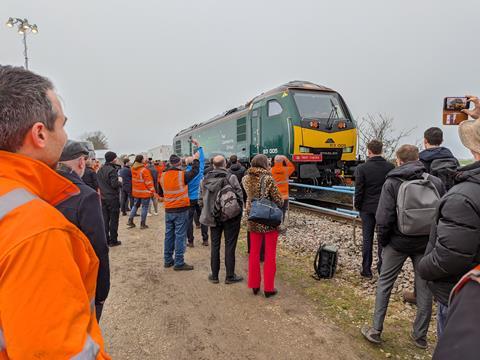
Dave Penney, Managing Director for Rail Services & Heavy Haul at Freightliner, told guests that the rail freight sector had had to ‘evolve’ after the end of coal traffic on the British network over the past decade. He suggested that commodities like hydrogen could hold huge potential for freight operators to grow their traffic, but that work would be needed to assess how that could be done in an economically optimal manner, echoing the successful ‘merry-go-round’ model that was used to bring coal to power plants for many years.
‘Pipelines are expensive; we need to show that rail can work’, he added. ‘Freightliner is proud to be the first Freight Operating Company to transport hydrogen on the rail network.’
Shunter on show
Other partners present at Tuxford included Vanguard Sustainable Transport Solutions, Enspired Consulting, Toyota UK, lighting specialist TCP Group and JCB.
Vanguard STS was displaying the battery-hydrogen Class 08 shunter which it launched at the Severn Valley Railway in January 2025. The loco has now been fitted with its fuel cell to augment the battery pack that replaced its diesel engine, and it is expected to be tested commercially during 2026. However, Helen Simpson of Enspired Consulting, who has been involved in the conversion of the loco, told Rail Business UK that ‘a few small niggles’ meant that it was not able to move under its own power at Tuxford.
Among the technologies on display were fuel cell-powered floodlights provided by TCP Group, which now has 685 of the lighting towers in operation across the rail and construction sectors.
JCB meanwhile showcased its zero-emission hydrogen combustion G60RSH 60 kVA generator and three-phase powerpack. The company said this technology was well suited to applications that previously used diesel, providing a familiar and robust power generation option. Working closely with Network Rail, JCB had deployed the two products at Rugby on the West Coast Main Line in January 2024, JCB Principal Engineer Mark Richards told Rail Business UK.