The rail sector needs to introduce a funnel process to incentivise and speed up the adoption of innovative technologies and materials offering long-term cost savings, says Steve Barbour, Managing Director of Composite Braiding.

The rail industry is well regarded for its openness to innovation, but progress often stalls when it comes to the actual adoption of new technology. This takes a long time in comparison to other sectors, because of a combination of risk perception, procurement structures and regulatory barriers.
A new approach is needed – one that ensures innovative materials offering efficiency and sustainability benefits and long-term cost savings are assessed and qualified before they reach the procurement process.
Barriers to innovation
One of the biggest barriers to innovation is rail’s tendency to prioritise immediate cost savings over whole-life value. Instead of focusing on the upfront expense of new materials, we should instead shift the focus to the long-term benefits.
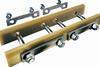
For example, lightweight composite materials offer significant advantages over traditional steel. Composite Braiding’s production process reduces waste by 97%, cuts energy usage by 95% and slashes labour costs by 90%. In a whole-life assessment, this would translate into major savings through lower maintenance costs, longer service life and reduced energy consumption.
However, without considering these long-term savings as part of the procurement process, innovative materials struggle to gain traction.
The industry’s fragmented structure means that the costs and benefits of innovation often accrue to different stakeholders – manufacturers and suppliers may develop cutting-edge materials, but the companies responsible for infrastructure maintenance or train operations might not see a direct financial incentive to adopt them.
This can lead to a cycle whereby sticking with traditional methods remains the default, as no single entity within the rail ecosystem is incentivised to take the financial risk upfront. This is in stark contrast to the aerospace and automotive sectors, where vertically-integrated supply chains enable quicker adoption of new materials due to clearer alignment of the costs and benefits.
Even when the will to innovate exists, railway procurement is often constrained by rigid standards and specifications. At the crucial Option Selection stage, where materials and designs are evaluated for new projects, decision-makers face strong incentives to stick with what has already been approved.
This means that the risk of deviating from existing specifications is high. If an alternative material fails to meet stringent regulatory requirements or if its performance cannot be demonstrated with sufficient historical data, projects may face costly delays, penalties or even legal repercussions. As a result, innovation can be overlooked not because of a lack of potential, but because it introduces uncertainty into a system that is designed to be risk-averse.
Innovation funnel
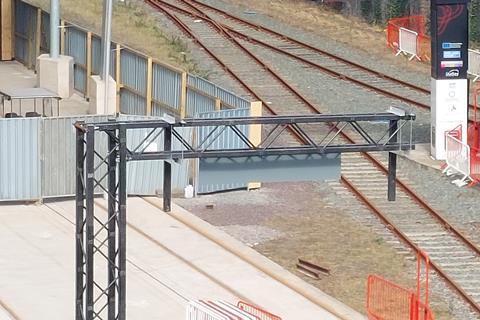
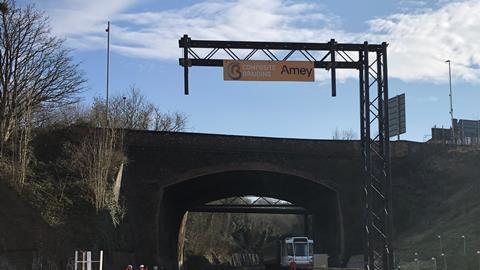
A prime example of how composite materials could revolutionise rail infrastructure is Composite Braiding’s Twin Track Cantilever project. This required the development of an advanced automated process to create an overhead electrification cantilever weighing just 277 kg, compared to 1 700 kg for a traditional steel structure.
Despite these impressive figures, the challenge remains in scaling up such innovations. Without a pre-established route for qualification, products struggle to move beyond pilot projects.
The rail industry would benefit from a structured innovation funnel, a process whereby new materials and technologies can be assessed, tested and pre-qualified outside of the traditional procurement cycle.
This would allow promising innovations to be evaluated rigorously in advance, so that by the time they reach Option Selection they arleady have the necessary approvals, safety data and performance metrics to compete with traditional alternatives on a level playing field.
An innovation funnel would also encourage greater collaboration between manufacturers, operators and infrastructure managers. Aligning the incentives and providing a clear path for new materials to enter the market would help break the cycle of risk aversion.
It is not enough for the sector to be open to innovation; it must be able to adopt it at scale. Otherwise, rail risks falling further behind other industries that are already embracing new technologies and materials.