






Between the beginning of November 2024 and the early days of 2025, almost 600 km of new metro and suburban railway was put into service across 22 Chinese cities, but the focus is on expanding networks in cities where urban rail already exists. Toma Bačić and Andy Hellawell summarise the latest growth surge.
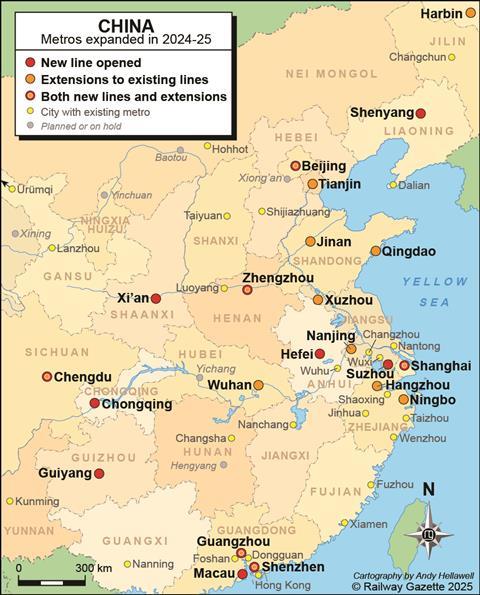
China’s urban rail drive is continuing, with a raft of new lines and extensions coming on stream over the past few months. Completely new lines have been added to the metro networks in Chongqing (Bitong), Shenyang (Line 3), Zhengzhou (7 and 8), Guangzhou (Line 11), Guiyang (Line S1), Shenzhen (Line 13), Hefei (Line 8), Xi’an (Line 8), Chengdu (Line 27), Beijing (3 and 12) and Suzhou (Line 7), whilst in Shanghai a regional express railway now connects the city’s two airports.
Lines have been extended in Ningbo, Hangzhou, Nanjing, Shenzhen, Tianjin, Wuhan, Chengdu, Qingdao, Beijing, Xuzhou, Shanghai, Zhengzhou, Harbin, Jinan and Guangzhou. Together with the completely new lines, these have added more than 590 route-km with 369 stations (Fig 1).
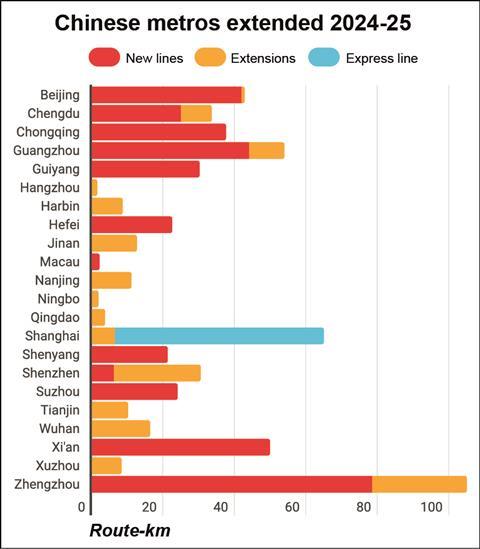
By far the biggest growth was seen in Zhengzhou, where new lines 7 and 8 opened on December 29, adding a further 78 route-km to the 26·4 km extension of Line 6 inaugurated a month earlier. Since September 2023 the city has opened no fewer than five lines totalling more than 210 route-km, almost doubling the size of its network to nearly 450 route-km. This makes it bigger than the metros in Seoul, New York and London.
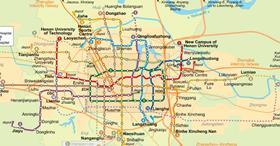
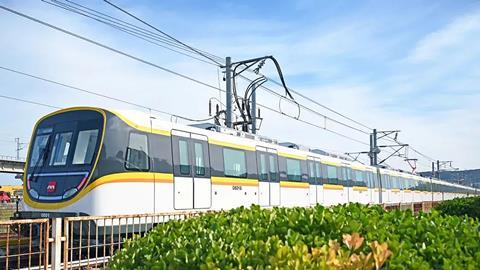
Automation is being adopted more widely, with GoA4 fully automatic operation in use on new or extended lines in Guangzhou, Zhengzhou, Shenzhen, Nanjing, Xi’an, Hefei, Chengdu, Beijing and Suzhou. Meanwhile, Shanghai’s extended Line 17 operates to GoA3.
Line by line
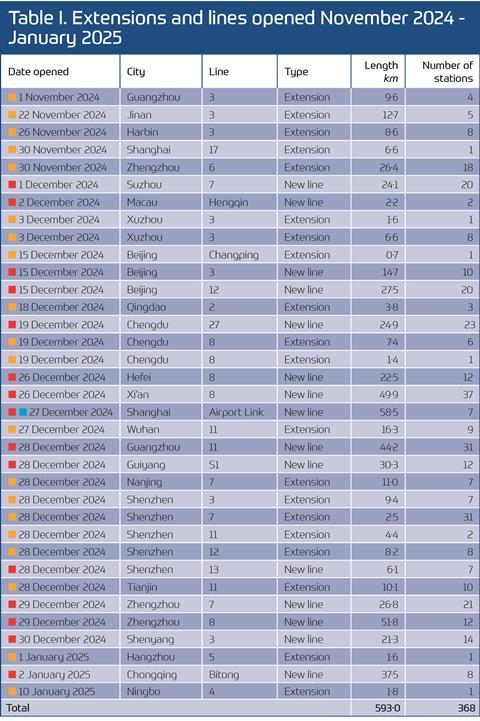
Since the beginning of November, China’s metros have seen 15 new lines brought into service, along with extensions to another 18 (Table I).
- November 30, Zhengzhou. Line 6 extension, running north from Changzhuang across the city to Qinghuafuzhong, 26·4 km, 18 stations.
- November 30, Shanghai. Line 17 western extension, Oriental Land to Xicen, 6·6 km with one station. Equipped for GoA3 automated operation with attendants. This was the city’s first metro expansion for nearly three years.
- December 1, Suzhou. Line 7 from Hongzhuang to Changlou, 24·1 km, 20 stations. The former Line 4 branch from Hongzhuang to Muli in the southwest was redesignated as Line 7 on October 10 2024, and its northward cross-city extension took the network to more than 350 route-km.
- December 3, Xuzhou. Line 3 extended at both ends: south from Gaoxinqunan to Yinshan, 1·6 km with one station; northeast from Xiadian to Zhenxingdadao, 6·6 km with eight stations. Automated Line 6 is expected to open in September 2025, adding a further 22·9 km of line and taking the city’s network to just over 95 route-km.
- December 15, Beijing. Line 3 is a new radial route running east from the city centre to Dongbabei, 14·7 km with 10 stations. Equipped for GoA4 driverless operation, and worked by a fleet of 84 four-car trains shared with new Line 12 from Sijiqingqiao to Dongbabei. This 27·5 km west-east line with 20 stations is also equipped for GoA4. The Changping Line has been extended south by 0·7 km to an interchange with Line 12 at Jimenqiao, and an infill station added at Zhufangbei.
- December 18, Qingdao. Line 2 extended through the city centre from Taishan Road to Sichuan Road, 3·8 km with three stations.
- December 19, Chengdu. Line 8 extended northeast from Shilidian to Guilong Road, adding 6·2 km and six stations; Line 8 was also extended 1·3 km southwest from Lianhua to Longgang, adding one station. These extensions take the line to a total length of 35·3 km. Line 27 is a new tangential route through the northwest suburbs from Shixin Road, which then turns north to Shifo, 24·9 km, 23 stations. Fully automated to GoA4 and worked by 29 six-car Type B trains.
- December 26, Hefei. Line 8 is a new radial line in the north of the city linking Yilijing to Beicheng Gaotiezhan, 22·5 km and 12 stations. This is the first GoA4 automated line in Hefei.
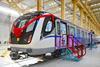
- December 26, Xi’an. Line 8 is a new loop line around the city, 49·9 km long with 37 stations, of which 13 are interchanges. This line is equipped for GoA4 operation using technology developed and supplied by Unittec. It is operated with a fleet of 79 six-car Type A trains supplied by CRRC Dalian. The 19·5 km Line 15 to the south of the city is expected to open in late 2025.
- December 27, Wuhan. Line 11 extended from Wuhan Dong station to Jiang’an Road, adding 16·3 km and nine stations.
- December 27, Shanghai. Airport Link Line: This new express metro line connects Hongqiao International Airport T2 to Pudong Airport T1&2, 58·5 km with seven stations. The line is operated by 14 four-car and three eight-car Type C trainsets manufactured by CRRC Changchun. A 10·2 km eastern extension to Shanghai Dong station is under construction. The line uses Chinese heavy-rail standard systems including 25 kV 50 Hz electrification, permitting future through working with the national network.
- December 28, Guangzhou. Line 11 is a new city loop line of 44·2 km with 31 stations, of which 16 are interchanges. The line is equipped for GoA4 operation, and worked by 55 eight-car Type A trains from CRRC Zhuzhou. A further 10 metro and suburban lines are under construction in the conurbation, totalling 173 route-km.
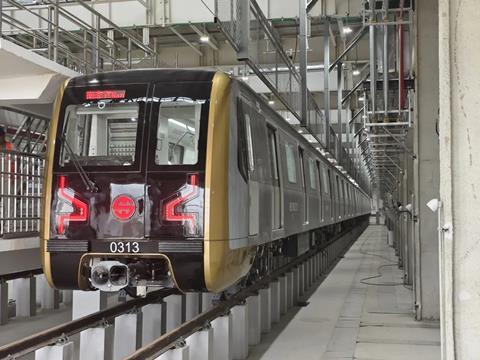
- December 28, Shenzhen. One new line and four extensions opened. The first phase of a new south-north Line 13 links the Shenzhen Bay Checkpoint to Hi-Tech Central, 6·4 km with seven stations. Designed for 100 km/h operation, the line is fitted for GoA4 with equipment from CRRC Qingdao Sifang and CRRC Guangdong, and worked by an initial four eight-car Type A trains — three from CRRC Sifang and one from CRRC Guangdong. Line 3 extended northeast from Shuanglong to Pingdi Liulian, adding 9·3 km and seven stations. Northern extension of Line 7, Xili Lake to SZU Lihu Campus, 2·5 km with two stations. Line 11 city centre section, Gangxia North to Huaqiang South, 4·4 km with two stations. Line 12 northwest extension, Waterlands Resort East to Songgang, 8·2 km, seven stations.
- December 28, Nanjing. Line 7 central segment from Yingtiandajie to Mufuxilu, 11 km with seven stations. Connecting the northern section of the line, which opened in December 2022, and the southern section, which followed a year later, this brings the total length of Line7 to 35·5 km with 27 stations. Equipped for GoA4 operation, the line is worked by 53 six-car Type B trains from CRRC Nanjing Puzhen.
- December 28, Tianjin. Line 11 western extension from Dongjiangdao in the city centre to Shuishanggongyuanxilu, adding 10·1 km and 10 stations. A further 4·2 km extension west to Wenjielu is due to open in December 2026, adding another three stations.
- December 28, Guiyang. New suburban Line S1 from Wangchengpo to Zaojiaoba, 30·3 km with 12 stations. Operated by a fleet of 20 six-car Type B2 trains from CRRC Nanjing Puzhen and CRRC Zhuzhou.
- December 29, Zhengzhou. Line 7, a new north-south line linking Dongzhao and Nangangliu, 26·8 km and 21 stations. Worked by a fleet of 25 six-car trans. New east-west Line 8, Lumiao to Tianjianhu, 51·8 km with 28 stations. This GoA4 driverless line has a fleet of 29 six-car trains.
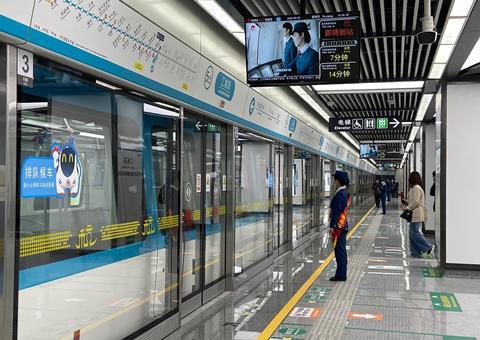
- December 30, Shenyang. Line 3, first phase of a new radial route serving the southwest, Lida to Nan Liguan, 22·9km with 14 stations. Initial fleet of 27 six-car TypeB trains from CRRC Dalian; 21 more are on order for completion of the 41·3km line.
- January 1, Hangzhou. Line 5 western extension from Jinxing to Eash Nanhu, 1·6 km with one station.
- January 2, Chongqing. Bitong Line, new suburban line connecting Bishan to Tongliangxi, 37·5 km with eight stations.
- January 10, Ningbo. Line 4 northwest extension, Chicheng to Chicheng Xi, 1·8 km and one station. Three more metro lines in the central area and two suburban routes are under construction, which together are expected to add another 226 route-km by 2028.
Coping with growth
It is now more than two years since a new Chinese city joined those already operating metro networks — the last to open being Jinhua, which opened the first of two regional lines in August 2022. Most larger Chinese cities now have some metro infrastructure.
Instead, new construction is increasingly focussed on providing additional capacity: Beijing’s Line 12 acts as a relief line for the busy north side of outer loop Line 10, whilst Chengdu’s Line 27 takes some traffic from parallel lines 5 and 3.
Another trend is the development of express routes with more widely spaced stations. Whilst the growth of the national high speed network has provided rail access for some satellite towns and outer suburbs, there are many areas where no main line construction is planned. Suzhou’s Line10 is under construction to fill such a gap, providing a link to Jin’gang, some 90 km north of the city. The limited-stop metro line is planned to be extended south across the city centre, connecting the north and south high speed stations.
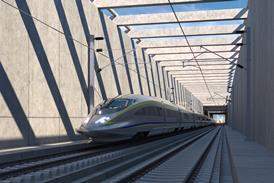
Shanghai’s Airport Link Line blends urban and main line even further, providing an express metro service connecting the airports at Hongqiao and Pudong, but with infrastructure designed to accommodate future through-running onto the national high speed network. This would enable China Railway high speed services to access the hub station being built at Shanghai Dong, which is due to open in 2027.
Carbon fibre train in service
On December 27 2024 Dalian metro began refurbishment of its 63·5 km Line 3. That line was opened in 2002 and has depots at Haiwan and Jiuli. The same day media in Beijing announced tenders for three metro projects: phase two of Line 19, the first phase of the northern section of the R4 line and the remaining section of Line 12.
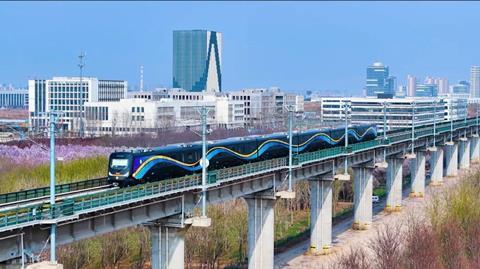
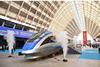
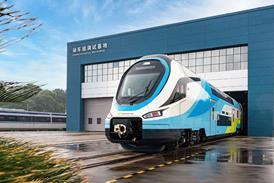
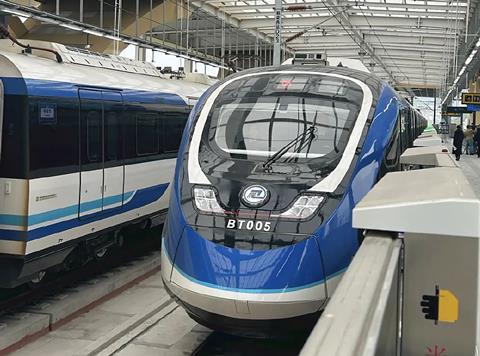
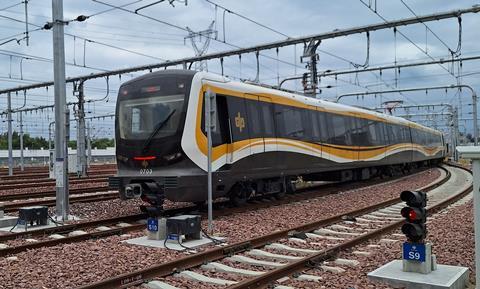
On the rolling stock front, CRRC Qingdao Sifang’s first Cetrovo 1.0 Carbon Star Express metro trainset entered revenue service in Qingdao on January 10. The six-car unit has carbon fibre composite bodyshells, bogies and other load-bearing structures; according to the manufacturer the carbodies are 25% lighter than comparable steel vehicles and the bogie frames 50% lighter, reducing total vehicle weight by 11% and energy consumption by up to 7%.