





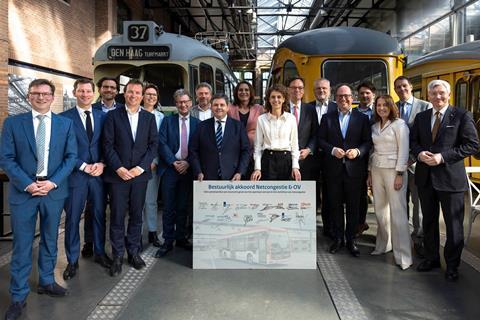
NETHERLANDS: An agreement to help balance demand on the heavily-loaded national grid has been signed by public transport operators which are dependent on the supply for their growing number of electric services but also have their own infrastructure which could be used to help optimise usage.
This is one of a number of sector agreements designed to address grid congestion which has led to a waiting list for high demand users to be connected to a supply.
Hans-Peter Oskam, Managing Director of power suppliers’ association Netbeheer Nederland, said the agreement would be ‘good for public transport and good for the power grids’. It would ‘have a very large effect, because it keeps public transport available for the many passengers who use it every day, and ensures that we make the best possible use of the capacity on the power grids, because the public transport parties can supply power at some times’.
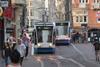
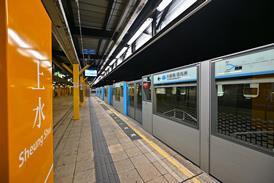
Amsterdam transport operator GVB will install equipment at four sites on the metro to recover braking energy for reuse. Next year it will pilot a scheme for charging electric buses with the regenerated energy from the metro train. The operator is also working with the universities of applied sciences in Amsterdam and Den Haag to investigate how solar panels and charging points for cars could be connected to the metro traction supply network.
Since the beginning of this year Rotterdam transport company RET has been supplying electricity that it does not require for tram services at off-peak times to Rotterdam municipality and nature organization Zuid-Hollands Landschap. The municipality wants to provide new charging points for road vehicles, and using electricity from RET will mean this can be done without the need to install new power feeds.
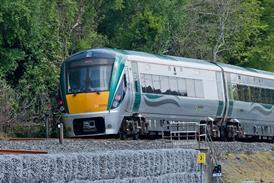
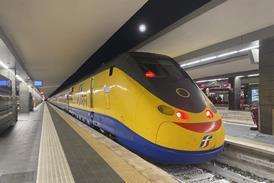
Rail infrastructure manager ProRail, in collaboration with the Utrecht municipality and grid operator Stedin, will place a biodiesel generator next to the railway to remove existing bottleneck on the power grid. This approach could also be used in other places.
Bus operators will agree contracts to charge their electric buses at night, when there is less demand on the power grid.
The government is to provide €3·2m of funding to support the various projects over the next four years. It will also facilitate knowledge sharing and investigate legal and regulatory obstacles to making more effective use of the available power.
‘Large-scale consumers can help spread the peaks on the power grid’, eexplained Minister for Climate & Green Growth Sophie Hermans. ’This is in their own interest as well as that of all people and companies who are desperate for a power connection.’
Minister for the Environment & Public Transport Chris Jansen commented that the Dutch public transport industry was ‘smart and innovative, adding that it was ‘fantastic that the sector can contribute to tackling the full power grid. In order to be able to run more trains, trams and electric buses, the public power network must be able to handle that.’
- Signatories: Ministry of Infrastructure & Water Management, Ministry of Climate & Green Growth, DOVA (transport authority partnership), EBS (bus operator), the municipalities of Arnhem and Utrecht, GVB (Amsterdam), HTM (Den Haag), Keolis (transport operator), the Rotterdam-Den Haag Metropolitan Area, Netbeheer Nederland (power suppliers association), NS (train operator), ProRail (rail infrastructure manager), Province of Utrecht, Qbuzz (transport operator), RET (Rotterdam) and the Amsterdam Transport Region.