




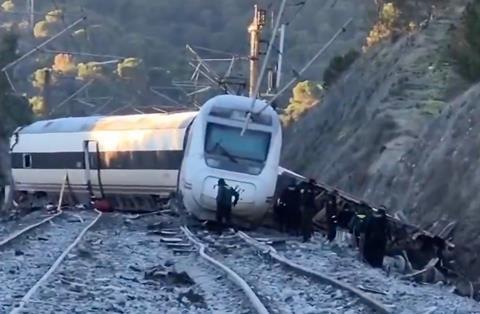
SPAIN: RENFE President Álvaro Fernández Heredia has urged commentators ‘not to speculate’ about the possible causes of a collision between two high speed trains at Ademuz on the Madrid – Sevilla high speed line, pending a detailed investigation by the national Railway Accident Investigation Commission CIAF which is expected to take at least a month.
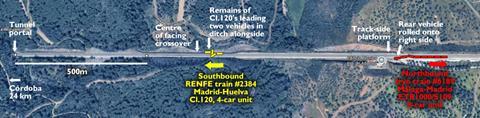
The accident occured when a northbound Iryo service from Malaga to Madrid became derailed on the approach to the Adamuz technical station around 19.45 on the evening of January 18, approximately 10 min after departing from Córdoba. Train 6189 was being operated by an eight-car Series 109 trainset, similar to the Italian ETR400 trainsets; this was built by Hitachi Rail for the Trenitalia-backed operator in 2022. The rear three coaches left the track, and were then hit by a southbound RENFE Alvia service 2384, a CAF-built four-car Series 120 EMU en route from Madrid to Huelva.
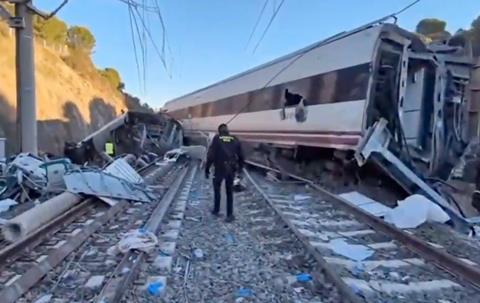
A reported death toll of at least 41 fatalities and more than 120 injured would make this the worst rail accident in Spain since the high speed derailment at Santiago de Compostela in 2013, in which 79 people died. Prime Minister Pedro Sanchez immediately declared three days of national mourning, while emphasising the importance of establishing the cause of the accident without spreading unverified rumours.
Fernández Heredia told local media that the line speed limit at the point of the Ademuz derailment was 250 km/h. One train had been travelling at 205 km/h and the other at 210 km/h, he reported. No faults had been identified with the rolling stock, and there was apparently no ‘human error’ regarding the train operations.
Transport Minister Oscar Puente commented that the accident was ‘extremely strange’ and ‘difficult to explain at the moment’. CIAF President Ignacio Barron de Angoiti — a former Director of High Speed Rail at UIC — explained to Spanish television that ‘what always plays a part in a derailment is the interaction between the track and the vehicle’, adding that this was what the Commission was currently examining.
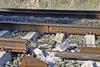
Spanish media confirmed on January 19 that an infrastructure failure was being investigated as a potential factor in the initial derailment, with investigators reportedly identifying a broken or damaged rail joint, amid suggestions that a 300 mm section may have broken out of the rail. Technicians reportedly told El Mundo that a ‘bad’ or ‘deteriorated’ weld was ‘more than likely’ the cause. Puente said this section of track had been refurbished in May 2025 as part of €700m investment, and was ‘supposedly in perfect condition’.
Track technology specialists have noted that cracks in the heat-affected zone of a welded joint are a known failure mechanism, and suggest that the rail may have broken under the leading vehicles of the Iryo train, with the damage being aggravated by subsequent wheel impacts until a section of the rail gave way.
I think we’re now able to build a pretty clear picture of the most likely mechanism of the train crash at Adamuz in Spain. pic.twitter.com/XuOD7UkFQv
— Gareth Dennis (@GarethDennis) January 19, 2026
Photographs of the damaged track indicate that the rear vehicles of the northbound Iryo train initially derailed to the right, away from the other running line. However, they subsequently moved left into the path of the southbound train, probably as the train passed over a facing crossover at the technical station. The collision is reported to have occurred around 20 sec after the initial derailment.
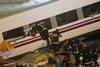
The high-energy impact deflected the four-car Alvia trainset to its right, towards the wall of a rock cutting, and the first two vehicles then rolled into a 4 m deep drainage ditch beside the line, sustaining severe damage. The rear vehicles jacknifed across the track before coming to a stand. The majority of the fatalities are understood to have been in the two leading vehicles, where 53 passengers were reported to have been travelling. The driver of the Alvia was confirmed to be amongst the dead.
The high speed line is expected to remain closed until at least January 23 while work continues to recover bodies and clear the wreckage of the two trains.