



SPAIN: Ongoing investigations into the high speed derailment and crash at Adamuz on January 18 have found further evidence pointing towards a rail break as being the primary cause of the tragedy, with the next phase of the inquest focusing on laboratory analysis of the rail section involved in the accident. Chris Jackson reports.
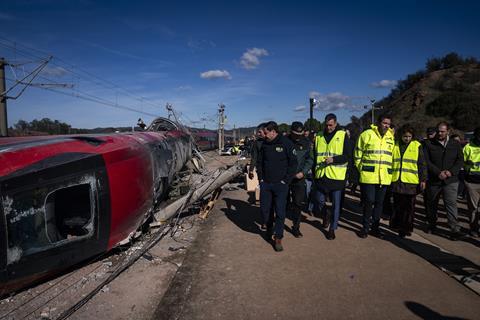
On January 23, Spain’s independent accident investigation body Comisión de Investigación de Accidentes Ferroviarios issued an interim note on its findings to date about the fatal crash at Adamuz on January 18. This saw two trains leave the track on the Madrid – Sevilla high speed line to the northeast of Córdoba, leading to 45 deaths.
CIAF said its working hypothesis was that a rail fracture had ‘occurred prior to the passage of the Iryo train involved in the accident and therefore prior to the derailment’. However, it cautioned that this hypothesis ‘should be considered provisional, pending verification through additional tests that are planned to be carried out’.
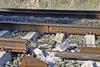
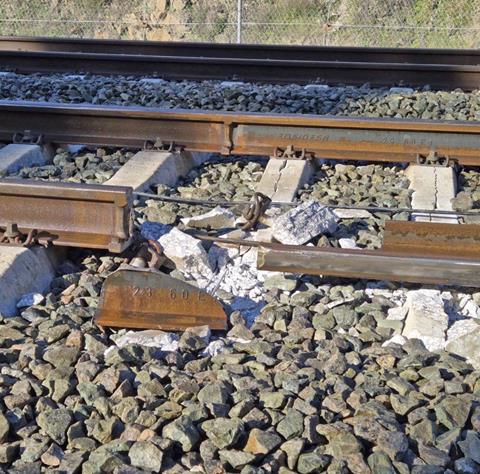
The report explained that the site where the Iryo train began to derail had been re-inspected on January 20, and a visual record made of the area where the rail broke, ‘corresponding to a weld between two rail sections’. Relevant rail samples had been sent for laboratory analysis, including sections of rail of 1 m in length on both sides of the breakage. A segment of rail about 400 mm in length that had become detached from the breakage area would also be studied, as would rail samples from areas not affected by the breakage, while a section from the other rail that did not fracture would also be assessed.
CIAF’s initial findings focus on the ‘notches’ found on the wheelsets of the Iryo train, and similar impact signs ‘with a compatible geometric pattern’ that had been found on three other trains that had passed over the site of the rail fracture prior to the derailment. Transport Minister Óscar Puente had earlier confirmed that damage had been found on the wheelsets of the leading coaches of the Iryo trainset which had passed over the defective track before the rear vehicles derailed.
Defective welding suspected
Soon after the accident, CIAF had asked infrastructure manager ADIF Alta Velocidad for a complete record of all trains using the Córdoba – Puertollano section of the high speed line over the two days prior to the derailment. According to the investigators, the leading right hand wheel of each bogie under coaches 2 to 5 of the Iryo trainset had significant tread damage including scarring and scratches. The damage to the wheels under coach 5 indicated that the rail had begun to overturn. Wheelsets on the three other trains exhibited similar tread damage approximately the size of a 50 cent coin.
The rail break is believed to have resulted from a defective aluminothermic weld, a short distance before the facing crossover on the approach to the Adamuz technical station. This led to the 400 mm section breaking out of the right-hand running rail under the repeated hammer blow from the wheelsets passing over the broken rail ends.
Although Puente insisted that the accident had not been caused by a ‘lack of maintenance’, questions are being asked about whether the rail welding had been unsatisfactory when this section of line was relaid and why any potential fatigue cracking had not been picked up during the inspection regime over the intervening months. Documents published by infrastructure manager ADIF and seen by Railway Gazette International show that dynamic non-destructive acoustic tests were carried out on the affected section on September 9 and October 13 2025, while ultrasonic testing took place on November 10.
Acccording to Puente, the 60 kg/m rail which broke had been manufactured in 2023 and installed during May or June 2025; he said he had in his possession the quality control certificate for this batch of rails. Although local media queried that the new rail had been welded to an older length manufactured in 1989 and not replaced, CIAF President Ignacio Barrón emphasised that this was not unusual and rails of that vintage should still be in good condition if maintained properly.
However, Barrón noted that the track spacing on the Andalucía high speed line, which opened in 1992, was only 4 300 mm, as on the first French LGVs. A spacing of 4 500 mm was subsequently adopted for later lines.
The laboratory analysis is expected to assess whether there was a material weakness in the newly laid rail itself, or in the heat-affected area of the welded joint. Rail supplier Arcelor Mittal told local media in northern Spain that while it was willing to co-operate with the ongoing investigation, it would wait for CIAF’s final report into the crash before addressing questions about possible manufacturing defects.
The Córdoba public prosecutor’s office has formed a working group to investigate the case, amid suggestions of irregularities involving AZVI. The Andalusian company was part of the consortium awarded the €700m track renewal contract in 2021, and reportedly had close links with former Transport Minister José Luis Ábalos and his adviser Koldo Garcia Izaguirre, who are currently in custody on corruption charges.
Meanwhile, a bogie from the Iryo-operated Hitachi S109 trainset was discovered partially submerged in the Tamujosillo stream, around 300 m from the site of the derailment and approximately halfway between where the two trains came to rest. Puente later confirmed that it came from the rear coach 8. The bogie is believed to have become detached following the derailment, and its trajectory is expected to provide investigators with information about the dynamics of the Iryo trainset during the accident.
Spanish train drivers have called a three-day strike on February 9-11 in sympathy for the deaths of three of their colleagues, which is being attributed to poorly maintained infrastructure. As well as the Alvia driver, a second RENFE driver who had been travelling on the S120 as a passenger with his family was killed. A third died in an unrelated accident on the evening of January 20, when a Barcelona suburban EMU ran into a section of retaining wall which had collapsed during heavy rain.
Accident timeline clarified
Information collected by CIAF, including data from the event recorder of the Iryo trainset, has brought further clarity to the timeline of the accident, confirming that there was barely 9 sec between the initial derailment and the collision between the two trains.
Iryo train 6189, the 18.40 from Málaga to Madrid, was formed of an eight-car S109 trainset carrying 289 passengers, plus the driver and four on-train crew. Train 2384, the 18.10 Alvia service from Madrid-Atocha to Huelva, was formed of a four-car Series 120 carrying 187 passengers. Of these, 40 had reservations in the leading vehicle and 13 in the second coach.
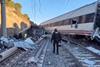
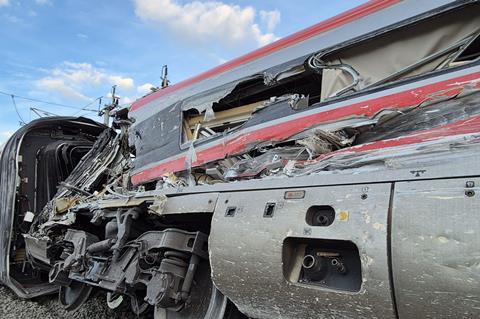
The rear three cars of the S109 were derailed at 19.43.40, and the collision with the other train occurred at 19.43.49. Bodyshell impacts show that the leading vehicle of the S120 struck the coupled ends of cars 6 and 7, which were fouling the southbound track. The eighth coach of the Iryo trainset was overturned by the glancing blow, which diverted the Alvia set to its right.
Systems at the Atocha control centre recorded that the traction current was lost at 19.43.45.
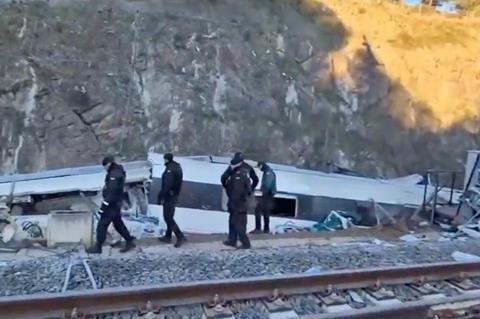
At 19.45.02 the Iryo driver called the control centre to report that the train had come to a halt due to loss of power, suggesting that it had become entangled with the overhead wire. The vehicles had been ‘plunged into darkness’, implying that the onboard auxiliary batteries were not working. At this stage the driver did not realise that the rear vehicles had become derailed, or that a collision had occurred.
At 19.46.07, the control centre received a call from the driver of northbound train 2181, which was following the Iryo service, reporting that it had also lost power and had therefore stopped.
On two occasions, at 19.48.39 and 19.48.51, the control centre attempted to contact the driver of the southbound Alvia service, without success. Control finally established contact with the S120’s train manager at 19.49.53. Although reporting that she was suffering from head injuries, the train manager said she would try to contact the driver, but she was unable to do so.
At 19.49.35: the Iryo driver asked the control centre to halt all traffic, having established that the train had been derailed, although still unaware of the collision, or the fact that the S120 had come to rest some 800 m further along the line. The control centre activated the emergency services at 19.50.
At 19.50 the Alvia train manager informed the control centre that passengers had been injured, and that the last two cars of the train were being evacuated. Calls from the train reached the Andalucía emergency services around 19.55.
According to the ministry, the Guardia Civil managed to locate the derailed S120 at around 20.15. The first medical team reached the Alvia at 20.30, and evacuation of the injured passengers started around 21.00, being completed at 23.00.
Supporting documents
Click link to download and view these filesCIAF interim report January 23 2026 (English)
PDF, Size 0.58 mb