






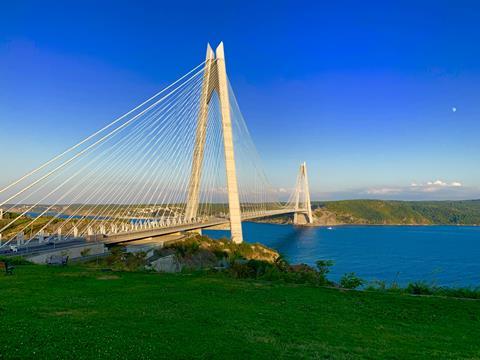
TURKEY: The government has reached preliminary agreement on US$6·75bn of financing for the construction of the long-planned Gebze – Halkalı railway bypass around Istanbul. This would create an uninterrupted freight and passenger corridor linking the country’s European and Asian rail networks via the Yavuz Sultan Selim road bridge which was built more than a decade ago with provision for a double-track railway.
On February 24 Minister of Transport & Infrastructure Abdulkadir Uraloğlu said the preliminary agreement for the largest external finance package for any Turkish rail project had been reached with the World Bank, the Asian Infrastructure Investment Bank, the Asian Development Bank, the Islamic Development Bank, OPEC International Development Fund and the European Bank for Reconstruction & Development.
No construction start date or completion timeline was announced. According to the public investment programme for 2026, the new line was scheduled to be developed in 2020-30 at a total cost of US$6·5bn, of which US$5·4bn was to be external credit.
Gebze – Halkalı railway bypass route
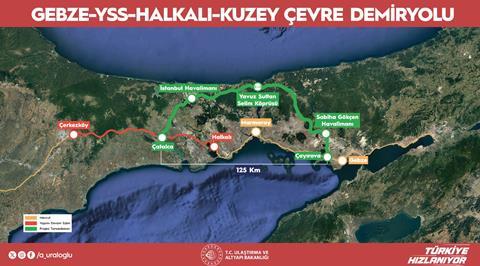
On the Asian side, the new line would start at Çayırova to the west of Gebze on the existing Istanbul – Ankara main line and the Marmaray suburban line. It would then loop north and west via Sabiha Gökçen Airport to the Yavuz Sultan Selim bridge.
In Europe, the new line would run around the west of Istanbul via the main Istanbul airport to Çatalca where it would connect with the Halkalı – Kapıkule line. This is currently being rebuilt as part of the Trans-European Transport Network; the EU agreed to part fund this project on the condition that Turkey pushed ahead with the Gebze – Halkalı bypass.
The bypass line will require the construction of 44 tunnels totalling 59·1 km and 42 bridges totalling 22·4 km.
Avoiding Istanbul
Once complete, the bypass would ease the movement of freight from Turkey’s Asian manufacturing heartlands as well as transit freight using the Middle Corridor route from China and central Asia to Europe.
Rail freight passing through Istanbul currently uses the Marmaray suburban rail tunnel under the Bosporus during a limited overnight window when maintenance work is not being undertaken.
The new line would also offer a high speed passenger link between Istanbul’s two airports and allow for direct passenger rail traffic across Turkey to Europe, without the need to pass through Istanbul.
According to Uraloğlu, once fully operating the line is expected to carry 30 million tonnes of freight and 33 million passengers every year.