




FRANCE: The first of up to 410 next-generation trainsets worth €3bn has entered service on Paris metro Line 10. Jérémie Anne reports.
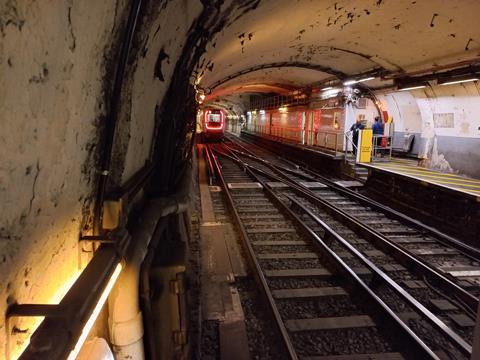
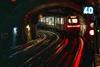
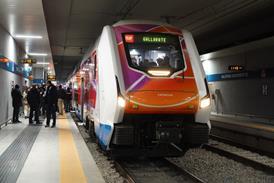
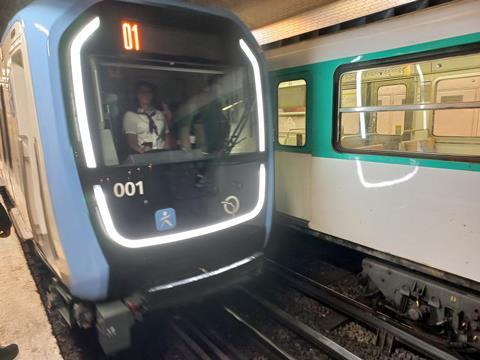
The renovation of the Paris metro fleet took a further step forward on October 16 with the entry into commercial service of the first MF19 trainset on Line 10.
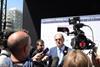
A launch ceremony marking the Alstom trainset’s début was held at La Motte-Piquet-Grenelle and attended by outgoing RATP Managing Director Jean Castex, President of Ile-de-France Mobilités Valérie Pécresse and Alstom Chief Executive Henri Poupart-Lafarge.
The arrival of the MF19 fleet kickstarts RATP and IdFM’s efforts to replace rolling stock on eight steel-wheel operated lines. The procurement of the MF19s began back in 2015, when RATP and its partners sought to develop a design that was standardised as far as possible, despite the variations in operating conditions across the eight lines.
In November 2019 RATP selected a 50:50 consortium of Alstom and what was then Bombardier Transportation to supply up to 410 steel-wheel trainsets to replace MF67, MF77 and MF88 sets on lines 3, 3b, 7, 7b, 10, 12 and 13.
The modular trainsets can be produced as four-car sets 61 m long, or as five-car sets in 76 m short or 77 m long variants.
They can be supplied with cabs for GoA2 semi-automated operation, with the possibility of conversion for GoA4 unattended operation.
The trains are being produced and assembled at the former Bombardier plant at Crespin, and at Petite-Forêt near Valenciennes.
Shorter dwell times
The differing train lengths of the various sub-fleets has been arranged to ensure compatibility with the train lengths of the rolling stock currently being used on the lines. The five-car MF19s are destined to replace the MF67 and MF77 trainsets on six lines, with the shorter four-car trains being deployed on the shuttle services on 3b and 7b. An extra bridge plate is fitted to the gangways of the 76 m trains to add the required 1 m of extra train length, says Matthieu Trenteseaux, head of the MF19 programme at Alstom.
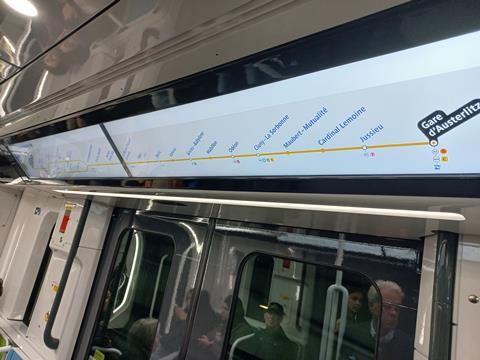
The walk-through trainsets feature the modern amenities increasingly expected by passengers, including dynamic passenger information screens, USB ports and LED lighting. Heating and air-conditioning equipment is fitted throughout, as is CCTV.
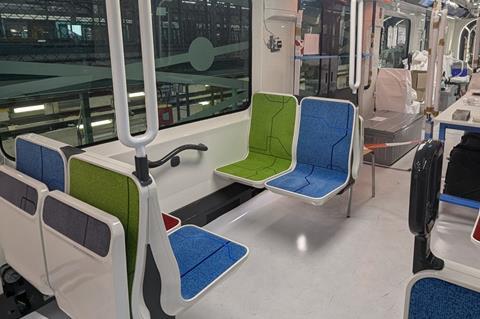
According to Stéphane Maillet, Head of Transport Systems at IdFM, the trains have been designed with two interior concepts available: a ‘comfort variant’, with 146 seats across the five cars, or a ‘capacity variant’, with 122. The two options are designed to reflect the different usage patterns of the various lines, and the length of journey typically made on each one. The overall capacity of the five-car sets is 590 in both variants.
Maillet told Railway Gazette International that a key area of focus for the designers has been the doors. The objective has been to work on the opening and closing process to ensure the shortest possible dwell time at stations; this is seen by RATP and IdFM as the major determining factor for overall line throughput. The wide doors supplied by Wabtec and spacious standing areas in each vestibule are intended to help passengers board and alight as quickly as possible.
Removable cabs
So far, a total of 147 MF19 trains have been ordered in two batches from the €3bn framework agreed in 2019.
The initial tranche comprised 44 trains for lines 10, 7b and 3b, with a follow-up option covering 103 trains for lines 8, 12 and 13. Côme Berbain, Director for Rolling Stock at RATP, says the future options could yet be amended, depending on the timescales for bringing the trains into service their reliability once in traffic, and the synchronisation of depot upgrades.
Automation of the network is an important consideration too. As with the internal design, the MF19 trains are being offered in two variants, with and without a driving cab. The driverless version will be fit for GoA4 operation, and this will be delivered for Line 13 initially. Meanwhile, RATP continues to roll out its Octys CBTC and traffic management platform across the various metro lines not yet fitted, including lines 8 and 12 for which resignalling contracts are due to be let in 2025.
The trains being fitted at the outset with a driving cab are designated MF19 CC, but as GoA4 capability gets rolled out across more metro lines, these will have the potential for conversion to the MF19 CA classification, for automated operation. The modular design of the trains means the cab itself can be removed and replaced with an extra set of bench seats, an emergency access area and forward-facing cameras, Trenteseaux explains.
The modular cab design was undertaken by IMF Ingénierie, which used 3D modelling to ensure driving desk ergonomics and structural strength requirements were met.
Asset enhancement
Alongside the rolling stock acquisition itself, IdFM is funding €4bn of infrastructure enhancements and modifications to support the fleet renewal programme. This includes €800m that is to be spent on depot and servicing provision for the MF19s.
Two entirely new depots are planned, at La Courneuve (serving lines 7 and 10) and at Créteil (Line 8). Meanwhile, a major refit of depots at Vaugirard, Chatillon and Saint-Fargeau are also planned, with major expansion of some sites and wholesale rebuilding of others.
According to Berbin, the ‘walk through’ nature of the new trainsets means key components can be spread though the train, usually on the roof or in under-seat boxes. This means HAVC, lighting and onboard technology components must be accessible along the length of the trains at each depot. In addition, the trains are fitted with condition monitoring tools for key components, which send data back to the depot for further analysis.
This digitalisation of maintenance marks a wholesale shift in how the Paris metro is maintained, believes Berbain. When all 410 trains are in service, they are likely to generate 1 TB of data every day, he adds.
Phased introduction
RATP and IdFM say that a ‘highly phased and structured’ delivery and commissioning programme is envisaged for the new trains. If all goes to plan, the aim is for the MF19s to take over operation of one line per year from now until deliveries are completed in 2033.
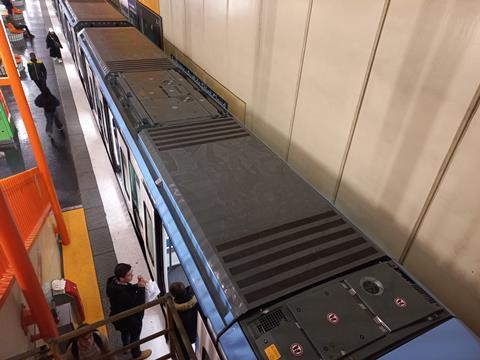
Pre-series operation is envisaged on each line, with Line 10 serving as the initial proving ground.
Five trains are to be introduced progressively onto the line over the coming months, with Berbain noting that ‘only 10% of the testing required is line-specific, and that concerns issues like electromagnetic interference’. He adds that ‘even if we know our network perfectly well, we cannot hide from unforeseen eventualities’. Typically, the first MF19s will run in trial operation a year ahead of series deployment on a given route. Line 13 will be the next in line, with initial MF19 runs beginning in early 2026 for series roll-out in early 2027.
Delivery of the trains from Crespin will ramp up in the mean time, with road and rail haulage both being used to deliver the trains to Paris. Freight operator Hexafret has a contract to haul the trains to RATP’s La Villette workshops, which has the sole connection linking the metro network with the main line railway.