

This week’s round-up of news from the urban transport sector.
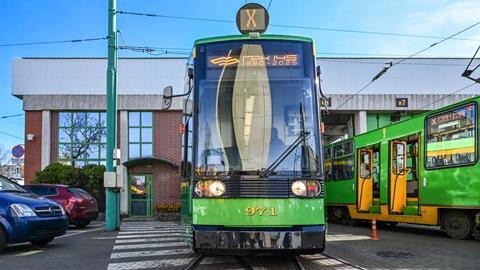
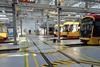
On November 23 MPK Poznań put into service the first of 24 secondhand Duewag/Siemens NGT6D trams dating from 1994 which it purchased from Bonn in December 2024. The price paid for each tram is subject to its condition, with a maximum of €46 500, and so far eight have been delivered as they are gradually replaced in the German city by low-floor Škoda ForCity Smart Bonn trams. They will replace MPK Poznań’s ageing high-floor Konstal 105Na trams.
Construction of a 3·9 km northern branch of Seoul’s Ui LRT underground light metro from Solbat Park station to Banghak was launched with a groundbreaking ceremony on November 24. It is being built by the HL D&I Halla with opening scheduled for 2032 at cost of 469bn won.
Italy’s national road and railway safety agency ANSFISA has issued a decree to create a national framework for tram-train operations, where services would use both tramway and main line railway tracks.
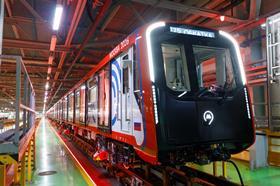
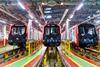
Moskva metro has begin testing running with the first TMH Metrowagonmash Moskva-2026 trainset ahead of entry into service on Line 2. ‘The Moskva-2026 train sets are the most modern Russian trains, made from domestic components’, said Deputy Mayor for Transport Maksim Liksutov. ‘Over the next two years, more than 700 new cars are planned to be delivered, which will allow us to complete the renewal of trains on the Line 2.’ The design is based on the Moskva-2024 fleet with minor updates. These include a new headlight design, with a feature to automatically decrease light intensity when entering a station. The colour of the cab interior will also be updated, and transparent monitors are to be built into side windows.
The 1·7 km, one-station western extension of Shanghai metro Line 2 from National Exhibition & Convention Centre to Panxiang Road/Shanghai National Accounting Institute opened on November 1.
The European Investment Bank has renewed an agreement with the International Association of Public Transport covering co-operation in decarbonisation, strengthening the European economy and enabling digital transformation in the transport sector. ‘Renewing our partnership comes at a pivotal moment for Europe’s urban mobility. As cities work to decarbonise, strengthen their competitiveness and embrace digital transformation, public transport must lead the way’, said UITP Secretary General Mohamed Mezghani. ‘By combining UITP’s global network and knowledge with the EIB’s financial and advisory expertise, we can accelerate innovative, sustainable and affordable mobility solutions that make our systems more resilient and future-proof.’
Zürich narrow gauge Line S18 operator Forchbahn is modernising its passenger information systems using PEAK.TMS from Berlin-based software provider Peak Mobility. This will provide unified real-time control of passenger information, integrated with other operators including ZVV, the ILTIS control and information system from Siemens Mobility, and with central data hubs such as SBB’s Customer System and the Visual Inspection System which monitors train operations via GPS tracking.
Egypt’s National Authority for Tunnels has started construction of Sheikh Mansour infill station between Ezbet El Nakhl and El Marg on Cairo metro Line 1.
South Australia’s Department for Infrastructure & Transport has added Adelaide tram services to the IVU Traffic Technologies IVU.rail software platform used for managing rail operations. More than 100 vehicles are now planned, dispatched and operated entirely using the software, with integrated processes for network and timetable planning, duty scheduling and personnel dispatch.
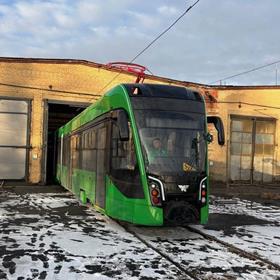
Russia’s UKVZ has delivered the first of five three-section LRVs for the initial phase of the Chelyabinsk ‘metrotram’ network which is currently under construction. Three lines are scheduled for completion in 2027, with a planned fleet of 32 vehicles.
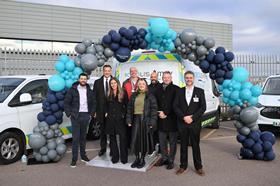
KeolisAmey Docklands which operates London’s Docklands Light Railway is working with leasing company DriveElectric to transition its entire car and van fleet to Ford electric vehicles by end of 2025. The legacy petrol and diesel fleet has been replaced with 39 electric vans and six electric cars, including specialist vehicles that have typically been challenging to electrify such as vans with tail lifts and flatbeds.
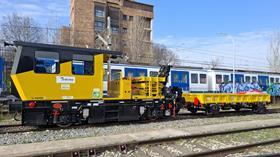
Uromac Systems is to work with SEMOP on a €40·5m contract to supply Metro de Madrid with 16 diesel-battery infrastructure maintenance vehicles. These will have a crane and elevating platform for overhead line works, along with eight wagons. Barcelona operator TMB has also ordered two Uromac battery vehicles for €5·5m.
London Underground has directly awarded Dellner Ferrabyrne a £7·4m contract to supply OEM bogie air springs for the Victoria Line 09TS fleet.