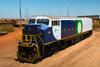







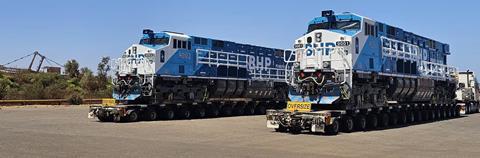
AUSTRALIA: Mining company BHP has taken delivery of its first purpose-built battery-electric heavy haul locomotives for trials between its Pilbara iron ore mines and Port Hedland.
Each of the Wabtec locomotives features a 7 MWh battery system which is charged using power regenerated during braking on the downhill runs.
Wabtec’s Regional Senior Vice-President for ANZ&SEA Peter Thomas said ‘these FLXDrive locomotives are purpose-built to perform in one of the world’s most demanding environments, combining advanced battery technology and regenerative braking to deliver high efficiency and lower emissions’.
BHP will work with the supplier to assess the performance and emissions reduction capabilities of battery traction in real-world consitions to support the planned electrification of its iron ore fleet, which currently comprises more than 180 high horsepower diesel locomotives.
‘It’s incredible to see these battery-electric locos in Port Hedland — the first new models in Australia, and representing years of planning, problem solving and partnership’, BHP Western Australia Iron Ore Asset President Tim Day said on November 14. ’It marks the beginning of an important trial to understand how this technology can help us reduce diesel use, lower associated operational greenhouse gas emissions and improve efficiency across our rail network.
‘The Pilbara has always been a place of big ambition, and these locomotives represent the kind of innovation that is needed to keep the region firing.’
BHP has also ordered two EMD Joule battery locos from Progress Rail for assessment.
- Earlier this year Fortescue cut most of the team which had been developing its Infinity Train concept for battery locos to store regenerated braking energy on the downhill leg and use it power empty trains on the uphill leg. Studies found insufficient energy would be generated, and increasing the number of battery locos or installing partial electrification was deemed to be too disruptive to operations.