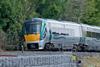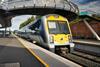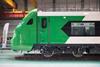



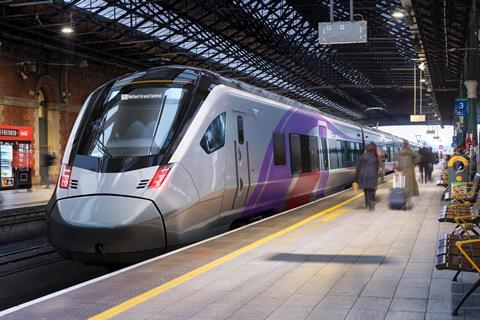
EUROPE: Ireland’s national railway Iarnród Éireann and North Ireland’s Translink have jointly selected Stadler from the three bidders for a contract to supply trainsets to replace locomotive-hauled rolling stock on the cross-border Dublin – Belfast Enterprise service.
Stadler had been informed that it was the preferred bidder in mid-September, but the award process was delayed when rival bidder CAF launched a legal challenge during the standstill period prior. The injunction sought by CAF was lifted at the High Court in Dublin on November 26, with the court noting the time-critical importance of securing EU funding contributions and also accepting that there is an urgent need to address emissions and improve accessibility.
Electro-diesel Flirt trainsets
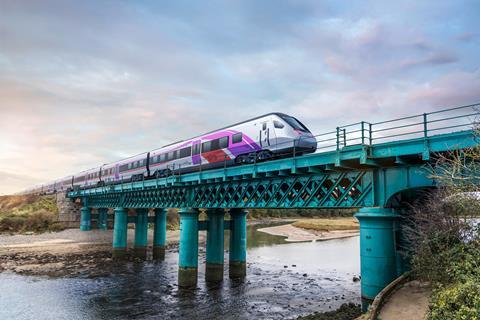
The order being placed through a joint venture of Iarnród Éireann and Northern Ireland Railways covers the supply of eight trainsets as well as simulators, plus separate 15-year service and support maintenance agreement which can be extended by a further 15 years.
The trainsets wil be based on Stadler’s proven Flirt platform. They will be capable of operating on the 1·5 kV DC electrification from Dublin, and in diesel mode elsewhere. Onboard traction batteries will be capable of powering the trains for short distances. These are expected to be used around Belfast’s Grand Central station and to York Road depot, which will be the principal maintenance facility for the fleet.
Two diesel engines will be installed in the driving vehicle at one end of a unit, creating a power car and avoiding the use of underfloor engines. Whilst both engines will normally provide power, it is expected that a single engine will be capable of delivering sufficient traction to maintain performance in the event of any failures.
There will be eight motors powering four bogies, two under intermediate vehicles and two located under the other non-articulated driving vehicle.
The design of the power car will allow for the future replacement of the diesel engines and fuel tank with pantographs and a transformer in the event of the Northern Irish network being electrified at 25 kV 50 Hz.
Passenger facilities
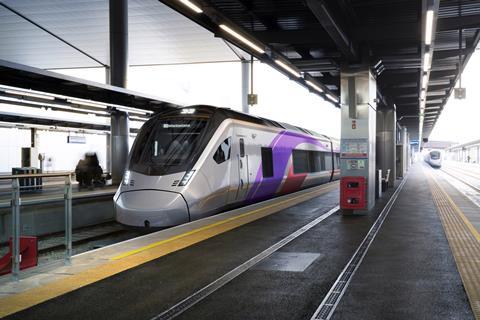
While some design elements are still to be formalised, it is expected that eight of the passenger vehicles will be formed as articulated pairs.
Passenger access will be via a single, wide doorway and vestibule located at the mid-point of each vehicle, where a movable step will extend to the platform to allow level boarding. Every carriage will feature a low floor area.
The specification for the trains specifically refers to a high level of seat comfort. There will be a mix of bay and unidirectional seating, with six wheelchair spaces in PRM areas located away from the toilets to give a more inclusive experience.
The trains will be fitted with eight toilets, two in first class, five in standard and one for catering and onboard staff use; two will be PRM-TSI compliant. The trains will also have six reservable bike spaces.
Catering provision will build on that provided on the current locomotive-hauled trains, with an at-seat service of hot meals in first class and a bar-bistro and trolley service provided for standard class passengers.
The cabs will be based on an existing Flirt design with a centrally located driving position and a seat for a second person. The trains will have ETCS and the UK’s TPWS safety systems. They will be capable of selective door opening, and the driver will be supported by 22 external CCTV cameras.
Delivery timescale
Delivery of the first sets for testing is expected to be in 2028 with entry into service in 2030, enabling the withdrawal of the existing Class 201 locomotives and De Dietrich coaches.