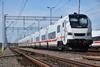
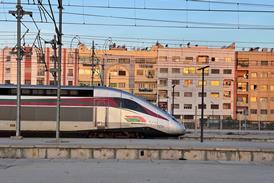





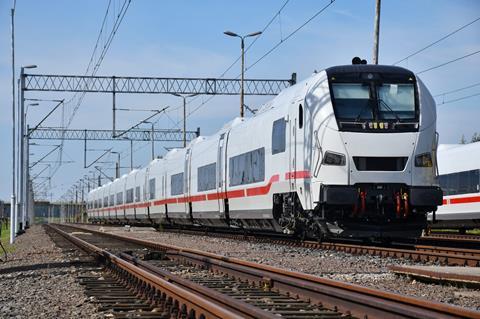
GERMANY: Deutsche Bahn says its Talgo-produced ICE L fleet will enter domestic service from December’s timetable change, but it will not confirm how many trains it now expects to be delivered.
On August 11, the Spanish manufacturer and German national operator announced that the trains had received certification for operation in Germany, paving the way for a formal unveiling of the train in Berlin in October before four trains enter service in December. DB said that they are initially to be deployed on Köln – Berlin services.
Ordered from 2019 onwards, the low-floor trainsets were initially planned to carry passengers from 2023.
A variant of the Talgo 230, the ICE L was at first known as the ECx when DB agreed a framework contract for up to 100 trains. An initial firm commitment to 23 sets worth €550m was followed by a further order for 56 trains in 2023. At €1·4bn, the latter tranche made up Talgo’s biggest ever order.
An ICE L coach was displayed at Berlin’s InnoTrans trade show in 2022, and vehicle testing began in Germany and Austria the following year. Initial delays to the planned service entry — at first to 2024 — were largely ascribed to the Covid pandemic.
Asked in July when it expected the ICE L to enter passenger service, Talgo said it would ‘not comment on specifics on the project development’ but ‘can only advance that the first trains have already reached Talgo facilities next to Berlin Ostbahnhof’.
It added that the ‘main reasons for the 2019 order being delayed have already been publicly stated, with several disruptions caused by several external causes including the Covid-19 pandemic and the supply chain crisis. This led to a revised calendar.’
Low-floor cars
Intended to replace DB’s locomotive-hauled inter-city vehicles that date from the 1980s, albeit with subsequent modernisation, the ICE L has a 760 mm floor height, offering step-free access; the ‘L’ in the name stands for ‘low-floor’.
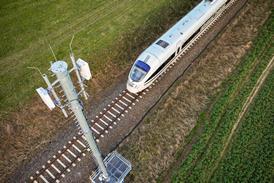
The 230 km/h push-pull trains are to run in rakes of 17 vehicles including a driving trailer, offering 477 Second Class and 85 First Class seats across a length of 236 m, not including the locomotive. Each set is to include a Bistro car, family areas, a PRM vehicle with three wheelchair spaces, and eight cycle spaces in the driving trailer. Windows are made from ‘mobile friendly’ material, to allow improved phone reception onboard.
The trains feature extruded aluminium construction, giving a claimed typical 30% weight saving over conventional vehicles, and articulation using the manufacturer’s distinctive stub-axle trucks.
Traction options
The ICE L sets are planned to be powered by Talgo’s Travca multi-system electric locomotives, of which 79 have been ordered. These are designated Class BR105 by DB; they were first tested in 2023 and a locomotive was displayed at InnoTrans in 2024. Their ability to draw power at 25 kV AC, 15 kV and 1·5 kV DC would facilitate international operation.
The ICE L coaches are also compatible with Siemens’ bi-mode Vectron locomotives, allowing the trains to be used on non-electrified lines; DB placed a contract for 21 Vectrons in 2022, the first order of the dual-mode version for passenger use.
As the Talgo locos are not now expected to be ready for service until later in 2026, the first trains are expected to be powered by Siemens Vectron locomotives.
A plan published by DB in 2023 envisages extensive domestic use of the ICE L, including over routes to heavily tourist-frequented destinations such as Oberstdorf in Bayern and Westerland on the North Sea island of Sylt. Neither of these lines have overhead wires.
In addition to domestic routes, the ICE L is intended for use on international routes, and in particular on the Berlin – Hannover – Amsterdam corridor. When the trains were ordered, DB anticipated that removing a need to change locomotives at Bad Bentheim on the German-Dutch border would contribute to a roughly 30 min time saving, reducing end-to-end journey times to 5 h 50 min.
However, since then, leased multi-system locos approved for both countries were deployed hauling legacy coaches on this route as an interim measure, and since June DB has been using its latest ICE 3neo Siemens Velaro MS high speed trains. Other published proposals also include the use of ICE L formations on services between German cities and Wien and København.
However, reports of a possible reduction in ICE L orders due to the trains’ delayed entry into service have not been confirmed by DB. The operator told Railway Gazette International in July that it would not comment on contract details.
Other orders
Although DB’s order remains the largest single procurement of the type, Talgo 230s have been selected by operators in various countries, including Egypt, where the first batch of six sets entered service five months ahead of schedule in December 2022.
An initial rake delivered to Denmark for testing was unveiled in January 2024, the year after DSB doubled its initial 2020 order from eight to 16 trains.
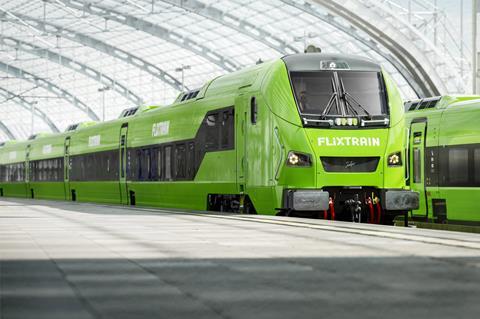
Most recently, German open-access operator Flixtrain agreed a framework contract in May for up to 65 Talgo 230 sets, with an initial firm order for 30 valued at roughly €1·06bn. If fully realised and including 15 years of maintenance, the deal could be worth circa €2·4bn. This contract does not include the supply of locomotives; the operator is expected source Siemens Vectron locos for traction.
‘We are planning to increase our network significantly in the next years and we are also planning to add even more cities in Germany and around Europe’, a FlixTrain spokesperson said.
FlixTrain has not yet published when it expects to introduce its Talgo 230s into service, but that company said it was ‘confident that the timeline we have agreed with Talgo and Siemens will be kept, and we will start operations as planned’.