UK: Agentic AI, accessibility and risk appetite were key themes at the inaugural YRP Innovation Conference in London on March 10.
Organised by networking and development organisation Young Rail Professionals and held at the Rail Safety & Standards Board’s offices, the conference sought to build on the recent Rail 200 celebrations by looking much further into the future, culminating in a panel discussion which asked if trains will even be needed in another 200 years.
GBRX will follow what works
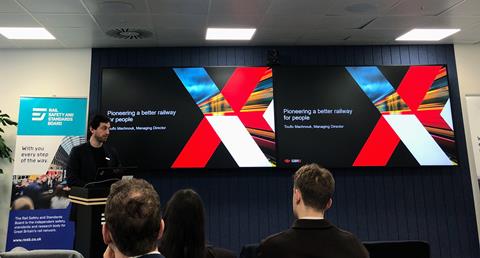
Keynote speaker Toufic Machnouk, Managing Director of GBRX, set out his views on the nature of innovation in the rail sector while touching on the aims of the emerging strategic innovation body he leads. Developed as part of the government reform programme that is creating Great British Railways as a ‘directing mind’ for the industry, GBRX is intended to overcome what Machnouk termed ‘the institutional barriers that make it hard to innovate in our industry’.
He said GBRX was taking cues from the Google X innovation hub and similar US technology sector initiatives ‘by trying to overcome with purpose’ and ‘seeing what works’. Insisting that ‘you can’t innovate without doing things’, Machnouk urged the audience to ‘remember their five year old selves’ because young children ‘are not weighed down with a whole set of assumptions about the world’.
This willingness to challenge assumptions was a key responsibility of younger staff in the sector, he added, emphasising that those early in their career should ‘surround themselves with as many of the most experienced people as they can’. This, he hoped, would foster a culture where innovative proposals can be tested from a position of expertise about what the railway needs. ‘Today, the rail industry has more pilots than British Airways’, he joked.
Machnouk briefly touched on current work packages being investigated by GBRX. These included assessing how AI and advanced data tools could be used to ease the flow of information through the supply chain in procurement programmes, reflecting recent legislative changes to the Procurement Act. ‘We are developing a future business unit driven entirely by AI workflows just to see what that looks like’, he added, suggesting this would then be tested against some of ‘the industry’s biggest challenges like ticketing systems and asset management’.
A defining moment
Fellow speaker Hayden Bartlett-Tasker, CEO of video inspection company CrossTech, urged the rail sector to understand the magnitude of change that AI would bring not just to the industry, but to the societal assumptions that underpin it.
He argued that ‘fundamental shifts’ driven by technological change mean that ‘people may no longer need to come to offices like this in the future’, even if there has been pressure applied by some businesses to urge staff to return to office locations around the world in the post-pandemic period.
Suggesting that Agentic AI tools could be as powerful a socio-economic change as the arrival of the web in the mid-1990s had ultimately proved, Bartlett-Tasker asked if the rail sector had yet started to consider ‘if its future customers will be AI agents and whether its systems are set up to manage that’.
Typically, the term Agentic AI refers to largely autonomous tools that are built into a device to undertake specific tasks within a given set of parameters without the need for prompting, as existing AI chatbots often do. ‘This technology will be normal within about six months’, he predicted, meaning AI tools could effectively be making decisions about the mode of transport customers might choose for a given journey. He urged delegates ‘not to let other industries innovate around rail’, and that the answer to the challenge was ‘not to be defensive, but to embed the technology in our systems’.
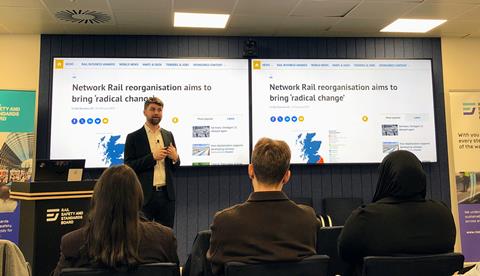
In a subsequent presentation, Greater Anglia Engineering Director Ben Parry cited work the operator was doing with the University of Huddersfield’s Institute of Railway Research to assess the potential for robots to be used to support the automation of routine rolling stock servicing tasks such as emptying toilet tanks.
Slush
However, embracing innovation and becoming attractive to technology investors remains a work in progress, the event was told.
Universal Signalling Chief Executive Stephen Head reported that he had now made two visits to the high-profile Slush event in Helsinki, which is effectively a marketplace for start-ups to seek angel investors and venture capitalist support. ‘Out of 7 000 people there, I only found three who were involved in rail’, he said.
‘In rail we often tend to invest in technology to make small changes and in innovations that we think will probably work’, he added, suggesting that a more nuanced appetite to risk and possible commercial failure might help the industry to secure more private-sector support.
Accessibility priority
The conference included a panel session that asked current YRP leaders about how they saw the rail sector’s priorities form the perspective of a cohort of future leaders.
While there was a broad consensus that rail’s inherent green advantages and its ability to move high volumes of passengers and freight efficiently meant it would remain relevant in an era of rapid societal change, there was a clear desire to address endemic problems facing the industry too.
Of these, accessibility emerged as a priority. Outgoing YRP CEO Bonnie Price felt it was essential that people with mobility issues could travel ‘like any other passenger, paying the fare and complaining about the same delays as everyone else’. At most UK stations, there is no ability to reach the platform or the train in a step-free manner, while there have been high-profile problems with station assistance initiatives intended to ensure staff are available to help disabled passengers board and alight from trains. Price described the current situation as a ‘lottery’.