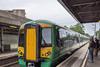
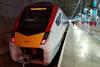
The reinstatement of 15-year old Class 379s for London suburban services is adding much-needed capacity for three train operators, but the programme logistics are challenging. Chris Jackson reports from Hornsey.
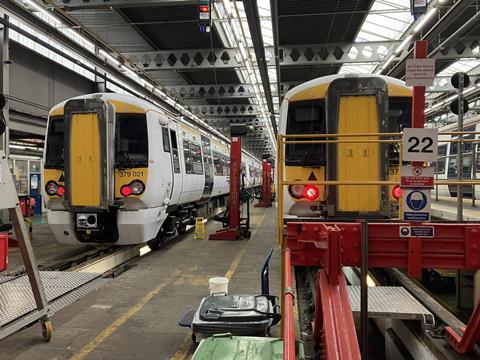
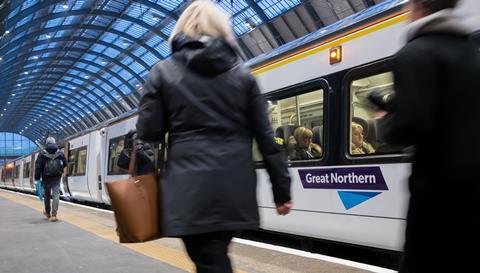
Work is in full swing at Hornsey depot in north London, where Govia Thameslink Railway is recommissioning a fleet of 30-four car Class 379 EMUs for use on its Great Northern branded outer suburban services. Due to be completed by March 2026, the project is intended to provide additional capacity for the Southern and Southeastern networks as well as Great Northern, thanks to a complex cascade of rolling stock between operators.
Owned by the Govia joint venture of Go-Ahead (65%) and Keolis (35%), GTR is the largest of the London suburban operators. It is responsible for the Great Northern, Thameslink, Southern and Gatwick Express businesses, which have been run under a series of contracts from the Department for Transport since September 2014
Engineering Director Steve Lammin explains that GTR ‘lost a lot of rolling stock’ during the Covid 2019 pandemic. More than 90 three- and four-car EMUs of classes 313, 455 and 365 dating from the 1970s, 1980s and 1990s went for scrap without replacement as DfT sought to reduce costs in the face of plummeting ridership. Running shorter trains allowed other stock to be redeployed to cover the gaps, but once the traffic began to return, the operator needed to add capacity quickly.
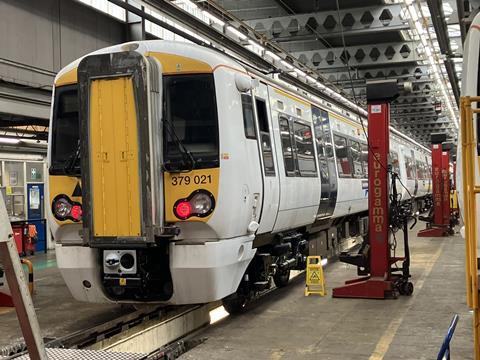
Having obtained DfT consent to augment its fleet, GTR went out to tender in 2023 for additional vehicles that could be introduced rapidly. Its fleet is dominated by Bombardier-built Electrostar EMUs, with several variants of Class 377 operating on the Southern routes and the later Class 387 derivatives mainly deployed across Great Northern and Gatwick Express services. Both types include dual-system units suitable for 750 V DC and 25 kV 50 Hz operation, although many of the 377s are third-rail only.
Lammin comments wryly that it might have been nice to take over the Class 387s used by Great Western, but that would in turn have required GWR to find a new fleet. The obvious alternative was the Class 379s, which were then being stored in Nottinghamshire after coming off-lease from Greater Anglia. The key element was to put together a commercially viable proposal, and the best bid came from Porterbrook, which already owned the majority of GTR’s Electrostar fleet.
A chequered history
The Class 379s were originally supplied to Greater Anglia for use on the West Anglia routes from London Liverpool Street to Stansted Airport, Cambridge, Ely and Kings Lynn. Ordered in 2009 at a cost of £155m, they entered service from 2011. However, a subsequent franchise change saw the incoming Abellio-led consortium commit to a complete replacement of the GA fleet, and all 30 sets were taken out of service in 2022.
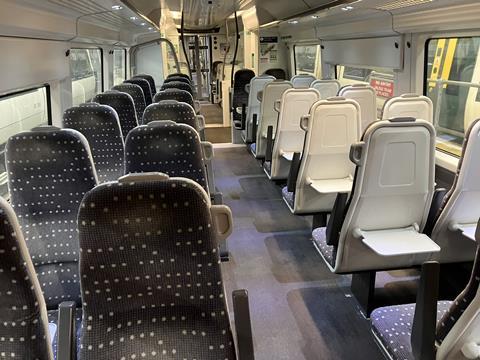
Although part of the Electrostar family, the Class 379s incorporated a number of technical changes from the original design developed in the late 1990s, making use of technologies being developed for the next-generation Aventra platform. These included a revised body structure to meet European crashworthiness requirements and an interior layout with 2+2 seating compatible with the Persons with Reduced Mobility TSI.
More significantly, the next-generation control systems and IP-based train management backbone mean that the 379s cannot operate in multiple with the Class 387s, which although built later were specified to be backwards-compatible with the Class 377s and have standard Electrostar equipment. However, the two classes can be coupled mechanically if necessary.
The Class 379s were initially funded by CBRail, but subsequently passed to Lloyds TSB with its takeover of HBOS group. They were then sold to Macquarie European Rail, whose assets were in turn purchased by Akiem in April 2020. At the time that GTR went out to tender, they were the only passenger vehicles owned by the French leasing group, which has focused primarily on electric freight locomotives for use in mainland Europe. However, Porterbrook agreed to buy them at an ‘attractive’ price, as part of its proposal for getting the trains back into service.
Refresh and overhaul
When the Class 379s were taken out of service, Akiem insisted that Greater Anglia handed them back in ‘pristine’ condition. The units were put into what project lead Chris Hook describes as ‘semi-warm storage’ with Harry Needle Railroad Co at Worksop (now part of Swietelsky). As the yard is not electrified, the leasing company arranged for each unit to be hauled to nearby Doncaster every 16 weeks so that the pantographs could be raised and the 25 kV electrical systems checked over — although the units did not operate under their own power at that time.
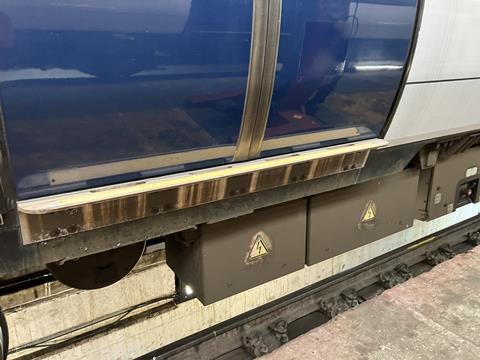
The 379s are now being put through Hornsey for recommissioning, and GTR reports that most have arrived in a relatively good condition. While in store, each coach was fitted with silica gel dessicants as used to absorb interior moisture in shipping containers. Despite that, there has been some evidence of minor corrosion, along with damp and mould on some seats and carpets,.
Faced with pressure to get the units back into traffic as soon as possible, the GTR project team developed a ‘recommissioning exam’ to identify essential work and a simple refresh programme to address interior cleanliness. Electrical components, filters, compressors and brake valves were removed for off-site overhaul as necessary. The bogies from each unit are being swapped out and sent to the Alstom plant in Crewe for attention.
Meanwhile, GTR also had to restart the regular maintenance examinations. While some aspects are mileage-based and could essentially be put on hold while the vehicles were in store, other time-based elements needed to be addressed as a priority. As a result, the project team has taken a mix-and-match approach based on the condition of individual units as they are delivered from Worksop and their place in the examination cycle. In what Hook calls a ‘bite-sized chunks’ strategy, some units have only had a minimal refresh before being put into traffic, but will be taken out of use later for further attention. Others are getting a more comprehensive overhaul before going into service.
To make space for the work in the relatively compact Hornsey depot, GTR’s train planners rearranged some diagrams to stable the operational fleet elsewhere. As each Class 379 is commissioned, it goes into service for an initial running-in period, but some sets have since been stored locally pending the next step in the rollout programme.
Meanwhile, the operator is undertaking an intense programme of driver training, covering around 360 staff at six depots. As the 379s are relatively similar to the 387s, a one-day conversion course is sufficient, although the drivers then need to be rostered to work the trains on a regular basis to maintain their competence.
Complex cascade
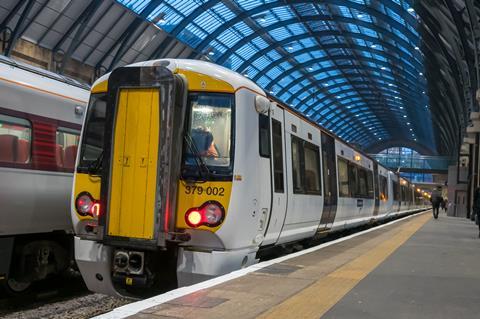
Under the plans agreed with DfT, GTR will take all 30 of the Class 379s, but release many of its Class 387s to Southern, allowing the transfer of Class 377s from there to Southeastern to help replace that operator’s ageing Networker fleet. Lammin notes that there is not a lot of slack in the programme, which is very much ‘timetable-led’.
The cascade began in November 2024, when Great Northern released five 387s to Southern, which in turn sent two 377s to Southeastern ahead of the December 2024 timetable change. The first six Class 379s entered service with GN from February 10 2025, initially working in pairs on some peak-only diagrams to minimise operational impact. Testing is now underway for the operation of 12-car formations using three 379s in multiple.
A further six Class 387s were released to Southern for the May 2025 timetable change, allowing that business to cascade seven 377s to Southeastern — an eighth is due to follow in September.
The Hornsey team is now focusing on having 10 more Class 379s recommissioned by November, in time for the December 2025 timetable change, as well as completing the refresh and periodic exams on some of the earlier units. December is due to see another 10 Class 387s moving to Southern, leaving just 14 at Great Northern for the longer term. Southern will then release a final three 377s to Southeastern.
Full fleet deployment is envisaged by May 2026. At the end of the project, GTR will have an extra six EMUs at Great Northern and 11 at Southern, while a net 13 trains will have moved to Southeastern.