






News that Keolis intends to abandon its passenger rail operations in Germany from the end of this year suggests that the long-standing model chosen for regional and local rail services may no longer be fit for purpose.
Coming on top of the financial woes being experienced by Netherlands Railways subsidiary Abellio GmbH, the announcement has triggered alarm bells among transport planners in federal and regional government. Not least because Abellio, Keolis and other independent operators such as Transdev, National Express and Go-Ahead are now responsible for providing 53% of all contracted regional and local train-km.
It was perhaps to be expected that operators would suffer when traffic plummeted during the Covid-19 pandemic. This precipitated a crisis for those operators with no sympathetic government to provide financial support, but it was just the latest in a long list of woes that have been accumulating over recent years. According to Handelsblatt, a ‘ruinous’ contract award system is primarily to blame; other commentators have suggested that bidders may have contributed to their own downfall by offering ‘dumping prices’ to win the contracts.
The contracting out of regional services over the past two decades has triggered a massive investment in new rolling stock, allied with reduced support payments per train-km that allowed an increase in the level of service provided. But while the number of train-km provided on regional services increased steadily from around 590 million in 2000 to 685 million in 2018, so did the overall subsidy. From an average of around €6∙5bn to €7∙5bn a year in 2000-15, payments rose steeply to €8∙2bn in 2016. The figure for 2021 is put at €10∙3bn, but that includes one-off federal grants reportedly totalling €3∙5bn which are intended to cover half the cost of pandemic-related losses.
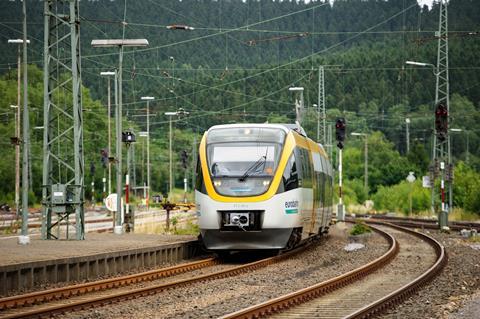
Keolis pulls out
On October 8 Keolis informed Agence France Presse that it had reached a preliminary agreement with the Rhein-Ruhr organising authorities Zweckverband Nahverkehr Westfalen-Lippe and Verkehrsverbund Rhein-Ruhr to transfer its stake in Keolis Deutschland to a new shareholder. ‘This agreement in principle, obtained following a constructive dialogue, constitutes an important step because it aims to ensure full continuity of operations, thus not leading to any change for travellers and employees of Keolis in Germany’, the company explained. It provides for ‘a transfer of capital and operations to a new shareholder by the end of 2021, leading to the group’s withdrawal from railway activity in Germany’.
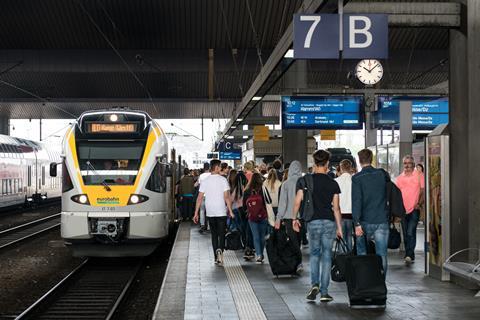
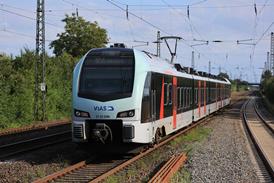
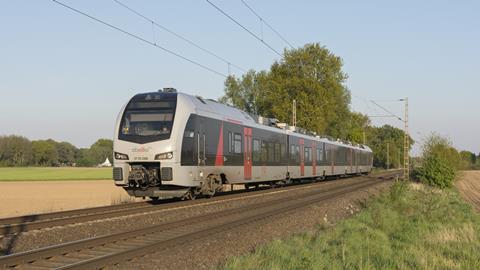
Owned 70% by French national operator SNCF, Keolis has been active in the German market since 1999, operating under the Eurobahn brand. It currently runs the Maas-Rhein-Lippe-Netz, which includes cross-border services into the Netherlands, Ostwestfalen-Lippe-Netz, Teutoburger Wald-Netz and four routes forming the Hellweg-Netz. The MRLN and OWL contracts are due to run until 2025, with HWN concluding in 2030 and TWN in 2032.

Financial problems were evident long before Covid-19, with the group’s International CEO Bernard Tabary acknowledging in mid-2020 that ‘in 2019 the deficit of our activities in Germany was very high, too high’. One reason for this, he suggested, was that contracts are typically agreed several years before the start of operations to allow for rolling stock procurement. Another issue is that staff do not automatically transfer from one operator to another, and recruiting sufficient train drivers has proved to be a major challenge for several of the contract operators. But Tabary also pointed to difficulties in obtaining paths, and penalties for late or cancelled trains, even where the operator was not to blame, had exacerbated an already tenuous situation.
The company’s decision to quit Germany would come as no surprise to former Executive Chairman of Keolis, Patrick Jeantet. Soon after his appointment, he told Ville Rail & Transports in early 2020 that the German business was the group’s biggest loss-maker. Criticising the contracts, he suggested that a change of strategy was needed, but in the event Jeantet had no time to act before he was ousted from Keolis on June 2 the same year.
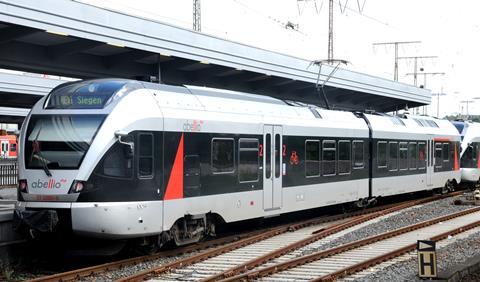
Abellio in trouble
Abellio was originally a German company, being founded in 2004 as a subsidiary of the then Essen public transport operator EVAG, with a view to entering the emerging regional market. The following year UK investment company Star Capital Partners acquired a 75% stake from the city government, but at the end of 2008 both partners sold out to NS.
Active in the market since 2005, Abellio has acquired operating contracts in Nordrhein-Westfalen, Baden-Württemberg, Sachsen, Thüringen and Sachsen-Anhalt. It now runs 52 routes totalling 5 428 km, delivering 53∙2 million train-km a year and employing 3 100 staff. Among its most high-profile services are the Rhein-Ruhr S-Bahn and two of the RRX regional express routes.
In the middle of this year it emerged that Abellio’s German rail activities were heading for a loss of €30m to €50m. At the end of May Dutch Finance Minister Wopke Hoekstra controversially wrote to the Minister-Presidents in various Länder warning that rising costs would ‘threaten the continued operation of high-quality passenger rail services by Abellio’. Describing the situation as an ‘unacceptable perspective’, he indicated that Abellio should pull out if rescue plans could not be arranged.
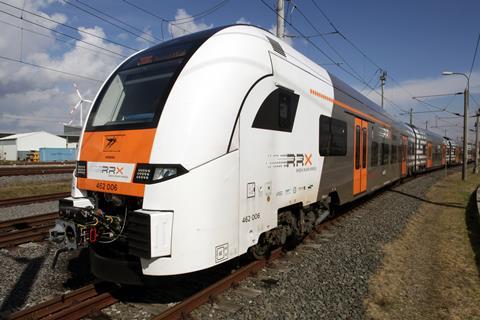
On June 30 Abellio’s German subsidiary entered a three-month ‘protective shield proceeding’ under the country’s insolvency laws. This allowed the company’s management to stay in place under CEO Michiel Noy but with a court-appointed trustee as a form of supervisor, in this case restructuring expert Prof Dr Lucas Flöther.
The main purpose of the three-month window was to allow rescue proposals to be developed before formal insolvency proceedings kicked in. During that period staff salaries were paid by the Federal Employment Agency. However, Abellio once again became liable for paying its staff after the main insolvency proceedings commenced on October 1.
Negotiations between the operator and the contracting authorities in various Länder during the three months had successfully put in place arrangements to keep most trains running. Abellio has agreed to continue operations in Baden-Württemberg until the end of December and in Nordrhein-Westfalen to the end of January 2022. Arrangements in Westfalen have been agreed to the end of March 2022. Operation of Dieselnetz Sachsen-Anhalt is expected to continue until December 2023, and the Saale-Thüringen-Südharz-Netz until the end of the current contract in December 2030.
Nevertheless, the situation in Rhein-Ruhr remains less clear-cut. The four contracting authorities — VRR, ZNWL, Zweckverband Nahverkehr Rheinland and Verkehrsverbund und Fördergesellschaft Nordhessen mbH — published a ‘voluntary ex ante transparency notice’ in OJEU on October 18 indicating that they were seeking an operator to run the two RRX routes, two regional express and three regional routes and four S-Bahn routes for up to two years from the end of January 2022. This would cater for the possibility of not reaching a suitable agreement with Abellio.
During the negotiations, ZNWL CEO Joachim Künzel conceded that Abellio had had to cope with problems outwith its control such as frequent closures for engineering works, as well as rising personnel costs. VRR Board Chairman Ronald Lünser, who had himself previously been CEO of Abellio Rail in Nordrhein-Westfalen, noted that Abellio’s representatives had been ‘responsible, constructive and keen to find solutions’.
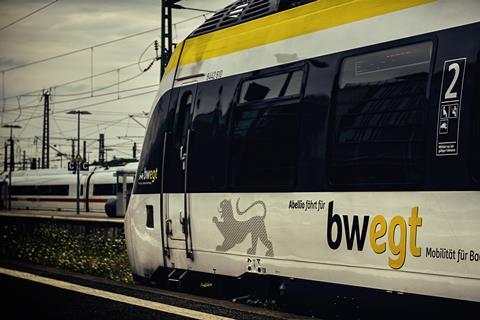
Baden-Württemberg’s transport ministry told our sister publication Rail Business that it was investigating ‘various scenarios’, and was committed to ‘ensuring that operations are permanently guaranteed by a reliable operator’, given that its current arrangements with Abellio are only guaranteed until the end of this year.
Call for change
Matthias Stoffregen, CEO of private operators’ association Mofair, suggests that regulatory changes are needed to provide a long-term perspective for the various companies competing with national operator Deutsche Bahn. He warned in August that the option of all regional services being taken back by DB would be ‘a backwards step for passengers’, suggesting that such a move would lead to a worse level of service.
Whether or not that would be considered as an option for Germany’s future government remains to be seen. Nevertheless, it seems clear that whatever combination of parties assumes power in Berlin will be faced by the need to find a more stable model for regional and local rail services.