








Business news from the world rail freight market.
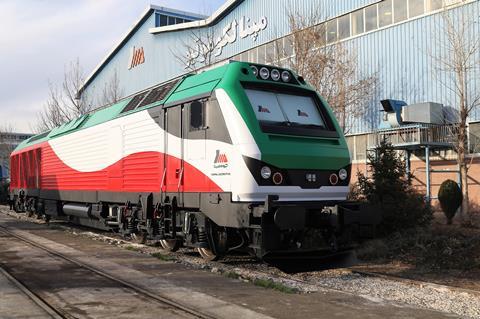
Islamic Republic of Iran Railways has awarded Mapna Group a contract to supply 40 MAP30 freight locomotives, developed domestically in line with national standards and operational requirements. Mapna said the order announced on February 21 is ‘a turning point for Iran’s rail industry’ and highlights its ‘strong domestic engineering capabilities, a well-developed local supply chain and large-scale industrial manufacturing capacity’.
Regular freight traffic on the Hungarian section of the upgraded Budapest – Beograd line began on February 27, with the first train being operated by MÁV Rail Tours using a Siemens Vectron locomotive. Zsolt Hegyi, CEO of national railway group MÁV, said rebuilding of the ‘old, poor-quality’ single-track line from Ferencváros to the Serbian border at Kelebia as a modern double-track line was the largest railway investment in Hungary in recent years.
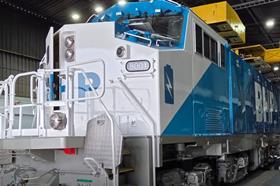
Progress Rail has built two EMD Joule battery locos in Brazil for use by heavy haul operator BHP in the Pilbara region of Australia. Last year BHP took delivery of two Wabtec FLXDrive battery locos, and it says it will be the only mining company in the world trialling two different main line heavy‑haul battery-electric locomotive technologies and suppliers side‑by‑side.
The International Union of Wagon Keepers reports that Swiss railway safety regulator BAV has rejected proposals put forward through the EU Agency for Railways’ Joint Network Secretariat to enhance wagon safety rules while maintaining pan-European interoperability standards. In a statement on February 18, UIP said that BAV ‘participated throughout the JNS process, contributing to discussions and technical assessments. No substantive objections were raised during the adoption process, and conclusions were adopted unanimously by all other national safety authorities. Several weeks later, in the absence of any new facts or evidence, BAV set aside the outcome it had helped shape and maintained its unilateral national measures. This sequence of events highlights the difficulty of maintaining consistency when collective efforts are later overridden by unilateral national measures which creates legal and operational uncertainty across the rail system.’
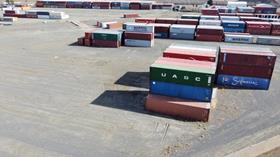
OmniTRAX has signed a long-term lease to create a multi-modal logistics hub on Chicago’s Southside, with access to Class I railways through its Chicago Rail Link. ‘This is an extremely rare rail-served industrial site in the heart of Chicago that offers unparalleled market access’, said OmniTRAX SVP Chris Tecu. ‘The city of Blue Island has a proud industrial and rail heritage that makes this partnership a perfect fit. This is a fantastic public-private partnership that is the model for shared success.’
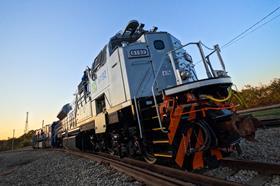
Progress Rail has delivered eight EMD SD70ACe-BB locomotives to Brazil’s VLI for use on the Centro-Atlântica Railway. ‘VLI transports cargo from the main sectors that drive the Brazilian economy, such as agribusiness, civil construction and industry’, said the operator’s CEO Fábio Marchiori. ’With new and modern locomotives, we also contribute to reducing greenhouse gas emissions, reinforcing our role in building a low-carbon and more sustainable logistics network for the country.’ VLI and Progress Rail have also signed a 10-year locomotive maintenance services agreement focused on the Northern Corridor. This connects Tocantins to the port of São Luís and serves the Matopiba agricultural region. It said this is its first long-term maintenance agreement in South America.
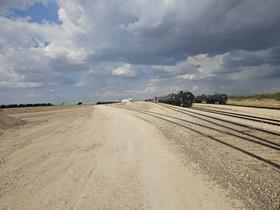
Twin Eagle Terminals & Logistics has completed a 600 m track expansion at its Big Spring, Texas transload terminal to increase throughput for pipe and oversized materials while maintaining flexibility to handle a diverse mix of commodities. The expansion brings the terminal’s total rail footprint to more than 11 000 m of track. The facility is served by Union Pacific and operates 24/7 with in-house shunting and material handling capabilities.
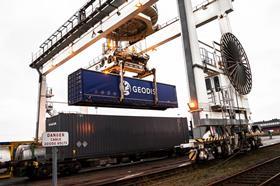
Geodis has begun transporting NAOS Group skincare products by road and rail, replacing an all-road flow. Goods are collected in Neuville-en-Ferrain then transported by lorry to Dourges, from where they travel by train to Avignon before final delivery by road to the NAOS logistics warehouse located in Port Saint Louis. Geodis said a full lorry carrying 15 tonnes generates around 1 tonne of CO₂ compared to ‘just a few dozen kilograms’ in the combined rail-road scheme. Secured containers are used, with dedicated drivers for both pickup and delivery operations to ensure confidentiality and operational control ‘suited to the demands of the cosmetics sector’.