










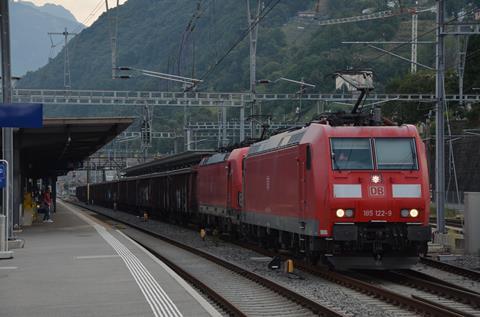
EUROPE: The Joint Network Secretariat managed by the EU Agency for Railways has proposed revised wheel inspection and safety measures as its response to steps taken by Swiss national safety regulator BAV to introduce tighter rules in the second half of 2025.
JNS issued the final report of its Gotthard Broken Wheels Task Force in late December; the group had been working since the derailment in the base tunnel in August 2023 to understand the factors that caused the incident and how these risks could be mitigated in the future.
Tracing defective wheels
The final report confirms that the derailment was caused by a broken wheel of type BA 390. Previous JNS measures in 2017–19 had focused on wheel type BA 004, but the accident revealed similar risks in other wheel types, which the task force has now sought to address.
The report found that cracks initiating in wheel rims remained the primary hazard, and that these were often linked to thermal overload. Six wheel types had been identified as comparable to BA 004: BA 390, Db-004sa, RI 025, R32, BA 304 and BA 005. An immediate recommendation was that the ‘white stripe’ markings be removed from these wheel classes as soon as possible; the white stripes were intended as a rapid visual indicator for train crew and maintenance staff that a particular wheel type had been declared thermostable in operation.
Having determined that the likely root cause of the accident was thermal overload during the months before the accident, the task force has proposed a set of risk control measures to be implemented in the short and medium term:
• visual inspections: mandatory for all tread-braked wheels from February 2026;
• white stripe removal from at-risk wheel types by July 2027;
• minimum wheel diameter to be increased to 864 mm for high axle loads, with stricter limits for reprofiling;
• enhanced maintenance through residual stress checks, non-destructive testing and hammer sound tests;
• Entities in Charge of Maintenance Certification Bodies and National Safety Authorities to monitor compliance;
• all stakeholders must report cracked or broken wheels using ERA templates.
The report said that the task force had looked at a variety of options for strengthening the regulatory regime for wagon wheels, and the proposed options has been assessed both for cost effectiveness and for ensuring European interoperability.
In its impact assessment, the JNS report recommended that its measures, known as Option 2, would provide optimal safety and cost-effectiveness, enabling the Swiss national rules to be withdrawn once the EU-wide harmonised measures were in place.
Working in practice
The International Union of Wagon Keepers welcomed the publication of the report, suggesting that it confirmed Europe’s strong and comprehensive rail safety framework. UIP said in a statement on January 6 that the key challenge facing rail safety regulators in Switzerland and across the EU was ‘not the absence of rules, but the consistent and effective application of existing measures across all actors involved in rail freight operations’.
UIP emphasised that its members had largely implemented the JNS risk control measures agreed in 2019 and 2024, and said the organisation was committed to ‘supporting swift and full compliance with the newly adopted JNS recommendations’.
‘This outcome shows how Europe’s rail safety system works in practice’, commented UIP Secretary General Gilles Peterhans. ‘The rules are in place, and the priority now is to apply them fully and consistently. The JNS provides the right European framework to manage risks in an evidence-based and proportionate way, while ensuring the legal predictability and security that rail freight needs to operate reliably across borders.’
Back to BAV
However, there has so far been no formal response from the Swiss regulator BAV to the JNS proposals. Its attempts to impose its own revised safety regime on all wagons running on the Swiss main line network have already faced a setback, after legal action from shipping and logistics companies led to an administrative court in St Gallen issuing a temporary injunction to prevent the changes being introduced.
The regulator has been granted an extended deadline of January 24 to respond to the court ruling.
Supporting documents
Click link to download and view these filesJNS Broken Wheels Task Force final report
PDF, Size 2.83 mb