






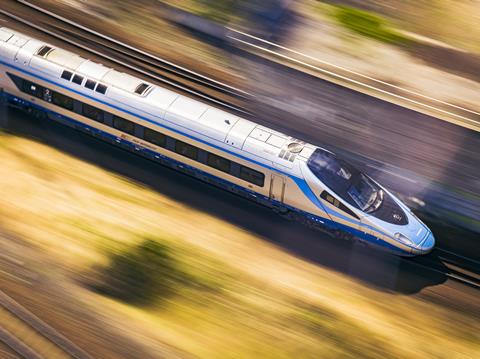
POLAND: Passenger operator PKP Intercity has formally announced a procurement procedure for 20 trainsets capable of operation at speeds of at least 320 km/h, with an option to order up to 35 more. The tender announed on December 29 includes delivery of the trains, long-term maintenance and construction of a dedicated depot.
CPK and beyond
PKP Intercity says that the rolling stock procurement process will resemble that undertaken for the most recent inter-city rolling stock order it concluded in November, when Alstom was chosen to deliver a fleet of double-deck EMUs for use on conventional lines. This will be what the incumbent terms a competitive dialogue, and participation in the procurement is conditional on the bidder having delivered within the last seven years at least five electric trainsets with a maximum speed of no less than 250 km/h, approved for operation in at least one EU country, Switzerland or the UK.
Interested manufacturers can submit offers until April 29 2026. The preliminary schedule assumes the examination of submitted applications in May and June. Invitations to tender are to be issued in July. The operator intends to select a preferred manufacturer by the end of 2026, with the contract to be signed by the end of 2027.
The first two trainsets are expected to be delivered by 2032, which would align with the planned completion date of the inaugural section of the national high speed network known as CPK. This initial route would form a Y-shaped network linking Warszawa, the CPK hub airport and Łódź. All 20 trainsets from the initial tranche are to be delivered within seven years of the contract signing.
According to PKP Intercity estimates, the cost of purchasing a single trainset is estimated at approximately 125m złoty or €29m.
The manufacturer would be required to provide maintenance services for 30 years at a workshop it will design and build. The location has not yet been selected, however PKP Intercity has indicated that three potential locations have been identified.
Dual-system trains
While technical details about the trains have yet to be formally released, local sources suggest the fleet will be equipped for dual-system operation with Poland’s legacy 3 kV DC power supply as well as the 25 kV 50 Hz overhead electrification used on high speed lines. An indicative maximum speed of 320 km/h is assumed, with scope for this to be raised to 350 km/h during the consultation process with interested bidders.
The bid evaluation criteria are expected to include an emphasis on energy consumption per seat as well as upfront production cost.
While the procurement process is intended to ensure that PKP Intercity has a fleet able to run over the nascent CPK network, the options on the base order are envisaged to support the operation of services linking Polish cities with Köln, Brussels, Paris, Praha and Wien.
- Independently of the PKP Intercity tender, high speed line project promoter CPK is also preparing to go to market for rolling stock. This is expected to form a pool of trains which future operators could lease as part of a competitive market for operations on the future network radiating from the hub airport. CPK is expected to call an initial tender during 2026 for a minimum of at least 40 trainsets capable of a maximum speed of at least 300 km/h.