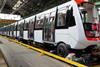







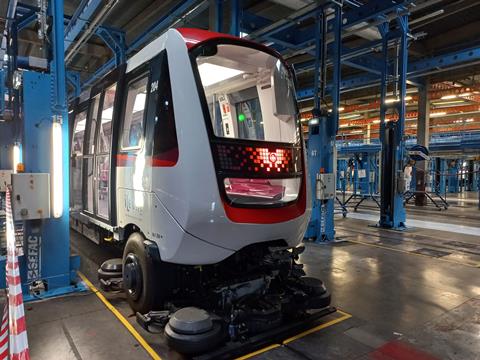
FRANCE: Alstom Boa automated rubber-tyred light metro trains have finally begun entering passenger service on Lille Line 1, as part of a long-running programme to upgrade the 12·5 km 18-station line 1, which opened in April 1983.
To cope with the line’s high ridership of 180 000 passengers/day, a €620m modernisation and capacity expansion programme was launched in 2010. This was funded by Métropole Européenne de Lille, the national government, the Hauts-de-France region and the Nord département.
In 2012 Alstom was awarded a €266m contract to supply 27 Metropolis trainsets with a ‘Boa’ walk-through configuration, as well as Urbalis Fluence CBTC to replace the life-expired train control system. Urbalis Fluence uses direct train-to-train communication, and was chosen in order to reduce maintenance costs and the need for lineside cables. The new systems were expected to come into service in 2015-17, but the implementation ran into technical difficulties and the CBTC project was not completed until November 2024.
Fleet renewal
The first of the new trainsets was unveiled back in 2019, but testing and commissioning could not proceed until the replacement CBTC was operational. The trains have been assembled at Alstom’s Petite-Forêt plant in Valenciennes with bogies from Le Creusot and software from Villeurbanne.
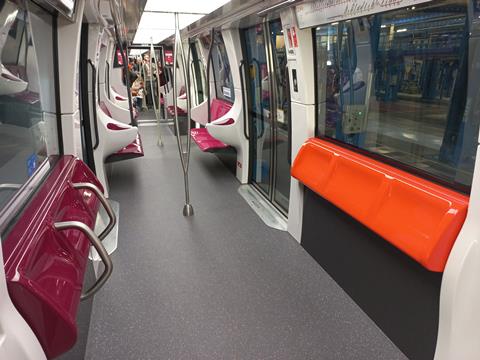
Unlike the previous generation of two-car trains, the new walk-through trains run as fixed four-car formations. Each set is 52 m long and 2 070 mm wide, with capacity for 521 passengers. Features include CCTV, information screens, air-conditioning and spaces for wheelchair users. They take power at 750 V DC and can run at a maximum speed of 80 km/h.
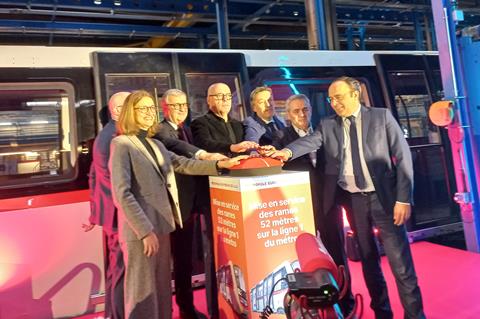
The first five sets entered service on February 14, with 15 sets expected to be in service during March and all 27 by December 2026.
The new trains are initially running interspersed with the older VAL 208 AG sets. Operator Keolis Lille has put stickers on the platforms to indicate the different stopping locations for the older short trains and the longer new ones.
A further 15 sets were ordered for €210m in January 2025, and these are expected to enter service from December 2026 to February 2028. Their arrival will enable Line 1 to be operated exclusively with new stock; the displaced VAL 208 sets will be transferred to Line 2 to replace life-expired VAL 206 stock. Safra and Hovart are to refurbish 60 VAL 208 AG sets in 2027-31.
Siemens Mobility has been awarded a €445m contract to supply 57 VAL 208 NG3 trains for Line 2 from 2028. These will enable the withdrawal of more VAL 206 sets whilst increasing the capacity of Line 2 by an estimated 30%.