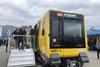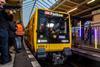








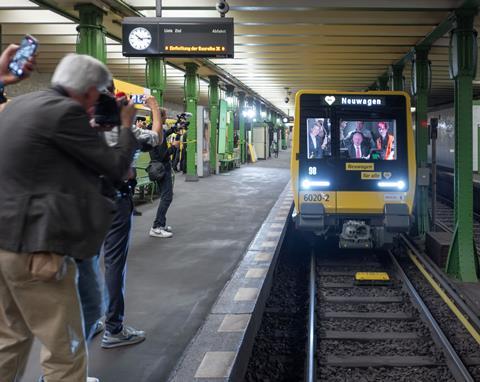
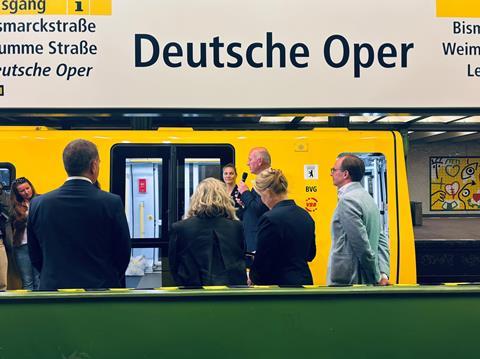
GERMANY: Berlin transport operator BVG put the first of its small-profile Type JK metro cars into passenger service on U-Bahn Line U2 with a ceremony at Deutsche Oper station on September 8. Up to 140 vehicles are expected to be in service by the end of the year.
‘From now on, our passengers will be able to experience the modernisation of our fleet’, said BVG CEO Henrik Falk. ‘They can see the new trains, touch them, get on board and experience the new sense of space. These new vehicles are not just an upgrade, but a commitment to modern, sustainable mobility and will continue to shape the cityscape in the coming decades.’
Mayor Kai Wegner said the new trains were ’a milestone for the future of local public transport in Berlin. With the renewal of the U-Bahn fleet, we will achieve more reliability and punctuality for the people of Berlin – and stabilise the BVG in challenging times and make it fit for the future.’
Stability before growth
In March 2020 BVG and Stadler agreed a €3bn framework contract covering the supply of up to 1 500 vehicles by 2035, along with the provision of spare parts for 32 years. Firm orders have so far been placed for 484 cars, although production at Stadler’s factory in Berlin has been delayed by problems with global supply chains.
The new trains will be supplied in two types, with 2 400 mm wide Type JK cars for the small-profile lines 1 to 4 and 2 650 mm wide Type J cars for the larger profile lines 5 to 9. The Type JK cars are being supplied as two or four-car sets which can be combined to form six or eight-car trains.
The programme forms part of BVG’s ‘stability before growth’ strategy, which aims to return to reliability levels of 99% over the next few years.
More reliable and more attractive
Stadler said the new trains offered technical stability, a spacious interior design and improved accessibility, which would make travelling on the U-Bahn more reliable and more attractive.
They have large, barrier-free entrances for rapid passenger exchange, along with wide aisles and spacious multi-purpose areas for passengers with reduced mobility. The interior is intended to be bright and friendly and convey a feeling of safety. A real-time passenger information system with flat wall-mounted screens provides rapid guidance. Other features include wi-fi, lighting that adjusts to the time of day and handrails designed to provide space for wheelchairs and pushchairs.
The first of the large profile Type J cars are currently on trial and are scheduled to enter passenger service in summer 2026.