


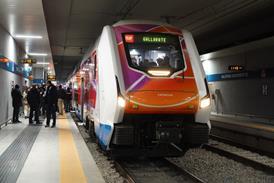






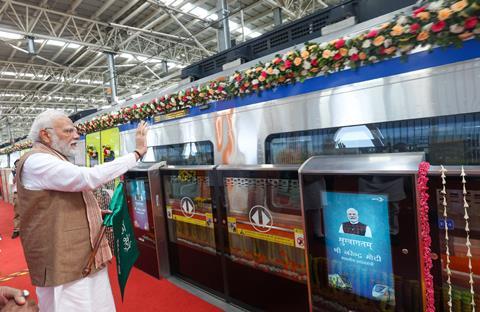
INDIA: ’The inauguration of the Meerut Metro, Namo Bharat train and the new section of the RRTS will make the lives of people in the National Capital Region even simpler, smoother and more convenient’, said Prime Minster Narendra Modi on February 22, marking the completion of the final sections of the 82 km Delhi – Ghaziabad – Meerut Regional Rapid Transit System and the Meerut Metro which will share its tracks for 23 km through the satellite city in Uttar Pradesh.
Developed by the National Capital Region Transport Corp, the line runs from a multimodal interchange at Sarai Kale Khan in central Delhi to Modipuram in the northeast, connecting urban centres including Sahibabad, Ghaziabad, Murad Nagar and Modi Nagar. The first of three routes to be built under Phase 1 of the RRTS project, the largely elevated line has been designed for operation at up to 180 km/h, although the Namo Bharat branded services are currently limited to 160 km/h.
The first phase of the Rapid X line was opened in October 2023, and the route has gradually been extended. The final parts to be completed were the 5·3 km inner section from New Ashok Nagar across the River Yamuna to Sarai Kale Khan and the northernmost 23·6 km between Meerut South and Modipuram which tunnels under the centre of Meerut.
Delhi services will make limited stops on the northern section, where eight of the 11 closely-spaced stations will only be served by local trains branded as the Meerut Metro. These will be operated by 10 three-car high-capacity EMUs, which were built at Alstom’s Savli plant alongside the 30 six-car sets for the Namo Bharat service.
Ahead of the inauguration, a non-stop special train completed the trip from Sarai Kale Khan in Delhi to Begumpul in central Meerut in 40 min, at a maximum speed of 159 km/h. Revenue services are expected to take 54 mins from Delhi to Begumpul and 58 min to the terminus at Modipuram. The end to end journey time of less than 1 h compares to more than 2 h by road during peak hours.
More than 100 000 passengers travelled on the completed railway during the first day of fulll commercial operation. Daily ridership is expected to reach 795 000 passengers, with trains operating at headways of 8 to 10 min. ’The entire Delhi – Ghaziabad – Meerut corridor now shifts the modal share in favour of public transport from 37% to 63%, which ultimately helps in curbing pollution’, an NCRTC spokesperson explained.
The terminus at Sarai Kale Khan is set to become a major hub with interchange to the Delhi Metro, Hazrat Nizamuddin railway station and the Veer Haqeeqat Rai inter-state bus terminal, as well as city bus services. It will also be served by the other two RRTS lines to be built in Phase I.
The planned Delhi – Gurgaon – Bawal route to the southwest is to be 92 km long with 17 stations; this would have 22 km in Delhi and 70 km in Haryana, and would also offer an end-to-end journey time of less than 1 h. The third corridor will run north from Delhi to serve Sonipat, Panipat and Karnal, with 18 stations along a 136 km route. Journey time between Delhi and Karnal is forecast at 90 min.
NCRTC Managing Director Shalabh Goel told local media that the Delhi – Karnal route and a portion of the Phase 2 Delhi – SNB – Alwar corridor are to be approved within this financial year.