





POLAND: Czech open access train operator RegioJet has announced its withdrawal from the Polish domestic market, alleging anti-competitive behaviour which the incumbent railway group has denied. Railway Gazette International looks at the claims and counterclaims.
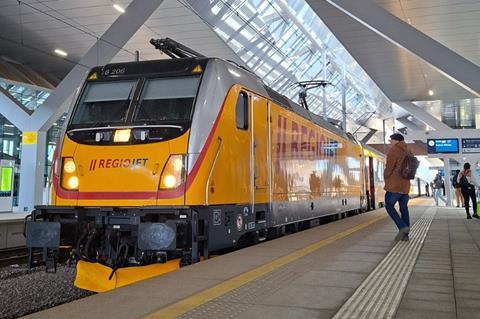
RegioJet announced its withdrawal from the Polish domestic market on April 9, claiming that ‘a strongly negative media campaign was conducted against our company, becoming part of a political struggle’. The current situation, ’including infrastructure blocking, sales restrictions, and predatory pricing, threatens the economic stability of the RegioJet Group’, it added.
The incumbent railway holding company PKP SA has disputed the allegations.
RegioJet’s Kraków – Warszawa – Gdynia and Poznań – Warszawa domestic services are to end on May 3. The Przemyśl – Kraków – Praha and Warszawa – Praha international services will continue to operate.
‘I cannot continue to jeopardise the future of the company I founded at the age of 23’, RegioJet owner Radim Jančura said on April 9. ’I believe that under more favourable conditions, we will be able to provide our services in Poland again in the future.’
Entry to the Polish market
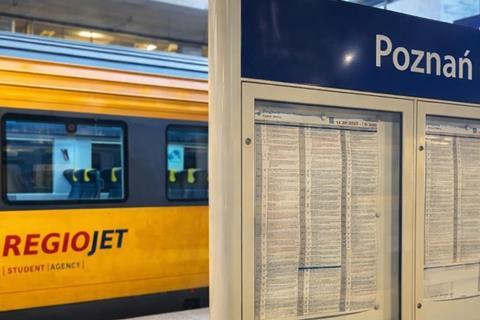
The Czech company said its decision to enter the Polish market was part of a long-term strategy of expansion into neighbouring countries, facilitated by its ‘strong’ financial performance and the emergence of ’a more open approach to competition’ in Poland.
On September 18 2025, it launched a pair of trains on the Kraków – Warszawa route, for what it said was a trial period running to March 2026. RegioJet said ‘the goal was to learn how to provide passengers with the same standard of service that we offer in the Czech Republic, Slovakia, Austria and Hungary’.
However, an expansion of services planned from December could not be implemented, with RegioJet saying this was partly due to insufficient capacity at an external supplier of drivers. It said passengers affected by the cancelled services were informed in advance, their fares were fully refunded, and they received 100 złoty as an apology. Full operation was implemented from March 1.
On April 7 Polish rail regulator UTK said that RegioJet had engaged in unlawful practices that violated the collective interests of rail passengers, with the cancellation of 23 trains in December. Passengers were forced to purchase new tickets.
UTK said the burden of risk associated with service provision falls on the carrier, not the passengers, and organisational difficulties cannot be an excuse for licensed rail carriers’ failure to fulfil their obligations to people who had purchased tickets.
The operator has 30 days to appeal against the ruling. UTK could impose a fine of up to 2% of the company’s annual revenue in the previous financial year.
‘Competitive conditions do not function’
Announcing its withdrawal from the Polish domestic market on April 9, RegioJet said it had ‘faced a number of actions that, in our opinion, disrupt a fair market environment’.
It said it ‘invited representatives of Polish state media to the first-ever journey of a competing operator on a domestic long-distance line. They declined participation, stating that as state media they could only report positively on the state carrier’, PKP Intercity.
It said state railway holding company PKP SA had terminated RegioJet’s marketing campaign at stations, and did not allow it to establish sales points. It claimed the CEO of PKP Intercity, Janusz Malinowski, published private SMS communication with RegioJet owner Radim Jančura, in which he was warned that any action hindering market entry could be seen as abuse of a dominant position aimed at eliminating a new competitor. The new entrant says ‘this step led to further negative campaigning against RegioJet’.
RegioJet also reported that PKP Intercity reduced ticket prices by up to 70% in an effort to drive it out of the market. RegioJet said ‘a new entrant has the right to temporarily offer below-cost prices to gain attention and establish itself, but a dominant competitor does not; on the contrary, it is explicitly prohibited.’
The new entrant said PKP Intercity used the gradual rollout of RegioJet’s services to occupy key paths.
RegioJet also says PKP SA is ‘actively blocking’ its purchase of a former PKP Cargo depot in Warszawa which it planned to use for maintenance. RegioJet assumed the sale would proceed immediately after its auction win in August 2025, but instead it has ‘had to repair carriages outdoors in the snow and transport them to the Czech Republic for more serious repairs’.
RegioJet said ‘in our opinion standard competitive conditions do not function in Poland’. It said the EU requires an independent regulator to protect new entrants from state-owned dominant carriers and infrastructure managers, but ‘in Poland, in our view, the opposite is true’.
It said ‘we are ready to return once the market is genuinely open and fair, transparent conditions are ensured for all operators’.
Incumbents respond
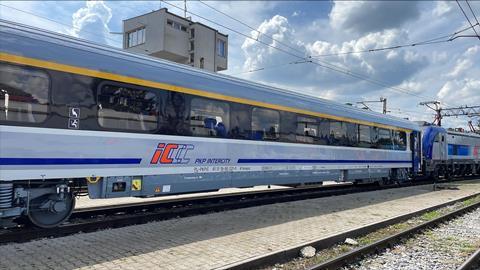
In response to the allegations, PKP SA issued a statement saying RegioJet’s withdrawal was is a purely business decision ‘for which its management board bears full responsibility’. PKP SA said ‘the rail sector is a demanding and complex industry’, with more than 12 passenger operators in Poland, and blaming the PKP group for RegioJet’s problems is ‘unfair to passengers and factually inaccurate’. PKP SA said it operates based on transparent business procedures and standard contractual provisions, and is open to collaboration, but RegioJet had attempted to build its offering without providing the foundations including its own drivers, technical support and reliable analysis of the market.
PKP Intercity said RegioJet’s had issued a ‘one-sided narrative’ with ‘numerous inaccuracies’. The incumbent said it operates under a public service contract requiring subsidy, unlike operators which can focus only on profitable routes. PKP Inetrcity said its prices are aimed at promoting rail use and not anti-competitive, and it supports the presence of commercial operators ‘provided that this is done on transparent and equal terms for all market participants’. It said capacity is allocated by the independent infrastructure manager and market regulator. The incumbent had made use of paths relinquished by RegioJet, and it had carried RegioJet passengers during disruption. In March PKP Intercity approached new entrants with a proposal to co-operate in accepting tickets and providing emergency traction during disruption, and a meeting was scheduled for April.
A ’step backwards’
Coming on the situation, the AllRail alliance of new entrants to the passenger market told Railway Gazette International ‘we share RegioJet’s disappointment at having to pull out of the Polish domestic market at this time, and applaud their open communication and concern for their Polish passengers. This development only highlights the persistent barriers to entry that remain in Poland.’
Secretary General Nick Brooks said RegioJet’s exit ‘is a significant step backwards for liberalisation, and sets a worrying precedent that the dominant operator can push competitors out, not on the merits of their services but through anti-competitive action.
This is especially disappointing because Poland had committed to opening the rail market to competition in 2021. Five years later they are going in completely the opposite direction, with a regulator that is not protecting fair competition.’