








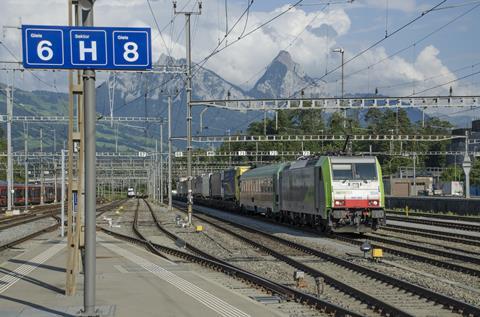
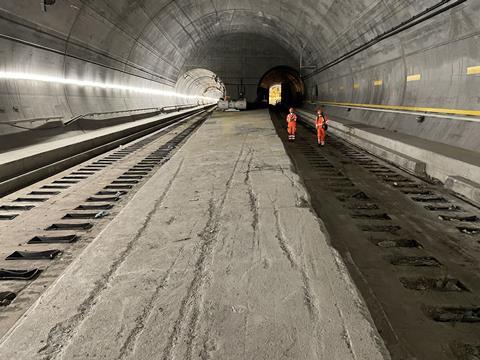
SWITZERLAND: Federal transport office BAV has issued a further amendment to the safety rules governing wagons using the Swiss main line network. It comes amid ongoing tension over the safety rules governing the condition and maintenance of wagon wheels and brakes in the wake of the August 2023 freight train derailment in the Gotthard Base Tunnel.
BAV announced a slew of changes to its national rules in September that attracted a fierce rebuke from Swiss and European rail freight trade bodies. They accused it of acting unilaterally and imposing costs that could affect the viability of some of the most important pan-European rail freight flows.
On October 28, BAV published an amended decree which stated that, ‘on the basis of the intensive dialogue with stakeholders’, the specifications for wagon inspections ‘are now based exclusively on the distance travelled’. It added that because data on the average mileage of freight wagons is already available and wagon keepers are legally mandated to know the condition of their wagons, ‘the additional time limit provided for in the decree in September can be dispensed with’.
However, all the other changes remain in place, including a change to the minimum diameter of some wheels, and BAV insisted that no further regulatory changes were envisaged.
A European answer
In a possible reflection of the pressure that wagon keepers and maintenance contractors have placed on it, BAV insisted in its statement that it was seeking a multilateral answer to the post-Gotthard derailment safety regime for freight wagons in Switzerland.
The regulator said it continues to ‘advocate for a solution at the pan-European level that is as broadly supported as possible in the industry’. It insisted that the EU Agency for Railways had not yet responded to Swiss independent safety investigation body STSB’s report into the Gotthard incident, which earlier this year had identified a systemic risk of wheel breakages. As a result, BAV said it had to ‘take action itself in the interests of safety as a first step’. It said it remained ‘in contact with the European bodies in order to find internationally coordinated solutions within a reasonable period of time’.
Crisis not averted
Responding to the latest amendments from BAV, the International Union of Wagon Keepers insisted on October 30 that the threat to an interoperable European rail freight network had not yet been averted.
UIP called on the Swiss regulator to ‘fully withdraw its unilateral wagon safety measures and rejoin the coordinated European process under the [ERA-backed] Joint Network Secretariat. The latest decree removes the annual inspection deadline for freight wagons but keeps all other national requirements in place.
‘This regulatory zigzag creates uncertainty for operators and confirms that Switzerland is taking serious safety decisions without an impact assessment or consultation with its European partners. BAV’s approach creates the risk of a supply chain crisis’, it added.
‘The technical requirements that BAV is imposing on European rail freight passing through Switzerland continue to differ from those applied across Europe. This leaves operators facing uncertainty, increased costs, and potential disruptions to cross-border freight movements. These are precisely the risks that harmonised European rules are designed to avoid.’
UIP continues to stress that any regulatory changes must be channelled through the JNS as a pan-European forum, and it pointed to the forum already taking steps that ‘led to relevant actors, including wagon keepers, making safety improvements’ since the Gotthard accident.
JNS is expected to issue harmonised recommendations on wagon safety, and ‘against this backdrop, there is no justification for maintaining national rules that contradict the very process designed to deliver European alignment. As a member of the JNS, BAV has a voice in pan-European rail safety decisions and should channel its energy into that forum rather than acting alone.’