









SWITZERLAND: German and Swiss rail freight associations warn that the Swiss Federal Office of Transport’s imposition of safety measures following the 2023 Gotthard derailment could severely disrupt cross-border operations, with at least 46 000 wagons potentially affected despite a partial deadline extension to December 2026.
Rail freight trade associations in Germany and Switzerland have expressed serious concern about changes to the rules governing freight trains passing through the trans-Alpine Gotthard Base Tunnel, despite an apparent partial extension of the deadline for their implementation.
In mid-September, BAV, the Swiss rail safety regulator, introduced updated regulations for rail freight based on the investigations into the August 2023 derailment in the Gotthard Base Tunnel.
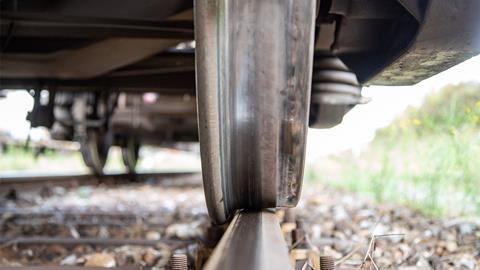
The focus is on requirements for minimum wheel diameters, systematic and more frequent maintenance and optimised inspections. Wheelsets used in Switzerland must have a diameter of at least 864 mm, compared to the European standard of 860 mm, and shorter and systematic intervals between technical inspections are required. There are also new obligations on asset owners and maintenance contractors to intervene if cases of overheating components are found or ultrasonic testing results exceed the requisite thresholds.
Implementation of the measures had initially been required by the end of 2025, but in mid-October, BAV relented on the deadline for the enhanced inspection regime. This part of the package will now take effect from December 2026.
‘Unilateral’
The revisions have provoked the ire of rail freight associations involved in cross-border operations, who note that the unilateral nature of the changes risks having severe implications for freight services running over the north-south axis through Switzerland.
In a statement on October 16, the International Union of Wagon Keepers said it welcomed BAV’s decision to extend the implementation deadline, which ‘reflects the scale and complexity of the task faced by the rail freight sector. UIP regrets, however, that the measures remain unilateral, adopted without a co-ordinated European discussion. In order to safeguard our ability to freely move goods across Europe, this additional time must be used to develop co-ordinated, evidence-based solutions that enhance safety without disrupting operations.’ UIP is calling for the year before the revised inspection process kicks in to be used ’to develop co-ordinated, evidence-based measures’ through the EU Agency for Railways’ Joint Network Secretariat.
Thousands of wagons affected
According to UIP, the requirement that all inspections ‘be carried out in stationary workshops and outside regular maintenance intervals’ will continue to ’reduce wagon availability, risk disrupting industrial supply chains add cost, especially along Europe’s vital Alpine corridors’.
Analysis from its members has suggested that around 20% of the UIP fleet could be affected by the changes, which equates to 46 000 wagons. The 20% share relates only to wagons designated as needing to comply with Swiss rules, and the overall number ‘could be much higher, depending on the needs of shippers and freight forwarders who transport goods across the EU and Switzerland. The impact on the economic efficiency and viability of operations is therefore expected to be significant’, it warned.
Safety is non-negotiable
When the changes were initially announced in September, UIP said it recognised that safety was ’non-negotiable in rail freight. It is undisputedly a matter of great importance to the whole industry, in particular to wagon keepers, to maintain the safety of their wagon fleet at the highest level. However, the unilateral safety measures by the Swiss National Safety Authority in reaction to the accident at the Gotthard Base Tunnel present a one-sided focus on wagon keepers, run counter to the work of ERA’s Joint Network Secretariat, and also initiate a meltdown for European rail freight traffic.’
UIP said ERA’s JNS had been set up as the entity to develop harmonised short-term and long-term risk mitigation measures for the whole EU rail network in response to safety-related issues. ‘Many safety measures relating to reducing the risk of broken wheels have been developed by the JNS since 2017 and consequently implemented’, it added.
Not proportionate
German wagon keepers’ association VPI said in a statement on September 15 that ‘the measures decided by BAV are not proportionate, sustainable or feasible. There is a risk of enormous economic damage to rail freight transport on Europe’s most important international corridor. The most environmentally friendly mode of transport must not be weakened — it is central to modal shift and an effective leverage for climate protection. Safety is our top priority. But it must not be a topic for national solo efforts.’
VPI Chairman Malte Lawrenz said ‘only within the European framework can practical and effective measures be developed that ensure both security and interoperability. We need European unity instead of isolated solutions.’
VPI said that it was not clear how wagon owners or depot managers could meet the deadline for the changes of the end of the year. The additional costs would ‘add up to double-digit millions [of euros] annually’, the association added. ‘They weaken the competitiveness of the rail compared to road and deprive wagon keepers of the resources urgently needed for future investments, such as digitalisation, automation, and the introduction of the digital automatic coupler’.
Deadline extension confirmed
A spokesperson for BAV confirmed on October 16 that the implementation deadline for technical inspection of wagons had been extended by one year until the end of 2026.
‘Various further discussions took place with the industry, which yielded new insights into the possibilities for implementing the measures’, BAV told Railway Gazette International. ‘The entities responsible for the maintenance of freight wagons pointed out that a stay in a stationary workshop is absolutely necessary for an initial technical inspection of wagons. With the new decision, BAV recognises that more time is needed to implement this measure. For the remaining measures, the implementation date remains unchanged.’
When asked to comment on BAV’s regulatory changes and their impact on pan-European rail freight operations, a spokesman for the EU Agency for Railways declined to issue a statement, noting only that its priority was to reach ‘EU-wide harmonised risk control measures within the JNS’.