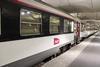
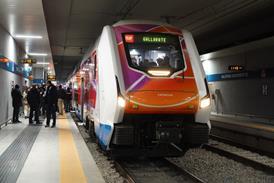












EUROPE: A Paris to Berlin night train service was launched by European Sleeper on March 26, reviving a connection that had ended in December. Jérémie Anne reports from Paris Nord.

The previous service, along with a Paris – Wien route, was operated by Austrian Federal Railways, Germany’s DB Personenverkehr and France’s SNCF Voyageurs. It had achieved an occupancy rate of 70%, but frequent engineering works prevented an increase in services and operations ended when the French government withdrew financial support.
When the end was announced, Dutch-Belgian night train co-operative European Sleeper stepped in with an ambition to provide a replacement Paris – Berlin service. It planned its offering in six months, which co-founder Elmer Van Buuren said at the launch was a short timeline for the rail industry and ‘a crazy challenge’.
Securing paths
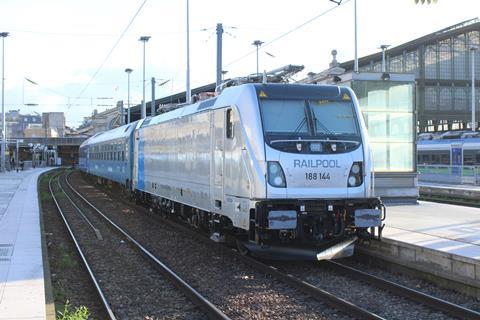
European Sleeper’s ongoing work to develop an Amsterdam – Barcelona night train service with the backing of the European Commission has allowed it to gain an understanding of French railway rules and practices, including about capacity allocation.
Van Buuren said there have been intensive discussions with French infrastructure manager SNCF Réseau, because ‘it is not easy to get a path’, although he stressed they ‘try to help us very well’. The service makes use of residual capacity, with each trip requiring day-to-day adaptations by schedulers to take into account planned engineering works and congestion on the suburban lines around Paris.
After discussions with all infrastructure managers involved, the first train left Paris Nord on March 26.
Three major capitals
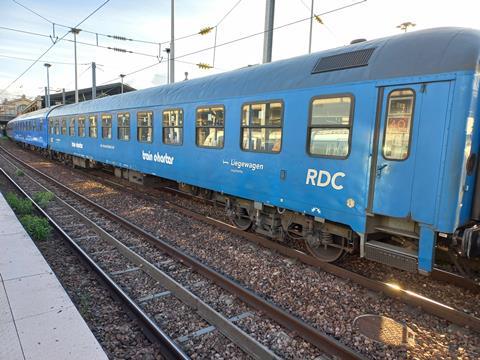
The service departs from Paris on Tuesday, Thursday and Saturday, and from Berlin on Monday, Wednesday and Friday. It calls at Aulnoye-Aymeries, Mons, Brussels Midi, Liège Guillemins and Berlin Hauptbahnhof with a journey time of almost 15 h. From July 13 it will also stop at Hamburg Harburg.
The night train connects ‘three major European capital cities’, Van Buuren said. He said Brussels has higher potential demand than the former service’s stop at Strasbourg, and enables passengers arriving from the UK by Eurostar to connect into the night train. Along with European Sleeper’s existing Brussels – Amsterdam – Berlin – Praha service, the company now offers trains from Brussels to Berlin six days a week.
Rolling stock and operations
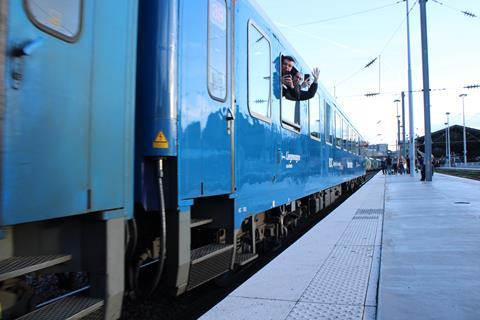
The first train had eight coaches, and the maximum possible length is 14 coaches. There are three classes of accommodation: budget, classic and comfort. Tickets are sold through the European Sleeper website, and by SNCB, Trainline, Rail Europe and Omio; 25 000 tickets for Paris – Berlin route had been sold by the launch date.
Operations are subcontracted to Train Charter Services, which has an operating licence and safety certificate for France as well as the Netherlands, Belgium, Germany, Switzerland, Liechtenstein, Austria, the Czech Republic and Italian border stations. TCS leases an Alstom Traxx MS3 electric loco from Railpool, while European Sleeper leases the coaches from Railroad Development Corp which maintains them at its workshop at Lengerich in Germany.
The train is stabled at Le Bourget near Paris Nord during the day, but this ‘is not a great place, because there is no possibility to do servicing’, said Van Buuren. He said gaining access to tracks suitable for servicing the train in France was ‘more difficult to obtain train paths’, and so cleaning, train preparation and restocking the catering is undertaken in Berlin.
- European Sleeper is to launch a Brussels – Köln – Zürich – Milano Porta Garibaldi night train on September 9, with an extension to start from Amsterdam in 2027. The train will run via the Gotthard Pass, as the originally planned route via the Simplon Pass proved unfeasible due to engineering works scheduled through 2027.