






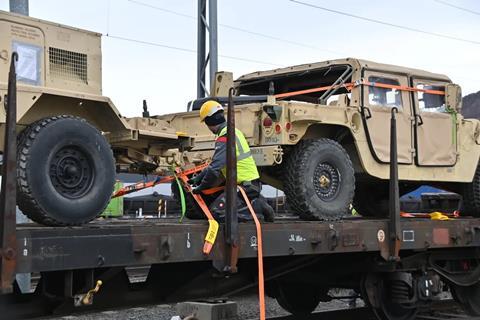
EUROPE: The difficulty in arranging short term paths for cross-border rail traffic is putting rail’s role in military mobility at risk, CER Executive Director Alberto Mazzola has warned.
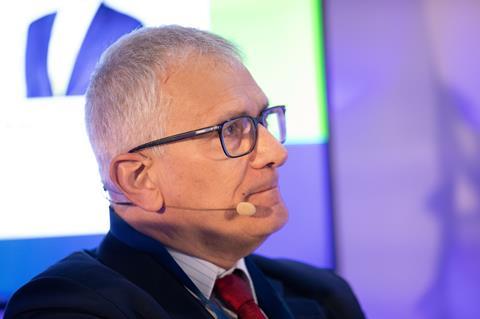
Speaking to the RailTech Europe Conference organised by ProMedia Group in Utrecht on March 5, Mazzola cited a recent trial movement of an armoured division by rail from France to Romania. ‘It took 45 days’, he said. ‘Of those 45 days, 30 were spent not moving anything — simply on planning and approving the train. If it takes 45 days in live war situation, we will lose the war.’
His stark assessment came in a keynote address that reasserted the role that rail that can play in reinforcing Europe’s strategic strength. ’Rail is the backbone of military mobility in Europe’, he insisted, noting that much of the materiel which needs to be moved is bulky or dangerous, and therefore ill-suited to road haulage. Mazzola also stressed that European policymakers’ focus on so-called dual-use infrastructure would also benefit rail, since ‘90% of the investment needed to support military traffic is also good for use by other rail freight’.
Ports and railways
CER welcomed the European Commission’s work to draft a Regulation covering military mobility, and he said the trade association representing incumbent railways was happy with ‘90% of that is in the regulation’.
Mazzola explained that a number of strategic corridors had been identified for military mobility, along with 500 ‘hot spots’ needing interventions to boost throughput. While the specific corridors are being kept confidential for security reasons, there is a high degree of overlap with the EU’s TEN-T axes.
Mazzola cautioned that the current technical specifications for the TEN-T rail network did not include the extra loading gauge requirements of military traffic. ‘We need an extra 20 cm in all the tunnel dimension specifications’, he said, adding that the sector would be pushing the Commission to amend this element.
CER welcomed the recent publication of an updated EU Ports Strategy, as this reinforced the need to address rail-sea integration. While the strategy highlighted cases of several ports including Bremen and Gdańsk where rail has a modal share of more than 30% for hinterland connectivity, Mazzola warned that in some of the biggest ports such as Rotterdam and Antwerpen, rail’s share is only around 10%. ‘Even if we don’t have war and crisis in Europe, we still need more investment [in port access] to be done to support rail freight’, he said, noting that this would drive modal shift and support the EU’s green policy goals.
Dual use requires redundancy
From an operational perspective, Mazzola warned that redundancy in rail operations across the continent would need to improve if military trains are to have the flexibility that the armed forces need.
Noting that ‘many lessons’ could be learned from the ongoing war in Ukraine, Mazzola said that railways could no longer ignore the need for an alternative traction option to move trains if electrical supplies are damaged by hostile actors. He said that while environmentalists may not like it, the reality was that ‘we cannot as a sector turn our back on diesel’ completely. He urged policymakers from the EU and member states to recognise the challenge by supporting operators to find the extra funding needed to invest in generally more expensive bi-mode and hybrid locomotives.
Europe also faces a critical shortage of wagons which could also act as a brake on military mobility if hostilities break out. ‘Only a small proportion of military movements need specialist wagons, most can use existing general freight designs’, he said. ‘But we simply do not have enough of them — in the event of a full conflict with Russia, we will need 50 times more.’
Nevertheless, despite the scale of the challenge facing the sector, Mazzola insisted that the geopolitical instability now facing the continent meant that rail advocates were gaining influence at the political level. He said ’the fact is that when we talked before about rail freight and the need for investment, only a couple of politicians would listen to us. Now, everyone in Brussels is listening’.