





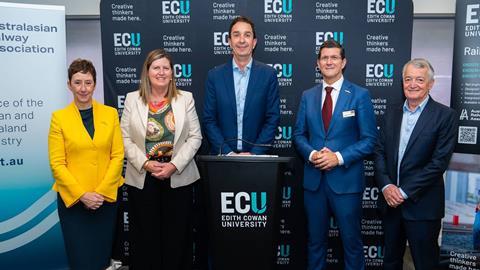
AUSTRALIA: Edith Cowan University in Perth has launched dedicated rail-based units across its Civil, Mechanical and Electrical Engineering undergraduate programmes, developed in partnership with the Australasian Railway Association to provide students with specialised knowledge and practical insights to help meet the sector’s future needs.
Mining company and heavy haul railway operator Rio Tinto, Public Transport Authority of Western Australia and rail infrastructure concessionaire ARC Infrastructure also supported the development of the modules to ensure their relevance to the wider industry in the state and nationally.
Three units
The first of the three units, Railway Design, Construction & Maintenance, will commence during the second semester of 2025, followed by Railway System Mechanics and Railway Electrical, Control & Signalling Systems.
What ECU said was Australia’s first core rail civil engineering unit addresses track design, railway bridge and tunnel construction, track maintenance and emergency recovery. The mechanical-focused unit covers rolling stock design and analysis, wheel-rail interface, transmission and braking systems, track assessment and defect management.
The electrical engineering module explores signalling, operational telecommunications, train control systems, overhead line equipment and power systems for both trains and tracks, alongside key technical and operational considerations such as safety and information security.
Pathway to a rewarding career in rail
‘The introduction of these rail-focused units at Edith Cowan University marks a significant step forward in aligning our engineering programmes with the future needs of Australia’s infrastructure sector’, said ECU School of Engineering Executive Dean Professor Paulo de Souza.
‘Rail generates 165 000 jobs across Australia and offers exciting careers on rail projects and networks, both here and overseas’, said ARA Chief Executive Caroline Wilkie. ‘The rail industry has suffered from persistent skills shortages in critical roles such as engineering and is facing a retirement cliff by 2035. However, despite the significant demand for new talent, very few dedicated learning pathways into the industry exist across the country. These units provide a clear pathway to help more students consider a rewarding career in rail.’