



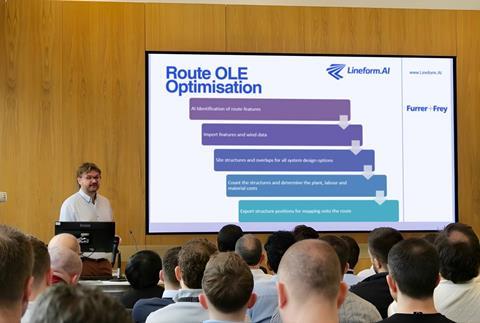
UK: Electrification technology specialist Furrer+Frey has developed the Lineform.AI tool which uses data from an array of datasets as well as Airbus satellites to produce options for electrification with high-level cost estimates as well as embodied carbon data.
Having been trained by engineers, Lineform.AI surveys satellite images to spot existing infrastructure such as culverts, signals, bridges and level crossings. With its understanding of a line’s constraints, and access to an in-depth database of electrification system standards, weather models and averaged construction costs, it then develops hundreds of electrification options for review by infrastucture specialists.
The AI tool can quickly run complex calculations that consider multiple interdependent variables such as wind speeds, span lengths, cable tensions and catenary height to optimise an overhead line system.
The Swiss-headquartered group says detailed AI analysis of the Perth to Aberdeen corridor led Network Rail to implement UK-wide changes in the way it designs electrification.
The latest work has looked at ScotRail’s Barrhead to Kilmarnock and Troon routes, helping shape early plans for upgrades provisionally planned to start in Control Period 8 from 2029.
Outside the UK it has been used to inform early design strategy for Dublin’s DART+ programme, and analysis is underway for various continental European routes.
Noel Dolphin, Head of UK Projects at Furrer+Frey, said ‘the Scottish case studies demonstrate how AI-enabled design can reduce cost and embodied carbon while increasing transparency and speed. What this really means is that ultimately, we will be able to deliver benefits to passengers sooner. We are using AI for good – to give engineers better data, not to replace engineers.’
Richard Stainton, Electrification Specialist at Network Rail, said ‘incremental gains in lowering the cost of electrification are how we make projects deliverable’.
Development of the tool was supported by Airbus Space & Defence and Network Rail, with funding from the UK Space Agency as well as the Department for Transport and Innovate UK’s 2025 First of a Kind competition.