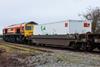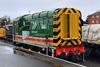











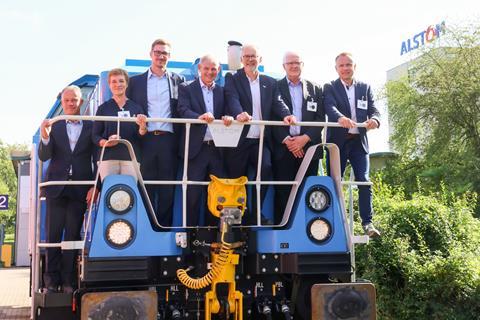
GERMANY: A diesel shunter which has been converted to the direct combustion of hydrogen is on test to assess the viability of reducing carbon emissions from existing locomotives with many years of life remaining.
The project is being undertaken by Alstom in partnership with steelmaker Salzgitter Group’s rail transport business Verkehrsbetriebe Peine-Salzgitter, research institute WTZ Roßlau, Technische Universität Braunschweig and the Fraunhofer Institute for Surface Engineering & Thin Films. It is supported by the city of Salzgitter, which has contributed €1·5m.
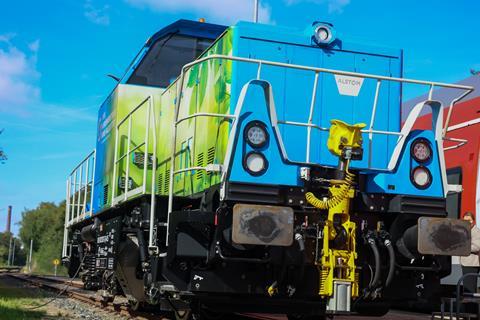
Testing by steelmaker Salzgitter Group is being undertaken during September and October. This will provide insights into the suitability of the technology for everyday use, and support the development of plans for series conversions of existing locos.
The locomotive will be returned to its original condition once the test are completed.
Potential for ‘huge’ CO2 savings

Alstom said the potential CO2 saving from converting shunters from diesel to hydrogen fuel is huge. VPS operates 42 locomotives for the transport of ore, coal, pig iron and steel products, and Alstom estimates that there are around 1 000 diesel shunting locomotives in use in Germany and 4 000 across Europe.
It said the average service life of a diesel shunter is 50 to 70 years, and it emits around 150 tonnes of CO2 per year. A modernised loco with a hydrogen drive could save up to 3 000 tonnes of CO2 over a remaining service life of 15 to 20 years, equivalent to the emissions of up to 650 cars or the savings from planting 200 000 trees
‘With this research project, we are once again pioneering the use of hydrogen in rail transport’, said François Muller, Vice-President Services for Central & Northern Europe at Alstom. ‘Thanks to this solution, our customers can switch to emission-free operation without having to replace their existing fleet. This is a particularly worthwhile option in shunting traffic due to the long service life of the vehicles.’