









EUROPE: The national passenger train operators of Estonia, Latvia and Lithuania have launched a joint procurement of 200 km/h electric multiple-units to provide regional services on the future Rail Baltica standard gauge line.
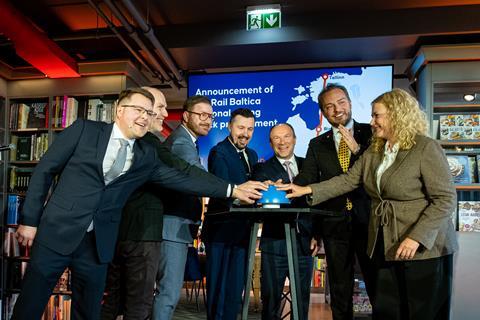
Planning for the procurement was supported by consultants from Switzerland, Sweden and Finland, and the call for tenders was officially launched at an event in Tallinn on March 18. Proposals are invited by May 4.
The trains are intended for use on journeys of up to 4 h. Requirements for the 1 435 mm gauge 25 kV 50 Hz EMUs include ETCS, a length of 106 m, a minimum of 200 seats arranged 2+2 in standard and 1+2 in business class (10% to 20% of seats) and charging points at every seat. There should be a quiet area and a family area, a catering area with a coffee machine, a minimum of 20 bicycle spaces, four wheelchair spaces and at least two toilets.
| Country | Operator | Number of EMUs |
|---|---|---|
| Estonia | Elron | 5, with options for 2 |
| Latvia | Vivi | Up to 5 |
| Lithuania | LTG Link | Up to 8 |
Estonia’s Elron plans a base order of five trainsets at an estimated cost of €60m to €75m. The aim is for the first to be ready for testing in 2029 and passenger service from the end of 2030.
‘The new trains will deliver substantial benefits to both passengers and operators by improving service quality while enabling more efficient use of available resources’, said Raitis Nešpors, Chairman of the management board of Latvian operator Vivi. ‘Our focus is on enhancing the customer experience across the region while promoting sustainable railway development in the Baltics.’
Shared European future
‘Rail Baltica is an important project for the Baltic States because it connects us more strongly both to each other and to the rest of Europe’, Estonian Minister of Infrastructure Kuldar Leis said at the launch of the procurement.
He said Rail Baltica matters for three reasons: for connectivity, because ‘for historical reasons the Baltic railway network has long been separated from the rest of Europe’s railways’; for creating value by encouraging investment and enabling businesses to reach new markets; and for providing ‘security and resilience in today’s geopolitical environment’ where ‘reliable transport links are not only an economic issue, they are also a strategic one’.
Lithuania’s Minister of Transport & Communications Juras Taminskas said ’this is an investment not only in new trains, but in people – making travel faster and more comfortable while also enhancing regional security’.
Kristaps Zaļais, Parliamentary Secretary at the Latvian Ministry of Transport, said ‘this is not only an investment in trains. It is an investment in connectivity, competitiveness and in the shared European future of our region. Here, on the northeastern flank of the European Union and NATO, connectivity is not just about mobility – it is about security, resilience and strategic autonomy.’
Zaļais said the Latvian domestic market shows that ‘when we have a good, comfortable train services the customer comes’. He believed that ‘when we work together as Baltic States we can achieve a lot of great things’, and the joint procurement shows ‘that we can work together, that we are a part of Europe, and we are realising our dreams and building on them’.