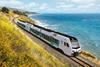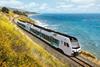
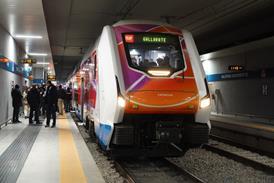

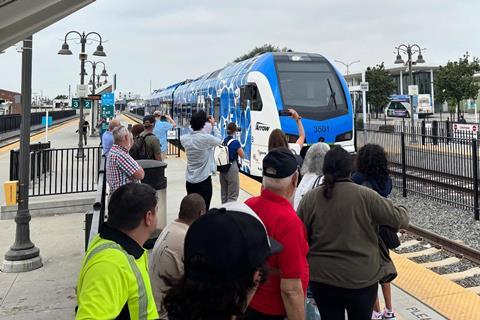
USA: The first fuel cell powered Stadler Flirt H2 trainset entered passenger service on Metrolink’s Arrow route in California on September 13, with San Bernardino County Transportation Authority saying its zero-emission multiple-unit was ‘born from a bold vision for clean, sustainable travel and powered by cutting-edge green tech’, and ‘represents a bold leap forward in clean transit’.
SBCTA said it was the first US passenger train of its kind to be compliant with Federal Railroad Administration standards, adding that the entry into service was the culmination of more than a decade of planning, engineering and testing.
Zero emission ambitions
The ZEMU is operating alongside the fleet of three Stadler Flirt diesel multiple-units on the self-contained 14·5 km five-station Arrow commuter line linking San Bernardino and Redlands which opened in October 2022.
SBCTA has long had ambitions for zero-emission propulsion on the line. It initially considered ordering a battery-electric trainset, but studies concluded that the available technology did not have the range needed for continuous operation. As a result, the agency ordered the first hydrogen version of Stadler’s Flirt family in November 2019, with an option for a further four units.
Made in Switzerland
While Stadler normally produces vehicles for the US market at its plant in Salt Lake City, the hydrogen unit was manufactured at its headquarters at Bussnang in Switzerland. As a one-off prototype, it was not required to comply with Buy America rules, although components and subsystems from its regular US suppliers were used.
The Flirt H2 was unveiled at InnoTrans 2022 in Berlin. Stadler told Railway Gazette International that it was an important milestone in its efforts to bring zero-emissions technology to the passenger rail market in the USA, where less than 1% of lines are electrified and wiring is time-consuming, costly and politically difficult.
The unit then underwent testing in Colorado, before arriving in San Bernardino in mid-2024.
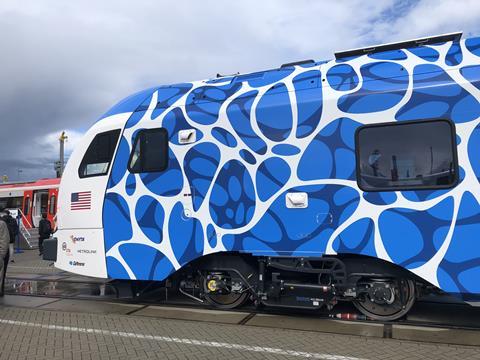
The ZEMU has a blue and white water-vapour livery around its two passenger cars and the central power module where the propulsion system is installed. The fuel cell charges a battery, which then supplies the traction, HVAC and other power needs and also enables regenerated braking energy to be stored.
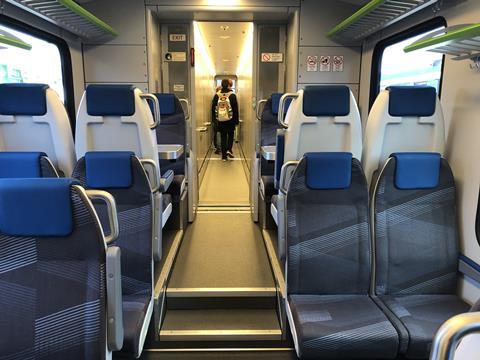
The unit is otherwise identical to the diesel versions, with 108 seats and a maximum speed of 130 km/h, the federal limit above which additional signalling systems would be required.