










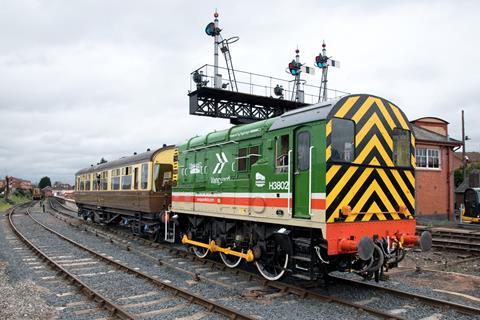
UK: The fuel cell-powered HydroShunter prototype developed by Vanguard Sustainable Transport Solutions has made its first public run under hydrogen power at the Severn Valley Railway.
Vanguard STS has been working on the repowering project for more than four years. The company is a spin-out from the University of Birmingham, whose rail research institute BCRRE is one of the partners in the initiative.
Three-axle Class 08 shunting locomotive 08635 owned by the SVR was built at British Rail’s Derby works in 1959. Its diesel engine and generator have been replaced with Vanguard STS’s bespoke NEO1 hybrid traction system comprising hydrogen storage cylinders, a fuel cell stack and a battery to provide additional power when needed.
Now renumbered H3802, the locomotive retains its original DC electric traction motors and is capable of running for an estimated 20 h between refuelling. It can provide 250 kW of tractive effort, broadly equivalent to its previous rating as a diesel loco.
The loco was formally launched with a ceremony at Kidderminster Town station on the heritage SVR on February 26, having been displayed to invited guests last year when it was only able to operate using its onboard battery packs.
Charging the battery
Speaking to Rail Business UK, Vanguard STS Chief Executive Dr Alex Burrows explained that the shunter is essentially a rail variant of a plug-in hybrid electric vehicle. ‘The battery provides the traction power and the hydrogen purely generates electricity to recharge the battery’, he explained. As installed, the fuel cell typically offers 30 kW of power in normal operating conditions, although this could rise to 50 kW or even 80 kW if the shunter is involved in more intensive work. One project engineer said ‘the fuel cell is essentially there to top up the battery, where the state of charge will fluctuate as the shunter starts and stops’.
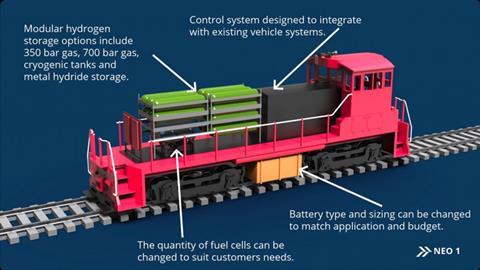
As with many battery powered vehicles, the Vanguard team recommends not letting the battery fall below 20% of full charge, and the loco has control software to prevent this from occurring by activating the fuel cell to deliver more energy. At the start of a day’s duty, the company suggest using a shore supply to charge the battery fully; hydrogen traction technology is seen as a desirable potential option for shunting applications where topping up the battery in the middle of a working day is impractical.
‘We’re not about hydrogen for hydrogen’s sake here, this is about providing an operationally sensible and appropriate locomotive. So we do say that if you can get away with running it just on battery, then just then do that and use hydrogen sparingly’, Burrows notes.
Storage challenge
Burrows acknowledges that storage of hydrogen on the locomotive remains a technical hurdle. Currently, hydrogen capacity on H3802 is 20 kg but this can be increased to around 60 kg using the conventional method of storage with tanks pressurised at up to 350 bar. But Burrows says the company is exploring the best means to optimise storage of the fuel onboard. ‘The problem is optimising around the space; we’re going to address that problem specifically. We could look at higher pressure, or we could look at the form that the hydrogen takes, or how it is stored. Certainly, from the UK perspective, where space is a real constraint and we can’t use tenders, I think compressed gas is only going to get us so far.
‘We are going to look at alternatives; if we transport the hydrogen in a different state, what does that mean? If we look at liquid hydrogen or at metal hydride storage, then we can look at doing everything differently with that device, and I believe that will change the opportunity in a positive way for us.’
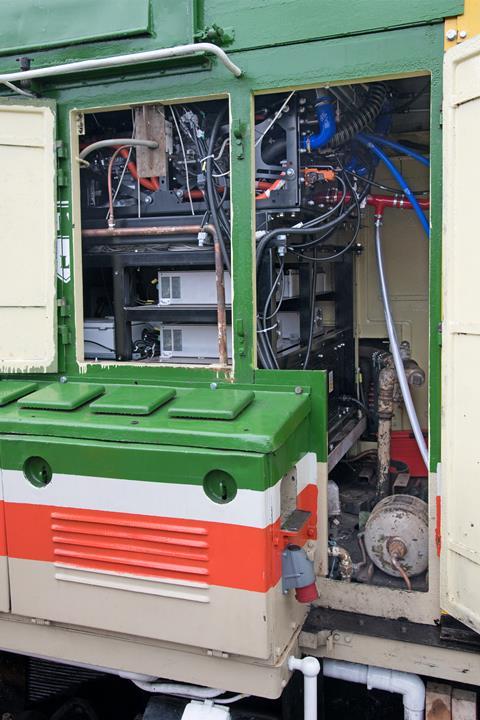
Having announced at the launch that the technology is now ready for sale, Burrows said the initial use of the hybrid technology would be in shunting and light applications, but that scaling it up for main line remains an aspiration.
‘We are ready to take orders, and we believe the technology could be scaled up to suit a mixed-traffic type locomotive, a Class 37 equivalent’, he added. However, the company acknowledges that this brings even more challenge in terms of storing enough hydrogen at volume to enable a meaningful duty cycle for a locomotive. This is understood to have been a factor behind the decision to scale back conversion of an Irish Class 071 locomotive to use hydrogen as a combustible fuel.
Material fatigue
Addressing concerns that materials which come into contact with hydrogen tend to become brittle, which can lead to safety concerns, Burrows insisted that Vanguard’s approach ‘it’s about making sure we have the right maintenance, monitoring, inspection regimes in place. We aren’t just keeping the old ‘08’ perspective on how we look after it, H3802 has full modern monitoring systems in place. The last thing we need, now we’ve proven it in operation, is in a year’s time, fatigue from hydrogen integration spoils it again.’
Now that the design is finalised, Vanguard estimates that re-powering a Class 08 shunter could be achieved in four to six weeks.
Beyond Britain
Speaking to guests at the launch, Burrows said that the HydroShunter project is not solely aimed at alleviating diesel use at yards and terminals in the UK. ‘This is a global issue. There are at least 20 000 diesel locomotives running around the European railways and that number exponentially increases as we go wider. Every part of this helps on the journey to net zero; for every country, as a world, as a planet.
‘Meanwhile the HydroShunter you’re seeing today is now 67 years old, but it runs perfectly and it will run for many more years to come, doing its duty on the Severn Valley Railway, because locomotives are built to last. It’s about reduce, reuse, recycle; we don’t need to build new locomotives. We can retrofit — it’s more cost effective up front to do that.’