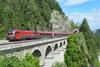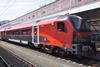
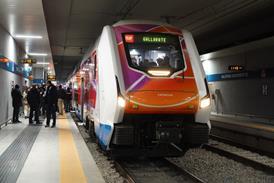

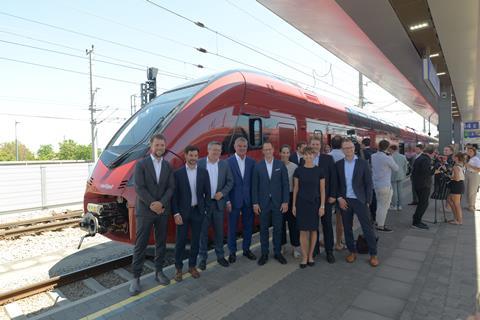
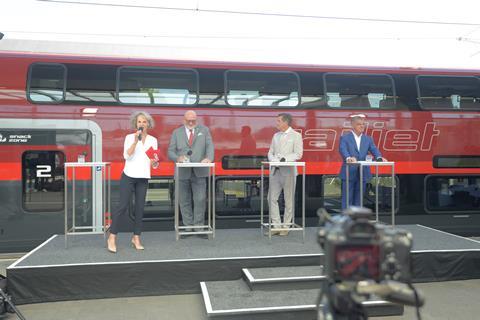
AUSTRIA: Senior representatives from national operator ÖBB and manufacturer Stadler gathered in Wien on June 25 to unveil the first double-deck Railjet trainsets for use on inter-city services radiating from the Austrian capital.
ÖBB has procured 14 six-car trainsets designated Class 4706 for use on the Wien – Salzburg route from the end of 2026. When the Semmering Base Tunnel has been completed in 2028-29, the EMUs will be also used on trains between Wien, Graz, Klagenfurt and Villach.
The 200 km/h Kiss trainsets manufactured by Stadler will augment the existing fleet of 60 push-pull Railjet trainsets, which are formed of Siemens Viaggio single deck coaches powered by Taurus electric locomotives capable of 230 km/h. While the Kiss trainsets have a lower maximum speed than the older Railjets, they have 20% more seats, giving a total of 486 places. The EMUs are fitted with vending machines, but they have no restaurant or buffet car.
‘Completely new’
‘We are presenting a completely new train’, said ÖBB Chief Executive Andreas Matthä. ‘At ÖBB, we have already been using double-deck trains in local transport for many years and are setting another milestone in modern rail transport with the new double-deck long-distance train. Starting at the end of 2026, the train will be travelling on the route from Wien to Salzburg, which will significantly increase capacity for our customers.’
In July 2023, ÖBB placed a €300m order as part of a €3bn framework agreement signed by Stadler and ÖBB in March 2022. This covered the supply of up to 186 Kiss double-deck electric multiple-units, and to date firm orders have been placed for 126 trains. The trainsets are fully TSI compliant, and they meet the accessibility guidelines issued by ÖBR, the Austrian council for disabled people.
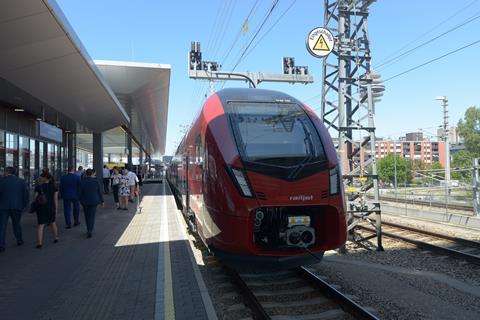
The trainsets are equipped with ETCS, and the onboard equipment has also been supplied by Stadler from its Guardia range. The HVAC units use natural refrigerant and heat pumps, and the trains have permeable windows for improved mobile phone signal reception. The EMUs have redundant traction and control equipment, consisting of two pantographs and four powertrains with water-cooled IGBT power converters.
High acceleration
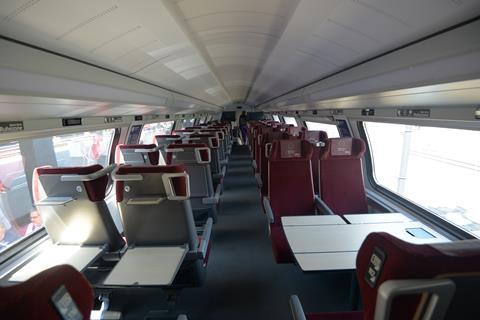
The two companies expect the EMUs to set new standards for acceleration and rapid boarding because of their wide and step-free doors. Both end cars are designated as quiet zones; in the four cars in between, there are catering facilities with vending machines offering snacks and drinks. The trains also have bespoke family compartments and areas with space for bicycles. Each EMU is 159·9 m long, there are 10 spaces for bicycles, and eight toilets, one of which is PRM compliant.
‘Every euro invested in the railway is a euro invested into the mobility transition. By 2030, we will invest around €19·7bn in expansion of the rail network in Austria, ensuring the continuity and modernisation of the railway infrastructure. In addition, ÖBB will invest around €6·1bn in its fleet by 2030. The new double-decker Railjets will be one of the highlights, offering more capacity and a comfortable travel experience for long-distance passengers’, said Peter Hanke, Federal Minister for Innovation, Mobility & Infrastructure during the event.